Ovid

Ovid puts today’s radicals to shame

It’s a crisp afternoon, and in a darkened room in central Amsterdam a woman is being smothered in snakes. Projected on to three walls is a massive video close-up of her face. She is young and beautiful  and remarkably composed: just a nose twitch here, an eyelid flutter there, as a python wriggles across her mouth or languidly caresses her cheekbone with its tail. In the room behind me, another woman stares fiercely back. Her shoulders are bunched with muscle, arms stiff at her sides, like a nightclub brawler about to nut someone. But it’s the bull’s horns sprouting from her forehead, and the mane of matted fur marching down her back, that make it hard to meet her gaze.
Vampires, werewolves and Sami sorcerers

From our UK edition

I have to be honest: I’ve never been much concerned with what happened in the Grand Duchy of Lithuania in 1387. I suspect that may even be true for many Lithuanians. In Silence of the Gods, Francis Young pinpoints this year – of the conversion of the duchy to Christianity – as the official triumph of Christianity in Europe over paganism and idolatry. But he then goes on to examine the debris – and the survivors of paganism and their traditions in the northern regions of Europe. The first difficulty is defining and identifying paganism. The book is published by Cambridge University Press, so there is an unmistakably academic, seminar-ready, conference-hardened edge to the text.

What Ovid in exile was missing

From our UK edition

A notable recent trend in popular history is the revival of interest in the ancient world. Mary Beard, Tom Holland, Bettany Hughes and Peter Stothard are just some of the historians whose books and television series have cashed in on our thirst for knowledge of distant forebears and their civilisations. Now Owen Rees joins the merry band with a strikingly original take on the subject. He argues that our interest in classical history focuses almost entirely on the Graeco-Roman world, specifically on the capital centres of those cultures. We therefore miss much of what was going on at the periphery of empires, with their vibrant cities and peoples.

A translator’s responsibilities are as formidable as a transplant surgeon’s

From our UK edition

When asked what it is we do, translators often resort to metaphors. We liken the act of translation to performing a piece of music, taking on a role in a play, kissing a bride through a veil or building bridges between cultures. But as the peerless Norwegian translator Damion Searls has said, when we sit down to work ‘there’s no metaphor at all really. The metaphors are just for interviews, or for talking with people about what translators do’. In this series of passionate, thoughtful essays, Jhumpa Lahiri uses metaphors, and more especially Ovid’s Metamorphoses, to explore the nebulous, almost ineffable nature of living between languages.

The problem with Ovid

'The Rotation Method’ is one of the most amusing sections of Kierkegaard’s Either/Or. The second-most famous melancholy Dane has some good advice for dealing with irritating absurdity: cultivate arbitrariness when confronted with flagrant examples of it. There is someone whose conversation you find insufferable. What to do? Kierkegaard’s narrator has some tips: ‘I discovered that he perspired copiously when talking. I saw the pearls of sweat gather on his brow, unite to form a stream, glide down his nose and hang at the extreme point of his nose in a drop-shaped body.’ There is much about cultural life today that can be profitably approached with the Rotation Method.

columbia

Wine is for lovers: mein Gott and yours

Ovid’s little how-to manual, The Art of Love, is full of good advice. Let’s say you are interested in a girl. Take her to the games. Sit close to her. If a speck of dust falls on her lap, ‘flick it off with your fingers. If none falls, flick off — none.’ The Art of Love is full of such useful tips, elegantly expressed. Practical chap that he was, Ovid knew that even so subjective a pursuit as love could be helped along by the mastery and deployment of certain techniques. Among the many impressed by Ovid’s handbook was the German Renaissance humanist Vincent Obsopoeus. In 1536, he published De Arte Bibendi (The Art of Drinking), an allegro poem deeply inspired by Ovid’s Ars Amatoria.

joel gott cabernet sauvignon

To ‘review’ such supreme paintings is slightly absurd: Titian at the National Gallery reviewed

From our UK edition

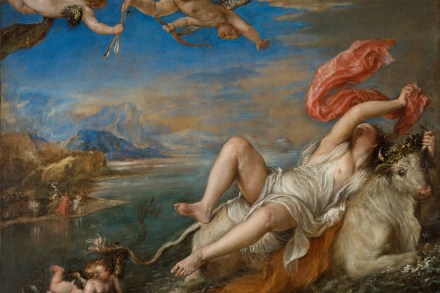
In 1576 Venice was gripped by plague. The island of the Lazzaretto Vecchio, on which the afflicted were crammed three to a bed, was compared to hell itself. In the midst of this horror Tiziano Vecellio, the greatest painter in Europe, died — apparently of something else. He was in his eighties and working, it seems, almost to the end. Titian: Love, Desire, Death, which was briefly on at the National Gallery, before it was closed down this week by our own plague, contained several of the greatest masterpieces of his old age — and also of European art. It comprises just seven canvases, all done for Philip II of Spain — a villain of English history, the man who launched the Armada, but as far as Titian was concerned his most discerning patron.