Ottomans

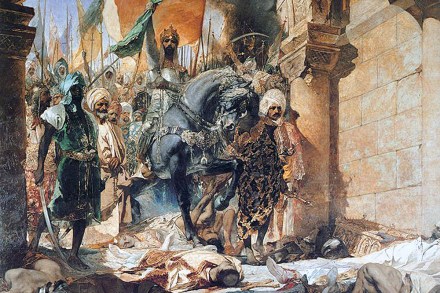
The Byzantine empire ends in an orgy of rape and slaughter

From our UK edition

Is there really anything new to say about the conquest of Constantinople? In the absence of fresh archaeological discoveries, a previously unknown text or neglected eyewitness account, can we reasonably expect, almost 600 years later, to break new ground? Anthony Kaldellis, a Greek-American classics professor at the University of Chicago, thinks so. His 1453 claims to offer a new perspective, namely that, contrary to almost all modern accounts, the Ottoman Sultan Mehmed II’s ultimate victory was ‘far less assured than is often thought’. It was a close run thing. Constantine XI, the last Byzantine emperor, almost won. For many readers familiar with this story, that won’t sound especially new at all.
The emperor as ruler of heaven and Earth

From our UK edition

Geography, climate, economics and nationalism are often seen as decisive forces in history. In this dynamic, original and convincing book Dominic Lieven considers emperors and their dynasties as motors of events. Defying constrictions of time and space, ranging from Sargon of Akkad, the ruler of what is now northern Iraq (r. 2334-2279 BC), to the Emperor Hirohito of Japan (r. 1926-89), he believes that ‘for millennia, hereditary sacred monarchy had been the most desirable and successful form of polity on Earth’. (Inhabitants of city states, from Athens to Venice, might not have agreed.) Emperors could create and extend states more easily than impersonal forces, as Lieven shows in chapters on many different empires, from China to Austria.