Northern ireland

Jonathan Powell interview: middle-man to the terrorists says ‘secret talks are necessary’

From our UK edition

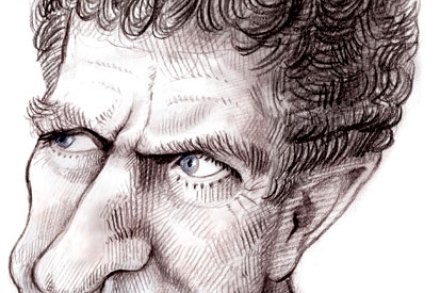
Jonathan Powell is a British diplomat who served as Tony Blair's chief of staff from 1997 to 2007. During this period, he was also Britain's chief negotiator for Northern Ireland. These days, Powell runs a charity called Inter Mediate, which works as a go-between among terrorist organizations and governments around the globe. David Cameron appointed him last May as the UK's special envoy to Libya. His book 'Talking to Terrorists' was published this month, a review of which can be found in the October 4 edition of The Spectator. In it, Powell argues the British government has failed to learn lessons from the history of diplomacy with guerrilla groups.

Ian Paisley’s private kingdom

From our UK edition

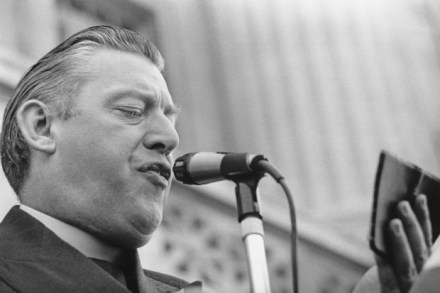
This is an extract from the The Spectator, 13 August 1982: One summer's evening, I went for a stroll by the shores of Lough Erne, just outside the city of Enniskillen, Northern Ireland. Swifts and swallows patrolled separate strands of midge-covered waters as if divided into Catholics and Protestants. Gleaming in the twilight, the Gospel Tent stood in a field beside a full car park. A small poster on a telegraph pole proclaimed a ‘Fundamentalist Convention. Preacher: Dr Ian Paisley’. The event was scarcely publicised, and few people in Enniskillen knew that Paisley was on their doorstep.

When the Welsh go it alone, blame me

From our UK edition

Oh dear. I think I may have inadvertently contributed to the dissolution of Great Britain. I’m not claiming sole responsibility. In due course, when the blame game begins, I’ll play second fiddle to the party leaders, Gordon Brown, Eddie Izzard and successive generations of carpet-bagging aristocrats. Nevertheless, when the rise and fall of the British Isles is written, I’ll be deserving of a minor footnote. I’m talking, of course, about the imminent secession of Wales from the United Kingdom. I say ‘imminent’, but it’s contingent upon a ‘yes’ vote in next week’s Scottish referendum, which isn’t yet a foregone conclusion.

One week to save Britain

From our UK edition

[audioplayer src="http://traffic.libsyn.com/spectator/TheViewFrom22_11_Sept_2014_v4.mp3" title="Fraser Nelson, Tom Holland and Leah McLaren discuss how we can still save the Union" startat=50] Listen [/audioplayer]Next week, the most important vote in recent British history will be held. Indeed, it may well turn out to be one of the last ballots in British history. Seven months ago, this magazine devoted its front page to warning that the United Kingdom was at grave risk of dissolution. The unionist apparatus had decayed, argued Alex Massie, and Alex Salmond was the best late-stage campaigner in Europe. The SNP deployed the language of nationhood and destiny, while the ‘no’ campaign droned on about the Barnett Formula. The conditions for calamity were in place.

Why I am voting No

From our UK edition

[audioplayer src="http://traffic.libsyn.com/spectator/TheViewFrom22_11_Sept_2014_v4.mp3" title="Fraser Nelson, Tom Holland and Leah McLaren discuss how we can still save the Union" startat=50] Listen [/audioplayer]Once upon a time, a long while ago, I lived in Dublin. It was a time when everything seemed possible and not just because I was younger then. The country was stirring too. When I arrived it was still the case that a visa to work in the United States was just about the most valuable possession any young Irishman or woman could own; within a fistful of years that was no longer the case. Ireland was changing. These were the years in which the Celtic Tiger was born. They were happy years of surprising possibility. Years later I lived in the United States and my perspective changed.

After Scotland, whither Britain? Divorce is a costly business.

From our UK edition

If, like me, you missed Andrew Neil's BBC programme exploring What the Hell Happens to the United Kingdom if Scotland Votes for Independence Next Month you might be interested to know that it remains available on the BBC iPlayer here. Prudently, dear reader, I liked it. It's a film best viewed as a companion piece to James Forsyth's Spectator cover story published last month. A call to arms to England - and Westminster in particular - to ponder the consequences and implications of Scottish independence. There is little sign that much thought has been devoted to these issues.

Queen refuses to play Game of Thrones

From our UK edition

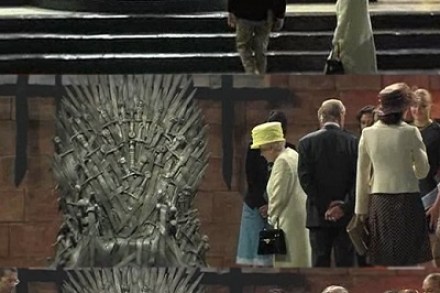
The Queen has visited the set of Game of Thrones in Northern Ireland. Frankly, she did not look that enamoured with the Iron Throne. Much to the disappointment of the gathered media, she did not sit down. In fact, she seemed indifferent to the hype...

Political euphemism, Ulster-style

From our UK edition

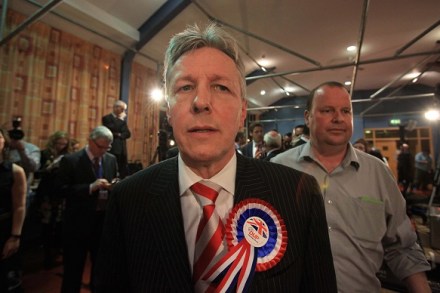
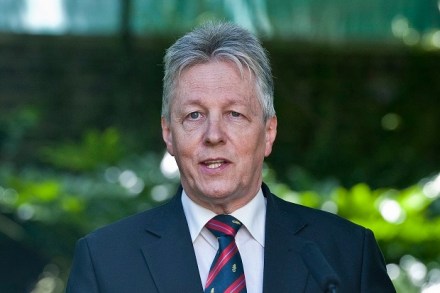
There was such a cherishable quote from DUP leader Peter Robinson on the occasion of the Queen’s visit to his old stamping ground, Coleraine Prison, I feel it shouldn’t go unapplauded. Mr Robinson recalled that he spent time at the prison ‘at her Majesty’s pleasure at a point during the last millennium’. The last millennium? So, sometime between, say, the Battle of Clontarf and the construction of the Millennium Dome? I love it, and commend the formula to politicians everywhere whose career lows took place before 2000. So last millennium…so over.

Let Evangelical Protestants be Evangelical Protestants

From our UK edition

Pastor James McConnell of the Metropolitan Tabernacle in Belfast has gone and done it. He declared in a sermon that: "Islam is heathen, Islam is satanic, Islam is a doctrine spawned in hell”. Golly. Not since the Rev Ian Paisley got the boot into the pope as Old Redsocks and indeed as the Scarlet Woman herself have we heard anything quite so robust in the way of religious rhetoric. (Oddly enough, there was something almost lyrical about it; he had lovely cadences.) But the anti-popery tradition is precisely the context these remarks should be seen in. Evangelical Protestantism has a thing about false prophets; it also has a thing about telling it like it is.

It was right to arrest Gerry Adams

From our UK edition

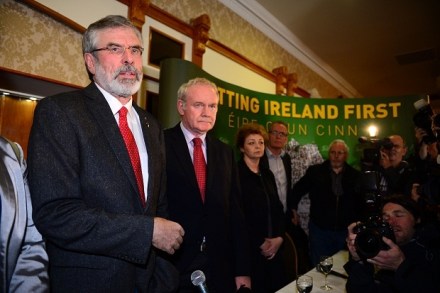
The release of Gerry Adams felt a bit like the old days. A Unionist protest outside the police station, a rally of a press conference at a Republican club with Adams, Gerry Kelly and Martin McGuinness on the podium.  Whether or not Adams will be charged with involvement in the 1972 murder of Jean McConville we do not know. But he is denying any involvement in the murder. He repeatedly said that ‘the past is the past’. He also said: ‘The future is about children…equality and justice for everyone.’ Yet he talked of his questioning as ‘the old guard using the old methods’ and of ‘dark’ forces at work. He said that the decision to detain and question him was not ‘the right decision for policing.

We should have nothing but contempt for Peter Hain

From our UK edition

Peter Hain has become a disgrace. Earlier this year it appeared that the Former Northern Ireland Minister was one of the people responsible for the cock-up over letters of amnesty for ‘on-the-run’ terrorists. Now he has gone several steps further. Just last month Hain was just telling everybody who has lost a relative during the Troubles in Northern Ireland and who never saw anyone convicted for the crime that they should just get over it. His line as of last month was that victims of unsolved cases must simply accept that they will never see justice. But now he seems to have decided that he is not merely a cack-handed peacemaker and advisor to the bereaved, but a judge and jury too.

Gerry Adams’s arrest is astonishing

From our UK edition

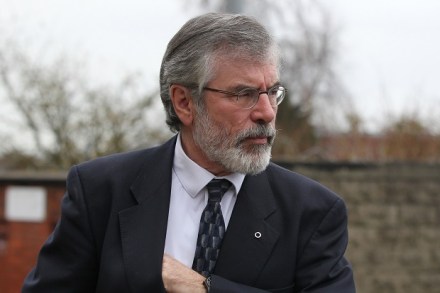
In one sense the arrest of Gerry Adams for questioning in relation to the murder of Jean McConville is not a surprise. On the other hand it is astonishing. I cannot think how many times over the years the connection between Adams and the McConville case - appalling even by the standards trawled during the Troubles - has been raised. Yet, as the years have gone on, the possibility that Adams would ever actually answer questions on the murder seemed ever more remote. Adams has always denied any involvement in this crime, and has offered the police his assistance in their inquiries. Adams presented himself at a police station yesterday and was then arrested.

Gerry Adams arrested in connection with the murder of Jean McConville

From our UK edition

Sinn Fein President Gerry Adams presented himself to police this evening and was arrested in connection with the murder of Jean McConville. McConville was abducted from her home in Belfast by the IRA in 1972. Her body was discovered on a beach in County Louth in 2003. Adams has always denied any involvement in Mrs McConville’s death, and has frequently offered to help the Police Service Northern Ireland with their inquiries. In an official statement released this evening, Sinn Fein said: ‘Last month Gerry Adams said he was available to meet the PSNI about the Jean McConville case. That meeting is taking place this evening.’ There have been a number of other arrests in connection with the McConville case recently.

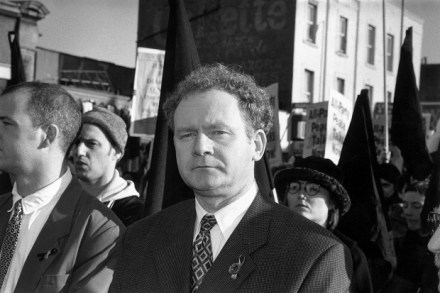
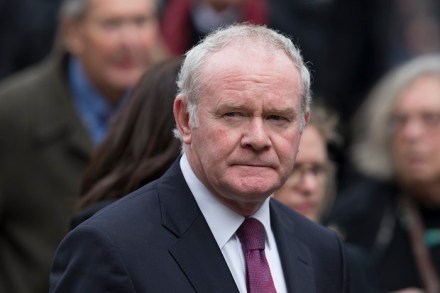
Truth, lies and Martin McGuinness

From our UK edition

Melanie McDonagh wrote a piece on Friday objecting to ‘those pundits who find Mr McGuinness’s presence anywhere intolerable.’ As one such pundit I would like to exercise a right of reply. Not to pick a fight with Melanie – who was very nice about my book on ‘Bloody Sunday’ and whose judgement for that reason, among others, I would not therefore like to call into question. And not because I disagree with the blame that Melanie rightly says should be laid at the door of the Conservative Party. But to add to this last point and come back on another.

If the sight of Martin McGuinness at state occasions repulses you, blame the Tory Party

From our UK edition

Well, those who get themselves worked up about the presence of Martin McGuinness around the Royal Family would not have enjoyed last night’s musical extravaganza, Ceiliuradh, for the Irish president at the Albert Hall. They’d have been on their own, mind you. Everyone else had a ball; it was a packed house for Elvis Costello plus Fiona Shaw and Dermot O’Leary, but the knockout element was the combined band of the Irish Guards and the Irish Defence Force doing the Minstrel Boy, which made me cry. That was a nice touch: Tom Moore, its author, was lionised in London as much as in Ireland.

Martin McGuinness at Windsor Castle. What an odious sight

From our UK edition

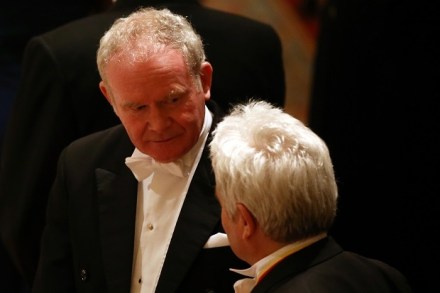
I know that the official line is delight at the ‘progress’ allegedly represented by the presence of Martin McGuinness, in white tie and tails, standing to toast the Queen’s health at a banquet in Windsor Castle. But what an odious sight. Firstly because the idea that this constitutes some important step is all post-hoc prevarication. The steps that Martin McGuinness has taken in the last ten years were all open to him forty years ago. But he chose to turn them down then and pursue the IRA’s path of violence and murder. Pursuing that path should have caused him the worst imaginable problems; instead it has brought him only rewards.

We need to know the truth about Gerry Adams’s alleged involvement in the ‘disappearance’ of Jean McConville

From our UK edition

Readers will know that I am interested in the subject of post-Good Friday agreement 'justice' in Northern Ireland. Having been one of the few people to have followed the possibilities of justice over Bloody Sunday, I also recently wrote about the apparently one-sided amnesties which the last Labour government appears to have given to Republicans not convicted of crimes but counted as 'on the run'. It has long been my contention that justice cannot only be applied to one side or one group of people. Investigate the 1st Battalion of the Parachute Regiment for what happened in January 1972 and you have to investigate the leadership of Sinn Fein – IRA for their activities.

Tweeting the Aurora Borealis

From our UK edition

Some people have been pointing their cameras at the night sky. The results are rather special: https://twitter.com/AngusMacNeilMP/statuses/439164673230135296 https://twitter.com/Akhan2001/statuses/439155568796651520 https://twitter.com/carlmilner/statuses/439130792414175233 https://twitter.com/weermanrobert/statuses/439143984238428160 https://twitter.com/ObservingSpace/statuses/439136185378553856 https://twitter.com/owenhumphreys1/statuses/439156693822214144 https://twitter.com/mfn1234/statuses/439154169018998784 https://twitter.com/DeffGeff/statuses/439154891882123264 https://twitter.com/orkneyrd/statuses/439159852888498177 https://twitter.com/ObservingSpace/statuses/439155901883097088 https://twitter.

The police’s blunder over John Downey is one thing, the government’s cravenness another

From our UK edition

So, the IRA terror suspect, John Downey, will now not face a trial for his alleged involvement in the Hyde Park and Regent’s Park bombings of 1982, in which eleven soldiers (as well as seven horses) were murdered by nail bombs. The former Northern Ireland Secretary Peter Hain seems to be delighted about this and expressed his astonishment that Downey had been arrested in the first place. Downey mistakenly received a so-called ‘comfort letter’ as part of the Good Friday Agreement, informing him that he was now effectively immune from prosecution. For what it’s worth, Downey denies the charges. It wasn’t a very good Friday, was it?

The Spectator’s Notes: French presidents used to have a touch of the monarch. Not any more

From our UK edition

When I interviewed Valéry Giscard d’Estaing, the former president of France, for my biography of Margaret Thatcher, I asked him why, when she lunched with him at the Elysée Palace for the first time, he had been served before her: she had been offended. M. Giscard explained that no slight had been intended. It was a matter of protocol — the president is the head of state, the British prime minister only the head of government. ‘You must remember,’ he added, ‘that the president is in the line of sovereigns.’ I recalled these words when reading about President Hollande and his amorous adventures in his helmet. To the British, it is a puzzle that French presidents are protected from the media scrutiny we inflict on our own leaders.