Northern Ireland Opera

When will I see a Carmen set in 19th-century Seville?

No critic sets out to be a reactionary, even though it’s much easier that way. There’s no real satisfaction in rejecting novelty on sight; no joy in measuring a living performance against your record collection and coming down, every time, in favor of the dead Nazi. I get that. Still, it’s a plain fact that in three decades of regular opera-going, I have never – not once – seen a live production of Carmen that locates the action in 19th-century Seville. Or one that centers the visual elements – mantillas, sunshine, picture-postcard Spanishness – that directors tell us (and how they tell us!) have become such clichés.

carmen

When will I see a Carmen set in 19th-century Seville?

No critic sets out to be a reactionary, even though it’s much easier that way. There’s no real satisfaction in rejecting novelty on sight; no joy in measuring a living performance against your record collection and coming down, every time, in favour of the dead Nazi. I get that. Still, it’s a plain fact that in three decades of regular opera-going, I have never – not once – seen a live production of Carmen that locates the action in 19th-century Seville. Or one that centres the visual elements – mantillas, sunshine, picture-postcard Spanishness – that directors tell us (and how they tell us!) have become such clichés.
Northern Ireland Opera have a hit: Follies reviewed

From our UK edition

Never judge a musical by its score alone. Even more than with opera, the music is only ever half the story and if you judge a classic show from the cast recording, you might get a shock when you see it staged. Leonard Bernstein’s Candide is generally reckoned to be one of the fizziest, funniest Broadway scores ever composed. But in the theatre, the storyline is so intractable that the combined efforts of Richard Wilbur, Lillian Hellman, Stephen Sondheim and even (it’s said) Dorothy Parker haven’t succeeded in establishing a definitive, stageable version.  No such problem with Sondheim’s own Follies: you’d be hard put to find a smarter piece of stagecraft. But even there, what you hear is not at all what you get.

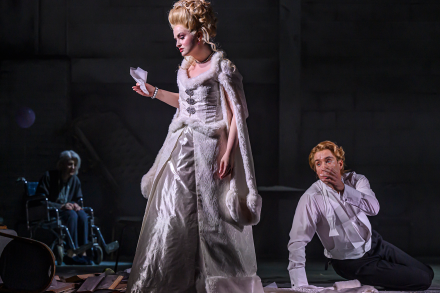
Committed performances – but who was the granny? Northern Ireland Opera’s Eugene Onegin reviewed

From our UK edition

It’s a critic’s job to pick holes in the dafter aspects of opera productions, but in truth audiences are usually capable of detecting nonsense when they see it. ‘She must be at least 150,’ commented the gentleman sitting behind me, referring to the wheelchair-bound old lady who was trundled on stage at the start of Northern Ireland Opera’s new production of Eugene Onegin, and then parked there, pretty much for the duration. It really buzzed along, even if the set resembled a public lavatory (urinal chic seems to be an emerging trend) He had a point. Was she meant to be an elderly Tatyana? Then why was she dressed in modern clothes when the rest of the action played out in the era of Pushkin?