Metaverse

The VR and AR arms race

You probably don’t remember the Humane Pin, despite its dominating the tech-news cycle a few months ago. It’s an elegant AI-powered square that sticks to your lapel and can send messages, search for information and tell you about what you’re seeing, all through voice commands. The Humane company raised more than $230 million in venture backing, and its rollout included a runway appearance at Paris Fashion Week, a TED talk and a chic announcement video where the pin repeatedly misinformed its user. According to the pin, almonds have far more protein than they do, and April’s solar eclipse would have been best viewed from Australia, where it wasn’t even visible. Also, there’s no way to use the pin other than with voice control.

VR

Good riddance to the metaverse

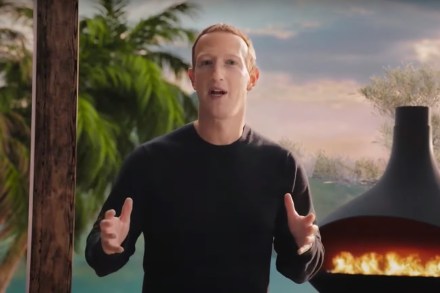
So pack it all in then. Away with the wisecracking butterfly that sits on your shoulder during work meetings. Out with the Gamorrean Guards who play Texas Hold’em with you around a floating table. The metaverse, Mark Zuckerberg’s fever dream of a virtual-reality infused world, is dead. That’s assuming it was ever alive and kicking in the first place. To assess just how “real” the metaverse ever was, we need to go back to its inception in the fall of 2021. That was when Zuckerberg released a video of himself in suspiciously Steve Jobs-esque garb — black shirt and pants, sneakers — tooling around what he called a “home space” that brimmed with holographic bric-a-brac.

metaverse

The golden noose around Apple’s neck

"Innovation comes from saying no to 1,000 things to make sure we don't get on the wrong track or try to do too much,” said the late Steve Jobs. “We're always thinking about new markets we could enter, but it's only by saying no that you can concentrate on the things that are really important." These days, Team Apple is all about finding new markets, no matter how removed they are from the company's core focus. Jobs once flirted with an advertising-supported operating system but ultimately gave it a pass. Now, in a strange twist, Apple is doing just that — selling ads in its services that are part of its platform. It wants to become a pooh-bah of digital advertising (it had tried before in 2010 with iAds, an effort that fizzled out).

Let’s ban the metaverse and colonize space

The way I see it, there are two options for the future: a transplanetary society or a transhuman one. What got me thinking about this was right-wing billionaire Peter Thiel’s recent interview with Mary Harrington, which she wrote up in UnHerd. As Harrington puts it, Thiel’s diagnosis of modern social ills is not that “progress is inevitably self-destructive,” but that we’ve been making the wrong kind of progress. "We’ve had continued progress in the world of computers, bits, internet, mobile internet, but it’s a narrow zone of progress. And it’s been more interior, atomizing and inward-focused,” Thiel said. Meanwhile, “there’s been limited progress in the world of atoms.” So far, so good. But then the interview took a strange turn.

Joe Biden in the metaverse

Meta is meant to be better — better than Facebook, better even than reality. In the future, a second Edward Gibbon may wonder not just whether it was a good idea for the federal government to encourage Mark Zuckerberg and a handful of talented techies to launch a Revenge of the Nerds coup against the minds and manners of America, but also what it was about reality that made us want to escape it so badly in the first place. There has never been a society more blessed than that of the United States.

metaverse

Boringly postmodern and an ideological fantasy: Slavoj Žižek reviews Matrix Resurrections

From our UK edition

The first thing that strikes the eye in the multitude of reviews of Matrix Resurrections is how easily the movie’s plot (especially its ending) has been interpreted as a metaphor for our socio-economic situation. Leftist pessimists read it as an insight into how, to put it bluntly, there is no hope for humanity: we cannot survive outside the Matrix (the network of corporate capital that controls us), freedom is impossible. Then there are social-democratic pragmatic 'realists' who see in the movie a vision of some kind of progressive alliance between humans and machines, sixty years after the destructive Machine Wars. In these wars 'scarcity among the Machines led to a civil war that saw a faction of Machines and programs defect and join human society.

Reality check: could our universe be a simulation?

From our UK edition

Are we all living in a computer simulation? Is the world we imagine to be real simply virtual reality instead, an elaborate computer program? That sounds ridiculous, but nonetheless it’s what many clever people actually think — or at least, think possible. One of them, the philosopher David Chalmers, has just written a book on the subject, Reality +: Virtual Worlds and the Problems of Philosophy. Chalmers is a serious intellect. He won a bronze medal in the International Mathematical Olympiad as a child and did his undergraduate studies in Pure Mathematics before turning to philosophy. Part of his argument is that we are already building simulated worlds ourselves — computer games as well as virtual environments like Second Life.

Why Julian Assange is hated

The British High Court ruled on Friday that Julian Assange can be extradited from the UK to the US. The US thus won its appeal against a January UK court ruling that he could not be extradited due to concerns over his mental health. This latest twist in the endless Assange saga is just the culmination of the long and slow well-orchestrated campaign of character assassination that reached the lowest level imaginable with unverified rumors that Ecuadorians in their London embassy wanted to get rid of him because of his bad smell and dirty clothes.

assange

Reality is enough without Zuckerberg’s metaverse

Take my hand, darling, and off we go into the metaverse. It's a whole new world...or at least it's a new world...maybe a brave new world? Enter Mark Zuckerberg, that Titanic captain of industry, who last week released a video introducing his latest plan to leave his Nike shoeprint upon reality. It's called the metaverse, and while even the savviest tech writers are grasping to explain what it is, it appears to be the fusion of our world with the virtual. Big Zuck wants what's on our screens to spill over into real life. We lived on farms, then we lived in cities, now we will live in "home spaces" with digitally rendered pterodactyls flying just outside the windows.

metaverse

Are we ready for the metaverse?

From our UK edition

Facebook has rebranded itself as Meta and last month chief executive Mark Zuckerberg announced the creation of 10,000 jobs to help build the ‘metaverse’ — a concept so radical nobody yet knows what it really is. People in the media tend to describe it as ‘a 3D version of the internet’. Facebook describes it rather vaguely as a network of ‘virtual spaces where you can create and explore with other people who aren’t in the same physical space as you’. Some suspect it might actually be hell. The term metaverse first appeared in Neal Stephenson’s 1992 novel Snow Crash, in which future humans distract themselves from economic collapse by submerging themselves in a parallel virtual reality world.