Maxim gorky

Don’t miss it: Summerfolk, at the Olivier, reviewed

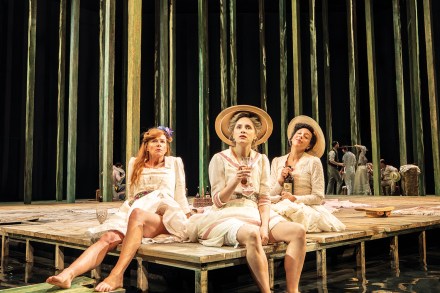
Dachniki meaning ‘dacha people’ is the Russian title of the National Theatre’s new production of Gorky’s sprawling 1905 drama. Nina and Moses Raine, who adapted the play, chose the flavourless title Summerfolk which doesn’t quite capture the play’s distinctive Russian atmosphere of ennui, intellectual rumination and despair. However, their perky, supple and idiomatic dialogue works very well. Gorky appears to have written the script as a feverish homage to Chekhov, who died in 1904, and he pinched numerous characters and plot twists from his mentor. The beautiful, vain and sexually inert Varvara is a copy of Yelena in Uncle Vanya. Kaleria, the nervous actress who performs amateur verse for her

Four dangerous visionary writers

‘The production of souls is more important than the production of tanks… And therefore I raise my glass to you, writers, the engineers of the human soul.’ The quote is usually attributed to Stalin, though the phrase ‘engineers of human souls’ most likely came from someone else. Who’s to argue? Purges, executions, deportations – what’s a little light plagiarism in comparison? Whoever coined the phrase, it certainly struck a chord and indeed continues to ring various alarm bells whenever one comes across writers who deliberately set out to influence politics and ideas – and not just the big beasts, the Nobel Prize winners, say, or the shopfront-filling non-fiction authors hawking

Stalin the intellectual: the dictator cast in a new light

The link between mass-murdering dictators and the gentle occupation of reading and writing books is a curious one, but it definitely exists. Mao was a much- praised practitioner of traditional Chinese poetry; Hitler was widely if haphazardly read, dictated Mein Kampf and was a fan of Karl May’s Wild West stories; and Stalin, as Geoffrey Roberts shows, took books at least as seriously as the purging of foes, real and imagined. Though we may wonder whether Enver Hoxha and Kim Il-sung really wrote the dense works of Marxist-Leninist theory with which they’re credited, there is no doubt that Stalin found the time while running the Soviet Union and fighting the