Marie Kondo

Put on a suit and tie, Prime Minister

A brass fanfare; a wide establishing shot of five men in three-piece suits, seated in a library of leather-bound tomes – this is Harold Macmillan doing informal. The scene is from a 1959 party political broadcast, which purports to show a ‘relaxed chat’ between Macmillan and four of his ministers, all of whom he refers to by their cabinet titles. Almost everything about it is artificial (including quite possibly the claim that it took place the day after the parliamentary recess). Watching it now is a reminder of two things, perhaps contradictory. First, that prime ministers have always played a clever and not entirely authentic game when it comes to informality; second, how far we’ve fallen. Can you imagine the equivalent today?

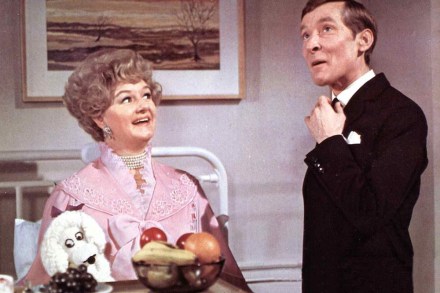
What would Kenneth Williams make of our age?

From our UK edition

Sunday marks what would have been the 100th birthday of Kenneth Williams. It’s tempting to try to imagine what he would have been like had he lived longer, though the absurdity of our age might have been beyond even his acid observation. That’s perhaps the most interesting aspect of Williams: he can’t be imagined in the present day at all. As recent as his lifetime was, it was one so utterly bound by the 20th century as to feel distant. How so? Well, his critics would point to the Carry On films. A young and serious acting talent, coached in Shakespeare by Olivier no less, was wasted, so the argument goes, on trivial smut, consigning him to perma-residence in the world of Ted Heath and the Wombles novelty record.

The stakeholder class needs blowing up

From our UK edition

In February 1974, a frustrated Ted Heath, unable to achieve anything in government against constant opposition by the mighty trade unions, called an election. One basic question was front and centre of the campaign: ‘Who governs Britain?’ Soon the answer came back: ‘Not you, mate.’ In fact, it would take Margaret Thatcher’s victory to clip the power of the unions – but only after enormous political and economic risks were taken. With the collapse of public infrastructure, a lingering sense of decline, and Britain looking embarrassed (and embarrassing) on the world stage, comparisons to the 1970s abound today. Another similarity is the presence of an all-powerful caste.

I decluttered a 1990s time capsule – and this is what I learnt

From our UK edition

After my grandmother died a few years ago, we couldn’t bring ourselves to get rid of most of her possessions. What had started as a storage room at my parents’ house quickly morphed into a living, breathing pile. It gradually invaded the spare bedroom and was making encroachments into my mother’s study. Answering the call of nature at night became fraught with terror, lest the pile had become sentient and would drag me into its clutches in the small hours of the morning. It was like living in a cross between Storage Wars and a Stephen King novel. There was a whole box devoted to Diana and Charles plates and Andrew and Fergie engagement mugs I’ve never been one for minimalism.

Slow down, shop less and style more: lessons from Allison Bornstein

That Allison Bornstein’s family all operate in care is no surprise. True, Bornstein, thirty-five, a stylist and rising social media star based out of New York and Los Angeles, is the odd one out. Her father and brother are doctors, her grandfather is a psychoanalyst and her mother was once a therapist. But the services she offers are not so different from the shrink’s couch. Bornstein has created a dedicated following on TikTok and Instagram for her tips and scripted reels, in which she implores us all to craft self-love around our clothes. To slow down, shop less, and style more. And in the world of stylists and influencers, who make careers out of telling people to consume, consume, consume, Bornstein is quietly radical.

allison bornstein

The Kondo effect in politics

The decluttering crusade of home-organizing guru Marie Kondo has taken on a life of its own. Kondo’s effort to shame us into tidying up our drawers, closets and desk spaces began as a harmless inanity. But it’s now intruding nefariously into every realm of existence. First, we were told that folding our underwear would spark joy in our lives. Now, we face a proliferation of magazine articles advising us to declutter ourselves of ‘unnecessary’ or ‘toxic’ friends. Clearly, not all friendships are healthy. But these assessments appear driven by market forces: they focus on what you can gain from a friend in terms of efficiencies and profit. Where does it stop?

kondo

No, Alison Roman isn’t racist

The cardinal rule of a good milkshake-ducking: it's not over until the duck has been declared racist. So it goes for Alison Roman, the popular (or formerly so) New York Times food writer who earlier this month became a loathed and villainous avatar of privilege after some ill-considered remarks about celebrity lifestyle-empresses Chrissy Teigen and Marie Kondo sparked a storm of backlash. The scandal ultimately became big and beefy enough to make the mainstream news: Teigen announced to her 12 million Twitter followers that Roman's comments had wounded her. Roman apologized, and then apologized again, and then stopped posting at all. The tide of takes inspired by the controversy will keep rolling until June.

alison roman

The anti-KonMari method: the case for material attachment

Recall a time when you re-encountering something that once held major significance in your life. Maybe it happened when you took a trip back to your childhood home. You pulled an old book bag out from the attic, or that soccer ball you practiced with during your high school playing days. If you’re anything like me, finding yourself in those situations can bring back a flood of lost memories. Some good, some bad – but ones that still mean something to you.With nostalgia and a sense of that significance seemingly superficial things can have in our lives, I’ve come to a startling conclusion: I think it’s OK to be attached to 'stuff.

marie kondo konmari

I could watch Marie Kondo forever

‘Talk to your crows!’ This precept should inspire us all as we begin the big, unknown adventure that is 2019. It’s going to change my life, that’s for sure. My wife’s too. That’s because we’ve both sat, increasingly enthused, through the first episode of Netflix’s eight-part series Tidying Up, presented by adorable Japanese tidying up sensei Marie Kondo, whose charming if rudimentary English I have just cruelly satirized. ‘Talk to your clothes,’ is what she was trying to say. Coming from a Western presenter this would sound like so much New Age airy fairy drivel. Coming from a beautiful Japanese woman with the serene aura of a Shinto temple nun, on the other hand, it comes across, somehow, as deep, wise and true.

marie kondo