Margaret thatcher

A rare mood of unity descends on the Conservatives

From our UK edition

The idea that ‘loyalty is the Conservative party’s secret weapon’ was always dubious. Benjamin Disraeli, for instance, made his name attacking a sitting Conservative prime minister. This, though, did not stop him becoming arguably the party’s most celebrated leader. But in recent years, the ‘loyalty’ adage has become a joke — one that has taunted leader after leader as they struggled to deal with an increasingly rebellious party. The party changed leaders four times in the eight years between 1997 and 2005. In these opposition ‘wilderness’ years, changing a leader was the closest to power that Conservative MPs came. Leadership plotting gave an odd sense of purpose to their presence at Westminster.

How Michael Heseltine won his first showdown with Margaret Thatcher in government

From our UK edition

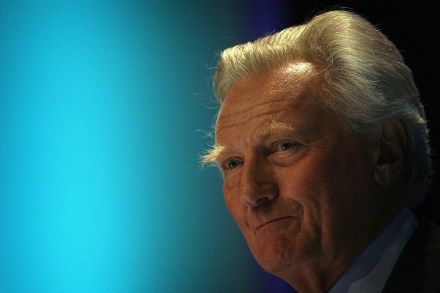
The extracts in the Telegraph of Charles Moore’s biography of Margaret Thatcher have confirmed that this will be one of the most important political books of recent times. One of the intriguing things about Thatcher’s premiership is how, for the early years of it, she had to deal with a Cabinet that was not convinced of her policy prescription. This meant that, contrary to the latter image, she could not simply proceed as she wished. (Though, it should be noted that events vindicated Thatcher’s judgment.) Charles Moore reveals in his book that in 1979 Michael Heseltine flatly refused the job of energy secretary. He reports that when Thatcher offered it to him, he replied ‘“No… I’ve been rehearsing environment for three years.

Thatcher didn’t really save Britain. She allowed Britain to save itself.

From our UK edition

Thatchermania has died down now, and I’ve personally stayed out of it. The quality of commentary from people around at the time has been outstanding, not least  The Spectator’s own Charles Moore. The Thatcher drama is one where I can’t even claim to have been a spectator. I was not into politics when I was young, not listening to Budget speeches on the school bus like the young George Osborne. Strife didn’t hit us much in the Highlands. I once crossed a picket line with my mum when teachers at my school, Nairn Academy, went on strike. She was a special needs teacher there and didn’t talk much about it, except to say she didn’t believe pupils should be made to suffer in disputes between adults.

The View from 22 — Margaret Thatcher’s secret Kremlin files, remembering her funeral and the Boston bombings

From our UK edition

Were Margaret Thatcher's relationships with foreign leaders as straightforward as they appeared to the public? In this week's Spectator cover feature, Pavel Stroilov provides a special insight into one particular relationship — Mikhail Gorbachev. Stroilov reveals the official Kremlin records of what Thatcher said to Gorbachev behind closed doors. On our View from 22 podcast, Thatcher biographer and advisor Robin Harris analyses her foreign policy legacy with Fraser Nelson, examining her relationship with world leaders, the personal and political differences that existed and the lessons the world today can take from her.

Margaret Thatcher’s funeral was the right funeral

From our UK edition

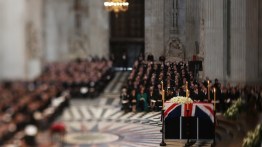
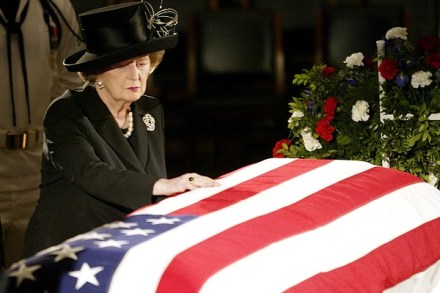
Today was a moment in our island story. The longest serving Prime Minister of the 2oth century was laid to rest with due ceremony. Watching the coffin move down to St Paul’s and the service itself, I was struck by how right it was that it was a ceremonial funeral. A private affair would not have done justice to the legacy of our first, and only, female Prime Minister. It was noticeable that the much talked-about protests along the route failed to materialise. But it should be stressed that today’s service was not a political affair. The eulogy was not about her policies but her faith and her understanding of it. Margaret Thatcher now passes into history. I suspect that her name will live on in the way that Gladstone and Disraeli have.

Margaret Thatcher’s funeral unites the political class

From our UK edition

Where there has been discord, Mrs Thatcher’s funeral brought harmony. From my seat in the gods at St. Paul’s, I watched as Westminster’s lesser mortals gathered in front of the altar to shoot the breeze in the hour before Lady Thatcher’s coffin arrived. Gordon and Sarah Brown were first to arrive. They plonked themselves down, but soon jumped up to chat to a passer-by. Quick as a flash, Ed Miliband and his wife Justine pinched the Browns’ vacated chairs. Time rolled by, and Miliband found it impossible to shake the shadow of his old master as he walked around the nave. How’s that for art imitating life? The pews soon filled up with cabinet ministers.

Andrew Neil discusses Margaret Thatcher’s funeral

From our UK edition

In tomorrow's View from 22 podcast, BBC presenter and Spectator chairman Andrew Neil discusses attending Margaret Thatcher's funeral, the significance of the event in British history as well as his personal encounters with the former Prime Minister. We're delighted to bring you the interview below. Subscribe to the View from 22 here to receive the whole episode first thing tomorrow morning, featuring Baroness Thatcher's biographer Robin Harris and Spectator editor Fraser Nelson on the lesser known side of her foreign policy.

Margaret Thatcher’s funeral: in words and pictures

From our UK edition

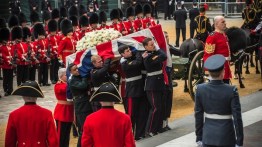
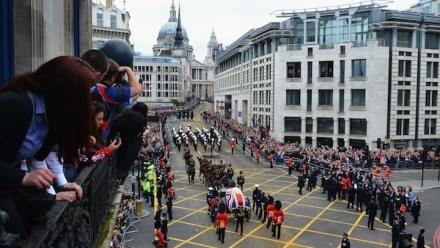
[caption id="attachment_8501512" align="alignnone" width="600"] Margaret Thatcher's coffin is carried from the Palace of Westminster to a hearse for the first leg of its journey to St Paul's. Picture: Getty[/caption] [caption id="attachment_8501522" align="alignnone" width="600"] The hearse moves past crowds outside Parliament. Picture: Getty[/caption] [caption id="attachment_8501532" align="alignnone" width="600"] The hearse passes Downing Street. Picture: Getty[/caption] [caption id="attachment_8501542" align="alignnone" width="600"] Some members of the crowd turn their backs on the cortege as it passes. Picture: Getty[/caption] [caption id="attachment_8501562" align="alignnone" width="600"] Another member of the crowd holds a placard protesting the cost.

The Myths of Margaret Thatcher, Sermon on the Mound Edition

From our UK edition

Like Iain Martin, I was not sure a full ceremonial funeral was quite appropriate for Margaret Thatcher. That is not to dismiss her achievements or her significance, merely to wonder if such pomp was wholly suitable for a figure who has proved as divisive in death as she was in life. And yet, the majesty of the service at St Paul's worked its magic. Combining grandeur with simplicity it said simply this: Margaret Hilda Thatcher mattered.  It is hard to think of other non-Royal Britons who will be afforded, far less merit, this kind of send-off. I thought the Bishop of London's address splendid. It deftly punctured some of the myths that surround the Thatcher legacy. She was, in truth, always more complicated than either her admirers or her enemies admitted.

Sir John Hoskyns: the Margaret Thatcher I knew

From our UK edition

Sir John Hoskyns was head of Margaret Thatcher's Policy Unit from 1979 to 1982. In a Q&A with The Spectator, he describes what it was really like to work with her, and how David Cameron could learn from the late Prime Minister. In 1977, you wrote the Stepping Stones Report, which looked at the fundamental problems holding Britain back in the pre-Thatcher era. If you were to write a sequel, what would you focus on? There’s no snap answer – at least from a bystander. Stepping Stones, and our ‘Wiring Diagram’ were written for  a particular crisis for the British economy. I had been working on an analysis of the problem since since the mid-seventies with the nuclear physicist and one-time head of the MoD think-tank, Terry Price.

David Cameron: We’re all Thatcherites now

From our UK edition

David Cameron is giving a reading at Margaret Thatcher's funeral later today, but this morning he gave his eulogy on the Today programme. He made the quite striking observation that 'we're all Thatcherites now'. In one sense this is quite an obvious comment: as countless commentators have observed over the past week and a half, Margaret Thatcher didn't just change the way the Conservative party viewed economics and the state, she also changed the way Labour sold itself as a party. Cameron said: 'I think in a way we're all Thatcherites now because - I mean - I think one of the things about her legacy is some of those big arguments that she had had, you know, everyone now accepts.

Row builds over the US Senate’s silence on Lady Thatcher

From our UK edition

Further to my report yesterday, the Heritage Foundation, the giant conservative think-tank that has its own Margaret Thatcher Centre to study and promote the Special Relationship, has weighed in: ‘To refuse to honour a woman of such great historical and political significance, who was deeply loyal to the United States, is petty and shameful.  One truly has to wonder, what is it about Lady Thatcher that gives them pause? Her unfaltering commitment to freedom?  Or perhaps the way she fought for individual liberty and limited government?’ A fine point by the Heritage Foundation; but time is slipping away if the Senate is to pass a motion before the Lady is interred.

Vladimir Putin meets the Munchkins

From our UK edition

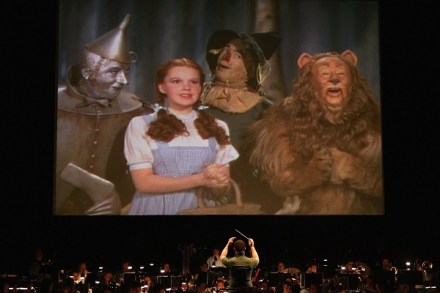
Late on Friday my editor at the Observer called and asked me to dash off a few words on what was wrong with the Mail and some Conservative MPs demanding that the BBC ban 'Ding, dong the witch is dead', a Munchkin chorus, from The Wizard of Oz. I was stuck on a train to Glasgow, but how could I resist? The partially successful attempt to stop the BBC playing a clip from a 1939 children's film is one of the most surreal cases of censorship I have seen. Right wingers were not demanding that the BBC blacklist the song because it was pornographic or libellous. The lyrics the merry Munchkins chirruped were irrelevant to them. They were censoring because they disapproved of the motives of the people who had bought the song, not because of the content of the song itself.

US Senate strangely silent over Margaret Thatcher

From our UK edition

In deference to Lady Thatcher’s immense popularity across the Pond, the US House of Representatives paid tribute to her. But the US Senate has been oddly reluctant to follow suit. Sources in Washington tell Mr Steerpike that a Republican resolution is ‘on hold’ because Democrat majority leader Harry Reid, with the help of a Senator Schumer, is blocking the move. This is poor show, as a quick history lesson will prove. US senators were slow to authorise President Reagan’s attack on the late and unlamented ‘Mad Dog’ of the Middle East. But the Gipper wasn’t worried because the Iron Lady allowed the assault to be launched from these shores. That’s friendship, honourable senators.

Once civil servants have praised one Prime Minister, they must praise them all

From our UK edition

Sir Jeremy Heywood and Sir Bob Kerslake have penned a civil service tribute to Margaret Thatcher in today’s Telegraph. They laud her as the ‘best kind of boss.’ They are full of praise for her habit of producing home-cooked shepherd pie for civil servants working late, a hint—perhaps—to the current occupant of Downing Street. But I have to say that the whole thing makes me slightly queasy. These two men place a huge value on civil service neutrality but applauding her for the fact the ‘civil service was modernised’ on her watch does seem to be, or risks being seen, as a political statement.

Grant Shapps on the Tories and Thatcher

From our UK edition

It is one of the paradoxes of modern British politics that in the post-war era the power and hold of political parties have declined and our system has become more presidential. But the two most electorally successful leaders of this era have both been deposed by their respective parties. This has created problems for both parties, as today’s Sunday Politics with Andrew Neil demonstrated. After John Reid had been on to discuss Tony Blair’s comments on Ed Miliband, Grant Shapps was up to be questioned on Margaret Thatcher’s legacy for the Tories. Shapps was reluctant to declare that the Tories are a Thatcherite party. Trying to suggest that it is but only to the extent that it is also a John Major party.

No battle at Trafalgar in the name of Margaret Thatcher

From our UK edition

Ever since the Poll Tax riots and Margaret Thatcher’s exit from Downing Street, the Iron Lady’s most fervent opponents have been talking about how they'd descend on Trafalgar Square the first Saturday after her death. Although a washout only in the literal sense, last night's ‘celebration’ to mark the end of Thatcherism was nothing like the carnage of the 1990 protest. The crowd consisted of the usual few troublemakers, bemused observers, hurt miners and the anti-everything brigade. At the gathering’s peak (~7:30pm) roughly 2,000 seemed to be present: Like the impromptu Brixton party, on which I dropped in earlier this week, many of the attendants were simply there to mess about and have a party. Dancing, drums and drink were in copious supply.

Where are today’s titanic Cabinet battles?

From our UK edition

Reading Norman Fowler’s recollections of the Thatcher years in the Telegraph, whose coverage this week has been simply superb, is to be reminded of how much debate there was in her Cabinet. Take Fowler’s account of the pre-Budget Cabinet in 1981: “Jim Prior described the proposals as ‘disastrous’, adding that they would do nothing for growth and send unemployment figures above three million. He was supported by the so-called economic ‘wets’, such as Ian Gilmour and Peter Walker, who on this occasion were joined by Francis Pym and Christopher Soames. Even Keith Joseph had his doubts as he argued for more private investment in public industries.

What Margaret Thatcher did for Eastern Europe

From our UK edition

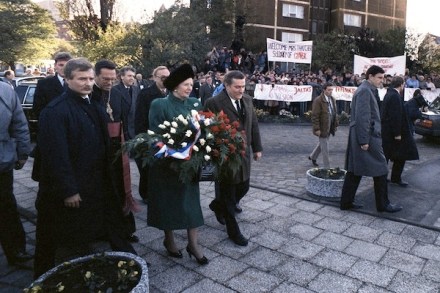
When Václav Havel first visited the United Kingdom as Czechoslovak President in March 1990, Margaret Thatcher hosted a dinner in his honour at 10 Downing Street. By then, Havel’s team, populated partly by chain-smoking dissidents, had been in active politics for only a couple of months. The Prime Minister did not hesitate to use the opportunity to coach the group of unlikely Czechoslovak leaders. 'She was very direct in giving us advice about economic transition, about what we should and should not be doing,' remembers Havel’s former press secretary, Michael Žantovský, who is currently serving as the Czech Ambassador in London.