London

Cameron announces that Parliament will be recalled

From our UK edition

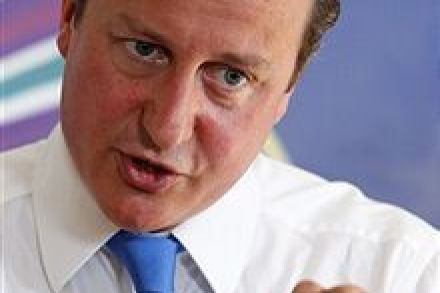
So far as its tone went, David Cameron's statement just now was firm and unyielding. He did express his sympathy for the victims of the riots; the emergency services, the shopkeepers, the fearful. But the major emphasis was on bringing the culprits to book. His "clear message" for the perpetrators of this destruction was that "you will feel the full force of the law". He preceded that by describing their actions as "criminality, pure and simple — and it has to be confronted and defeated". There were no excuses nor prevarications, and rightly so. As for the content, it seems that the government is eager to keep this a police matter, but to ramp it up nonetheless. "We need more," said Cameron, which included "more police on the streets" and "more arrests".

Last night in Peckham

From our UK edition

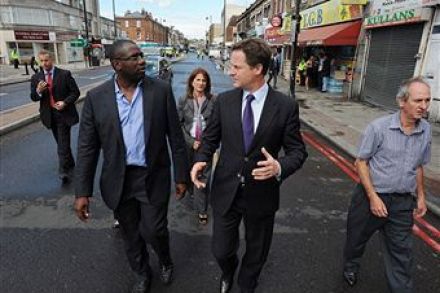
This was what Peckham High Street looked like at about 6.45 last night. I had heard that a bus was petrol-bombed although I neither saw nor heard evidence of that. There was no confrontation between police and the public and I didn't see any arrests. Mostly it was just a case of people standing around wondering what, if anything, to do next.

The Met is struggling to cope — it needs support

From our UK edition

It's a gloomy sort of morning ritual, posting on the riots of the previous night. I'm sure CoffeeHousers have seen and heard the specifics already: further burning and looting in parts of London such as Ealing, Croydon and Hackney, as well as bursts of violence in Birmingham, Liverpool and elsewhere. Businesses and livelihoods have been obliterated, areas set back years. Among the few mercies is that no-one, so far as we know, has yet been killed as a result. One thing that's becoming clearer through the smoke is that the Met Police are overrun, unable to properly deal with criminality at hand. The arrest figures tell a story by themselves.

Cameron to return to London as the riots spread

From our UK edition

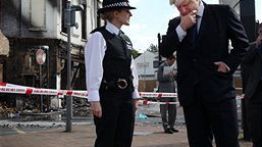
There we have it: David Cameron is to return to London tonight, and chair a meeting of Cobra in the morning. There was an inevitability to the decision even earlier today, with the news that both Theresa May and Boris Johnson had curtailed their own holidays. But the fact that the riots have spread — starting in Hackney this evening, and erupting even in Birmingham — served to underline the point. It is the right decision, in any case. Cameron's ability to control the situation may be limited, but his continued absence might only have inflamed things further. There are a lot of people scrabbling around for a grievance to bare and exploit tonight. The Prime Minister's holiday can no longer be one.

Syria and Libya overshadowed by London riots as Boris comes home

From our UK edition

President Assad’s tanks are still doing murder on the streets of Syrian, but the dictator’s isolation grows. After weeks of prevarication, several Gulf States have closed ranks against the Syrian regime. Saudi Arabia, Bahrain, Jordan and Kuwait have all recalled their ambassadors from Damascus, and King Abdullah of Riyadh has led the Arab League’s condemnation of Assad’s ‘death machine’. Better late than never, the international consensus says. Compassion for the oppressed is not a familiar trait among Arabian princelings, but their reticence on this occasion was particularly surprising given that Assad’s Syria is no friend of the Arab League, preferring to side with Iran in most things.

The politics of our discontent

From our UK edition

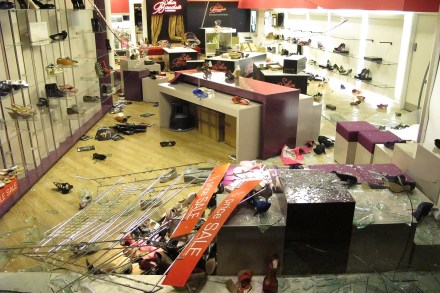
Even by the normal standards of Monday mornings, this one reeks. Just sniff around you. That burning smell, it's either coming from the global stock markets as they strain against the US downgrade, or from those places in London where the rioting spread last night. Although the destruction in Brixton, Enfield, Walthamstow and Waltham Forest didn't match up to that on Saturday in Tottenham, it still involved fires, missiles and clashes between rioters and the police. Reading the reports and watching the footage online, looting appears to have been one of the most popular sports of the evening. In terms of the short-term politics — as opposed to the slightly more medium-term politics of what can be done to properly fix these problems — two issues stand out.

Twitter had the riot covered

From our UK edition

The revolution may not be televised, but the riot was tweeted pretty well last night. I was up at 3am (don't ask), and BBC News hadn't even interrupted their normal programming. But turning to Twitter, it was all there. Specifically, via two reporters: Paul Lewis from the Guardian and Ravi Somaiya from the New York Times. They behaved like instinctive reporters: picked up (on the news or, more likely, on Twitter) that a riot was underway, then went out and reported it. And they did so with pictures and observations that were well-judged and informative, never hysterical or futile. The presence of a TV camera, with the bright lights, have a certain effect on a crowd — so the blogger with his mobile is better able to take and broadcast truer images of what's going on.

Tottenham smoulders

From our UK edition

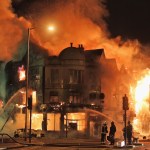
London has become used to protest recently, but there was still something terrible and unexpected in the images emerging from Tottenham last night. Here we had firebombs, missiles, riot police, burning vehicles, smashed-in shops, looting and other criminality — and it has left eight policemen injured, as well as others in hospital. The cause of the rioting was, apparently, the fatal shooting of Mark Duggan by police on Thursday. The effect was scenes reminiscent of Brixton or Broadwater Farm in the 1980s. There will be fresh attention paid to Tottenham — one of the poorest areas of one of London's poorest boroughs — by politicians now, and rightly so.

Don’t blur the lines

From our UK edition

Did you know that on the Central Line’s maiden journey to Shepherd’s Bush, one of the passengers was Mark Twain? Or that The Picture of Dorian Gray and The Sign of Four were both commissioned by the same publisher at the same London dinner? Or that Harrods dropped the apostrophe from its name in 1921, a full 19 years before Selfridges followed suit? My guess is that you probably didn’t — which is where Walk the Lines comes in. Did you know that on the Central Line’s maiden journey to Shepherd’s Bush, one of the passengers was Mark Twain? Or that The Picture of Dorian Gray and The Sign of Four were both commissioned by the same publisher at the same London dinner?

Boris to the fore

From our UK edition

Politics has a big, blond hair-do today, with Boris wiff-waffing all across the airwaves. The Mayor of London has already, this morning, called on George Osborne to do more to cut taxes, specifically the 50p rate and national insurance. And he will be leading a series of events, throughout the day, to mark the fact that the Olympic Games are exactly one year away. The Aquatic Centre will be baptised, the medal designs revealed, and general celebration staged across the city. It's difficult not to see all this as part of Boris's re-election bid, and perhaps as a marker for his wider ambitions. Although London's Olympics have not been an unambiguous positive so far, they still give him a bigger and friendlier platform than most politicians will enjoy over the coming year.

Talking about regeneration

From our UK edition

Iain Sinclair, the London novelist and poet, is always on the move. From the industrial sumplands of Woolwich to the jagged riversides of Gravesend, he rakes unfrequented zones for literary signs and symbols, locations of forgotten films and other arcana. His previous book, Hackney, That Rose-Red Empire, revealed that Joseph Conrad had been a patient in the German Hospital in Dalston. Whenever I drive past that hospital (now converted into private flats), it resonates with the presence of the Congo-sick Polish author. Typically, Sinclair explores London on foot, gathering all kinds of off-piste detail as he does so.

Gearing up for another European drama

From our UK edition

Away from the amateur dramatics in parliament this afternoon, the government is fighting yet another battle with the European Commission over banking reform. European leaders will vote later today on proposals to introduce the rubric of Basel III across European financial institutions. Led by EU Finance Commissioner Michel Barnier and ECB Vice-President Jean-Claude Trichet, these proposals would insist that minimal and maximum capital requirements are imposed on banks. The terms dictate that banks hold 7 per cent of their top-class assets in reserve. Britain opposes the scheme, not because the requirements are too steep: the UK’s Banking Commission has suggested that banks hold 10 per cent of their assets in reserve.

Now Sir Paul Stephenson resigns

From our UK edition

This story just keeps speeding up. Paul Stephenson, the commissioner of the Met, has now resigned because of his links to Neil Wallis. Wallis is the former News of the World journalist arrested recently as part of the investigation into phone-hacking; he was hired by the Met to offer media advice from autumn 2009 to 2010. The New York Times today claims that Wallis was reporting back to News International during this time. Boris Johnson and the Home Secretary will now have to agree on a replacement for Stephenson. Given what we have learnt about the Met in recent days, I suspect it will be an outsider. Bernard Hogan-Howe, the former chief constable of Merseyside who was a finalist when Stepehnson was appointed, will, I expect, be the early favourite.

Inadequate stress test inspires anti-EU sentiment across Europe

From our UK edition

Yesterday’s European Banking Authority (EBA) stress test was supposed to restore confidence in the euro and Europe’s beleaguered financial institutions; it has had the opposite effect. Investors and market analysts are preparing for ‘Black Monday’ after only 8 banks failed the test and must now raise £2.2 billion between them to stave off ruin. A respected estimate by Goldman Sachs expected at least 15 banks to fail, requiring £29 billion to recapitalise. As the Spectator’s business blog reported yesterday, analysts feared that the EBA’s test would not be sufficiently stringent, and so it came to pass.

Ofcom to rule on Murdoch’s purchase of BSkyB

From our UK edition

If News Corporation was not trying to buy the whole of BSkyB, there’s a good chance that phone hacking would not still be in the news today: that decision was one of the things that led to a revival of interest in the story. As has been said many times during the past few days, securing full ownership of BSkyB is regarded as crucial by the Murdochs and that is one of the reasons they were prepared to take the dramatic step of shutting down The News of the World. But the letter from Ofcom about the takeover and the possibility of Labour forcing a vote in the House of Commons on the matter on Wednesday, means that the bid is in real jeopardy. As Robert Peston points out, BSkyB shares have fallen as the City computes the obstacles now standing in the way of the take-over.

Rage against the tagine: Capital mistake

From our UK edition

There’s nothing like following a theme: playing it safe, being on-message. Thus, we hear endlessly — from Michelin-starred chefs to their adoring throng — the mantra that ‘London is restaurant capital of the world’. From bitter experience, I disbelieved this the first time I read it — and then I started to think further. The shocking truth is that everyone chanting this mantra has a stake in the message getting through — from people with a share in restaurants, which are notoriously risky ventures, to those invested in tourism, London 2012 or restaurant guides. Of course, London has pockets of food excellence, but they are little pockets. Is there good eating everywhere? No, there is not.

Osborne comes to a decision on the banks — but the story doesn’t end there

From our UK edition

In his speech to Mansion House last year, George Osborne asked a question of his frosted and cumberbunded audience: "Should we restrict or split the activities of banks?" In his speech tonight, he looks set to deliver an answer of his own. As Robert Peston reports, the Chancellor is to announce that the investment and retail arms of banks will be ringfenced off from each other, so that the dice rolls of the Masters of the Universe cannot tumble across everyday savers' cash. This does not mean a complete, Glass-Steagall-style separation between the two halves.

Deep, dark mysteries

From our UK edition

For Peter Ackroyd, the subterranean world holds a potent allure. London Under, his brief account of the capital’s catacombs and other murky zones, manages to radiate a dark mystery and sulphur reek. ‘There is no darkness like the darkness under the ground’, Ackroyd announces, like a Victorian raree-show merchant. This is an entertaining if slightly daft book, that reveals what a weird world lies beneath our feet. Whether Ackroyd has actually been to all the places he describes is uncertain. Journalists have contorted themselves through narrow, stinking cave-galleries and risked leptospirosis from rat urine in their quest for London subterranea. But the stately Ackroyd? The London sewers are vividly described here.

We are the past

From our UK edition

Julie Myerson’s eighth novel is told by a woman who roams the City of London after an unspecified apocalypse (no power, bad weather). Julie Myerson’s eighth novel is told by a woman who roams the City of London after an unspecified apocalypse (no power, bad weather). The Monument is rubble, Tower Bridge has ‘long gone’ and scavengers are chopping fingers off frozen bodies to snatch rings. Our narrator can’t remember much — two thirds of the book pass before we find out her name is Izzy — but a couple of randy fellow vagrants claim to know her, and some children say she’s their mum. By the time one of them ‘lifts off the ground and comes flying through the air’ — and vanishes — we’re not sure what to believe.