Liberal democrats

It’s obvious that Brown’s the impediment, why doesn’t Labour strike?

From our UK edition

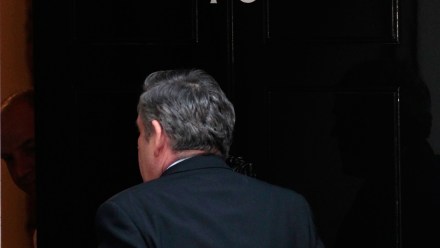
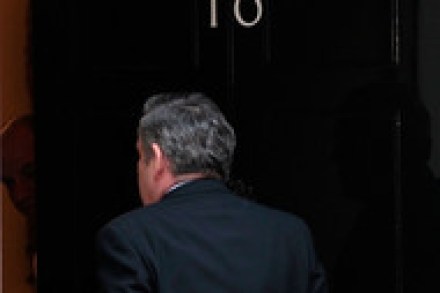
Well, Brown the Statesman was a short-lived incarnation. The BBC reports that Brown and Clegg exchanged ‘angry words’ yesterday evening and that Brown delivered a characteristic private political conversation: ‘a diatribe laced with threats’. Clegg and Brown simply cannot work together. This inability to put aside personal differences is far from magnanimous of both men, but it is plain that Brown no longer commands the authority to shape the nation’s future. If there’s no hope of a Lib-Lab coalition with Brown at the helm, then the knives will be sharpening - again. From Labour’s perspective, delaying the inevitable would be fatal as it gives Cameron more time to negotiate with Clegg knowing that he is Clegg’s only option.
The need for speed

From our UK edition

The markets have spoken, and they’ve done so with menace. The FTSE 100 closed down 138 points, which, though not a complete disaster, is far from encouraging. You might argue that the multinationals that comprise the FTSE 100 are more affected by the fortunes of international markets and commerce. Whilst that’s true it must be conceded that there is little comfort in the FTSE 250, a figure that provides a closer expression of domestic economic confidence, which closed down by 410 points. At the time of writing, Sterling, another bellweather indicator, is mired. The Pound is worth $1.47, and at one point it was at its lowest level against the dollar for more than a year. The Pound is also at a 6 month low against the imploding euro.

A deal that would kill Gove’s agenda at birth

From our UK edition

While both the Conservatives and LibDems support the idea of Swedish schools, a Lib-Con deal could kill the agenda stone dead. David Laws is proposing to allow local authorities to have the power to veto new schools – which would, in effect, mean no rollout. As we all know, this could strangle the Gove school agenda at birth. Local authorities, whether Labour or Tory, will hate the idea of competition in the provision of education. The local authorities and teachers’ unions are incredibly powerful, and defeated Thatcher, Adonis and Blair. They have also nobbled the LibDems to the extent that, I understand, David Laws believes that he could not get rid of the local authority veto. His party, and the special interests it represents, would not let him.

Do the Deal, Dave

From our UK edition

Tories are supposed to be pragmatists. That's why they're the traditional party of coalition in this country. On that front, it is interesting to see that John Major is suggesting that, to advance the cause of stability, Cameron should offer Clegg a number of cabinet seats. This seems sensible and, happily, would also improve the quality of the cabinet since, lord knows, there are a good number of Tories who ought to be kept well away from the Red Boxes. More interestingly still, it was notable today how both Dan Hannan and Douglas Carswell were warm on the idea of a coalition and even, if necessary, some kind of electoral reform. Of course, they're both liberals, not social conservatives and as such are less tribal, perhaps, than some.

Cameron offers the hand of coalition to the Lib Dems

From our UK edition

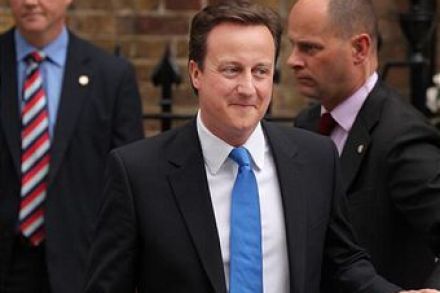
Woah, I didn't think Cameron would go that far.  In his statement just now, the Tory leader started off by talking about minority government, as one might expect.  But he soon skipped past that, and onto what sounded like a more formal coalition with the Lib Dems.  He called it the Tories' "Big Comprehensive Offer". This offer trumped the one that Brown put forward ealier by virtue of its clarity.  Where Brown had hints and innuendo, Cameron had an itemised list of policies and specifications.  And so the Tory leader set out the areas where he wasn't willing to compromise with the Lib Dems: Europe, cutting the deficit and immgration.

Nick Clegg gives the Tories the go-ahead

From our UK edition

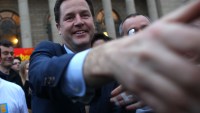
So Nick Clegg has finally spoken – and his words will be welcomed by the Tories.  In an address outside of the Lib Dem HQ on Cowley St, he reiterated his previous argument that "whichever party gets the most votes and the most seats, without gaining a majority, has the first right to form a government."  But added that "it seems this morning that the Conservative Party have the most votes and the most seats ... it is for the Conservative Party to prove that it is capable of governing in the national interest." What this means in practice isn't 100 percent certain – although it doesn't sound good for Labour.

Massive Failure by the Tories and Lib Dems to Manage Expectations

From our UK edition

The old political hands in the Labour Party at least knew that they had to talk down their prospects (beyond the usual nonsense about fighting to win). Lord Mandelson was right to fight this election as the underdog because this now looks in some ways like a victory.  In fact this is a massive achievement for the Conservative Party. When David Cameron took over in 2005 many Tories would have settled for this result. They should always have been fighting a two-election strategy. But the Conservative Party allowed itself to get overexcited about the possibility of outright victory. The Liberal Democrats allowed themselves to dream and find themselves bitterly disappointed this morning.

There may be Tory trouble ahead

From our UK edition

Will the 1922 Committee of Tory MPs elect an emergency chairman today? If so, the mission would be to warn Cameron off doing any deal with the LibDems. Most Conservatives will wake up today judging the Cameron campaign to have failed. In the view of many, he will have failed to honour his "change to win" promise: they all changed, as he asked, but he didn't win. There will be a price to pay, and perhaps one of the heads around Cameron will have to roll to assuage the discontent. Any Lib-Con deal over voting reform will be anathema to many recently-elected as well as existing  Tory MPs. A new chairman of the 1922 Committee will want to make this point to Cameron before any damage is done. A deal with Northern Irish MPs would probably be as much as the party would wear.

Let the recriminations begin

From our UK edition

Let's rewind to 10pm yesterday evening, when the exit poll was released.  Most politicos - myself included - were incredulous.  We could just about believe that there might be a hung Parliament with the Tories as the largest party, but a reduced number of Lib Dem seats?  After Cleggmania and all those recent opinion polls?  Gedouttahere. But, this morning, that exit poll is looking a good deal more prescient.  After an evening of erratic results, Sky's projection matches it almost exactly: 309 seats for the Tories, 259 for Labour, and 54 for the Lib Dems.  So we're on for a hung parliament, and all the backroom discussion and subterfuge that that entails. Already, the dividing lines have been traced across Westminster.

Election Night live blog

From our UK edition

0843, JGF: The result in Hampstead and Kilburn is remarkable. The local Lib Dems were convinced that they would win. But Glenda Jackson survives by 42 votes with the Tories in second. 0639, PH: A dejected sounding speech from Nick Clegg. 0638, PH: Clegg says "this has been a disappointing night for the Lib Dems - and we obviously didn't achieve what we hoped to achieve." 0637, PH: In his acceptance speech, Nick Clegg is going big on the voting problems of last night. 0634, PH: Some good news for the Lib Dems: erm, Nick Clegg holds in Sheffield Hallam. With an increased majority. 0620, JGF: Jon Cruddas holds on, he'll have a big role to play in the Labour party machinations of the last few days.

The party leaders vote

From our UK edition

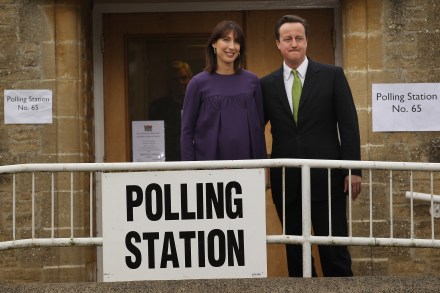
David and Samantha Cameron leaving the polling station in Spelsbury Gordon and Sarah Brown arrive to vote in North Queensferry Nick and Miriam Clegg vote in Sheffield.

Two more polls point towards a hung parliament

From our UK edition

Is this it? A couple more polls have been released, and – like all the others tonight – they point towards a hung parliament. An ICM poll for the Guardian has the Tories on 36 percent (up three points), Labour on 28 percent (no change), and the Lib Dems on 26 (down 2).  And a ComRes effort for the Independent and ITV has the parties on 37, 28 and 28, respectively. Most Tories I've spoken with this evening are, they say, mildly pleased with the opinion polls.  Not overjoyed, of course – but they feel their party's greater firepower in the marginals means that numbers like those above will translate to a small majority.  Either way, things are certainly very close.

And now YouGov…

From our UK edition

You want more numbers? Well, the YouGov figures for the Sun have just come in, and they are: the Tories on 35 percent (no change), Labour on 28 percent (down two), and the Lib Dems on 28 percent (up 4). So far tonight, all the polls have been in hung parliament territory (on an uniform national swing). And most have Labour and the Lib Dems more or less on level-pegging. More polls here and here.  There's a good handful still to come, so keep your seat calculators to hand. UPDATE: YouGov also conducted some marginals polling.

Times/Populus has the Tories close to a majority

From our UK edition

So the Times/Populus results are in, and they have the Tories on 37 percent (up one), Labour on 28 percent (up one), and the Lib Dems on 27 percent (down one). On a uniform national swing, this would leave us in hung parliament territory. But Tories I speak to are pretty confident that numbers like these, if replicated tomorrow, could give them a majority. Elsewhere, TNS-BMRB has the Tories on 33, Labour on 27 and the Lib Dems on 29.  Angus Reed for Political Betting has Tories on 36, Labour on 24, and the Lib Dems on 29.

An economic coalition makes political sense

From our UK edition

If you believe, as most people probably do, that Robert Chote of the Institute for Fiscal Studies and Mervin King of the Bank of England should be listened to, then two conclusion emerge: one, that a new government’s budget-slashing will be far, far worse than anything the main parties have hitherto acknowledged; and that after a parliament of deficit-busting, the party in charge will be severely punished by the voters. It stands to reason, therefore, that it would be better to spread the pain, even if one party has a near-majority or an outright majority.

The Tories’ final onslaught

From our UK edition

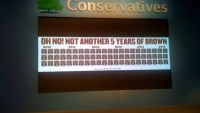
"Where's the popcorn?" I thought, as I joined a bunch of journos to watch the Tories' final broadcast of the election campaign. It was a good nine minutes long, and might as well have been titled The Downfall of New Labour. The opening shots were of Blair and Brown in 97: "a new dawn," and all that. But Blair's image soon faded to black-and-white, and we were bombarded with a montage of headlines, quotes and images which highlighted the failures of the Labour years. 10p tax. Falling education standards. MRSA. The misdemeanours of Peter Mandelson. Defence spending. Purnell's resignation. Gillian Duffy. Even Manish Sood's comments today. Depending on your disposition, it was all gorily nostalgic stuff. Negative, yes. But quite powerful nonetheless.

The G-men or the Granola Army

From our UK edition

In the last stretch of political campaigns, things tend to get ugly as the real cost of winning and losing becomes clear. This one is no different, with its suggestions of tactical voting and disagreements about tactical weapons. The latter has become particularly viscious with a former spymaster, an ex-general and a former CT chief calling into question the securty and defence policies Nick Clegg and the Liberal Democrats. In their defence, the Lib Dems have positioned their biggest weapon, Paddy Ashdown, who fired a volley against Richard Dearlove, the former head of MI6, saying that "things had changed since he supplied intelligence to Tony Blair about Iraq and WMD". Bull's eye! But who is right - Britain's G-men or the Granola Army?

Clegg Might Need Cameron More than Dave Needs Nick

From our UK edition

Paul Waugh has an excellent post on the difficulties and opportunities that will face Cameron if he falls short of winning a majority. Much of the commentary on this has hitherto focused on the difficulties but Waugh is right to suggest that, actually, a minority Tory ministry could probably pass a good deal of legislation and, just as importantly, effect change in other areas without the need for primary legislation. I doubt Cameron would want to run a minority government for more than 18-24 months but it's worth noting that Stephen Harper's minority ministry in Ottawa still stands and so does Alex Salmond's in Edinburgh.