Liberal democrats

David Lammy: Why Cameron has triumphed

With Ed Balls and John McDonnell announcing their candidatures for the Labour leadership, it's clear that Labour's soul-searching period has now begun in earnest.  Speaking in front of the cameras just now, Balls reeled of the lines that he's been priming over the past week: "listening ... immigration ... listening ... beyond Blair and Brown," etc.  While McDonnell was keen to separate himself from the other candidates, describing them as the "sons of Blair and the sons of Brown". Both of them might care to read David Lammy's appraisal of where it went wrong for Labour – and where it went right for Cameron – in tomorrow's issue of the Spectator.

The Bill of Rights would be useless anyway

I would like to defend the coalition from allegations that there has been a deplorable Tory concession on the Human Rights Act. Tearing it up was never in the Tory manifesto. Dominic Grieve, who drafted the Tory plan, is one of those lawyers who is rather passionate about the European Convention of Human Rights (ECHR) and praised it in his maiden speech. I had many conversations with him about this: for Britain to pull out of it, he said, would send an “odd” signal to the countries on the fringes of Europe whom we were trying to pull into our orbit. Grieve’s plan was to propose a Bill of Rights which would look and sound like something that would supplant the ECHR (put into British law by the Human Rights Act).

Mind the culture gap

Danny Finkelstein’s column this morning is one of the most important things to have been written since the coalition was formed. Danny makes the point that the coalition has no ideas infrastructure in place. There’s nowhere for it to go to get new ideas. Think tanks will rush to fill this void. But as Danny notes, there will also have to be a cultural comfort with the other side. That there isn’t at the moment is demonstrated by the look on Tory MPs’ faces when you debate whether Nick Clegg should be invited to address Tory conference. One of the clever things that the coalition agreement has done is to make the main tax cut of this government a Lib Dem one. It is a reminder to the Tory party that the Lib Dems believe in freedom too.

Trouble averted or trouble ahead?

"The biggest shake up of our democracy since 1832."  That's how Nick Clegg is describing the legislative package that he's announcing today.  And, even if that's pure bravado, there's certainly plenty of encouraging stuff in it.  Scrapping ID cards; restricting the storage of innocent people's DNA; and the government is even set to ask the public which laws they'd like to see repealed.  Sign me up. But it's one omission which is really ruffling Tory feathers today.  There will not, it seems, be an immediate move to supplant or even dilute the European Convention on Human Rights with a British Bill of Rights.  Speaking on Radio 4 this morning, Theresa May stressed that this is still a matter for negotiation within the coalition.

Govern together, campaign apart

One of the things that critics of the LibCon coalition keep coming back to is the question of what will happen in European, local and other elections. Will the two governing parties stand against each other? And how can they differentiate themselves when they support the same policies? To many, it seems like David Cameron and Nick Clegg are suggesting that we all walk backwards – odd, uncomfortable and unlikely to ensure progress. But why is this so odd? This kind of electioneering happens in many other countries. Take Denmark. There, a Liberal-Conservative government has been in power for almost a decade and across several elections, yet the two governing parties have gone to elections as separate parties, each with their own platform.

Bercow remains Speaker, as Parliament reconvenes

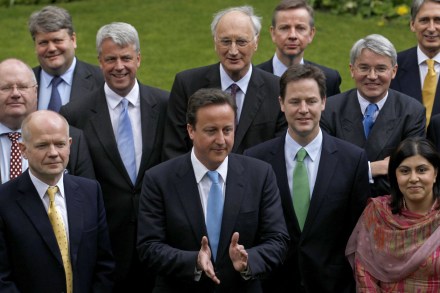
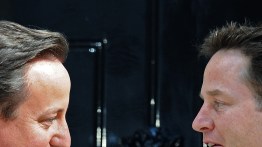
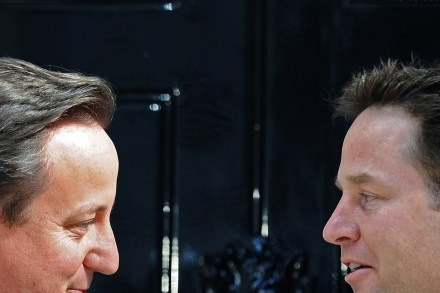
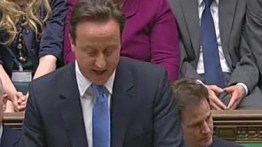
David Cameron sat alongside Nick Clegg on the government benches, with Harriet Harman two sword-lengths away as leader of the Opposition.  Even though the coalition has been around for a week now, it took the images from the Commons this afternoon to bring home just how extraordinary recent politics has been.  I mean, even the SNP's Angus Robertson got to make a speech now that the Lib Dems aren't a party of opposition.  This, plainly, is going to take some getting used to. They were all witness, today, to the re-election of John Bercow as Speaker.  In the end, it was easy for the Buckingham MP, as the "ayes" heavily outweighed a handful of "nos," and he was duly "dragged" to the Speaker's chair without a formal vote.

William Hague sets out the government’s Europe policy

Those who hate the new Conservative-led government and those who love it seem to be united in one expectation: that Europe policy may be the coalition's downfall. David Lidington, the able new Europe minister, certainly has his work cut out for him. In the latest of the Brussels journal Europe's World, Foreign Secretary William Hague lays out the government's Europe policy, a policy best described as "pragmatic scepticism": "The EU is an institution of enormous importance to the United Kingdom and to British foreign policy.

Nadine Dorries’ Kill Bercow email

Via PoliticsHome. If anything sways hearts and minds, then I suspect it will be the name of Sir Menzies Campbell among the "able and willing" replacement candidates: Dear new Member, Many congratulations and welcome to the House. Please forgive me for this generic email being brief and to the point. The first job of the House today is to appoint the Speaker. The Father of the House, Sir Peter Tapsell, will present a motion to the House that John Bercow remains as Speaker. At this point, members will shout 'Aye', on this occasion there will also be members from all parties shouting 'No'.

The gathering storm over the 55 percent plan

There is a massive difference between rebellious talk and actual rebellion. But some of the language surrounding the 55 percent rule has been striking. When I told one senior MP that David Cameron had said on Sunday that he would whip this vote, the MP shot back defiantly, ‘you whip if you want to.’ David Davis’s intervention on the issue on the World at One was particularly significant. Having called the 55 percent rule ‘just a terrible formula for government’ it is hard to see how he can support the measure. It is also hard to imagine that a man who picks his fights so carefully would have marched so far up the hill if he was not confident that he had a critical number of foot soldiers behind him.

Working side by side

George Osborne and David Laws’ press conference this morning gave some hints about the chances of the coalition making it. The Treasury is where, I suspect, this coalition will succeed or fail. If the two parties can keep it together on how to reduce the deficit and how fast to do it, then I expect that they’ll be able to deal with the other issues that are thrown at them. Encouragingly from this perspective, Osborne and Laws seemed comfortable sharing a platform; there were no attempts to score points off each other. It appeared to be a harmonious double-act. But Osborne didn’t refer as many questions to Laws as he did to Phillip Hammond, his trusted and super-able deputy in opposition, back in the day.

Osborne rolls his sleeves up

Just in case you didn't see the front cover of the Guardian, let me tell you: it's a big day for George Osborne.  This, after all, is the day when he finally launches the Office for Budget Responsibility's audit of the public finances – zero hour for the age of austerity.  Accordingly, then, Osborne has given his first major newspaper interview since becoming Chancellor.  Here, from that, is a quartet of observations for you: Office for Budget Responsibility.  The more I hear about it, the more I like this Office for Budget Responsibility.  Sure, it's another quango of sorts.

Osborne’s Big Choice: how much of our debt to reveal

The cover of today's Sunday Times spells out what we all suspected anyway: that the Labour government left behind acre upon acre of scorched earth for the Tories to contend with.  There's the £13 billion contract for tanker aircraft, the £1.2 billion "e-borders" IT project, a £420 million spend on schools, and so on – most of them put in place just before the election.  As James said earlier, Sir Alan Budd's audit of the public finances is likely to show that things are much worse than the last Budget dared admit. All this throws open the wider question of our debt position.  Even by Labour's measures, our national debt is likely to rise once all the hidden spending and exaggerated tax receipts are taken into account.

The life of a Tory MP

A Norwegian MP once told me that every time he thought life on the opposition benches was terrible he would think about life on the government backbenches – and realise how much he enjoyed his job. Life as a government-supporting backbench MP is difficult; if you are not willing to cap your ambition, you have to support the government, keep criticism muted and hope for elevation to ministerial rank in any future reshuffle. It is doubly difficult for the hard-working Tory MPs who lost out on government jobs because of the need to find space for Lib Dems, rather than because of their personal abilities. I can think of at least half a dozen MPs who would have made excellent ministers. What should they do now?

Why Labour is still within striking distance

Things are looking good for Cameron – his coalition has 60 percent approval rating, he has managed to persuade the Lib Dems to support what always was a liberal Tory agenda. There is plenty for Conservatives to celebrate, especially on welfare reform and education. But, still, things could be a lot worse for the Labour Party than they are now. I say in my News of the World column today that, rather than being “out for a generation” as Tory strategists were hoping only a month ago, Labour remains (amazingly) in striking distance of winning the next election. And there is no telling when that election will be. Clegg and Cameron say their pact will last until 2015 – but only a tenth of voters believe it.

The British People Have Not Been Betrayed

Norm does a good job pointing out the sillyness of this silly Johann Hari column in which Hari complains that the Liberal Democrats have betrayed themselves, their voters and the country by agreeing to advance Liberal Democrat goals from government. How shocking! Nevertheless, Hari complains that "the British people have not got what they voted for". Well nor have BNP voters but I doubt that Hari is bothered by that. Nor should he be. In any case, no-one votes for a government of any stripe. All anyone gets to do is endorse a given candidate in their local constituency. After that  it's a case of letting the national chips fall where they may.

The equality dilemma

Spare a thought for poor Theresa May. Judging by the reaction so far, she now faces the unenviable task of shouldering almost everyone’s preconceptions about Tory women in government – with Caroline Spelman, Baroness Warsi and the lower-profile Cheryl Gillan for back-up. She will no doubt continue to disappoint feminists and irritate reactionaries, and she will do so while responsible for the notoriously unwieldy Home Office, which has rapidly taken over from the Department of Health as the ministry where political careers go to die. Representation in politics does matter. It is not unreasonable to claim, as Katharine Viner did in Thursday’s Guardian, that “democracies simply don't work unless they represent those they govern”.

Building on the coalition’s good start

A week in, and I am loving the Conservative-led government. The new line-up of Secretaries of State is very impressive and, though a few solid Tory politicians missed out on Cabinet posts, the inclusion of the Liberal Democrat bench has swelled the government’s talent quota. David Cameron has infused No 10 with energy and purpose. You can just feel the umpf. As the former MP John Gummer said, there is now “smile on the face of Britain”. Foreign Secretary William Hague’s trip to the US set the right tone by calling the UK-US link “an unbreakable alliance”.

Hurd weighs in on the 55 percent debate

Plenty of eyes on the Tory grandees at the moment.  I mean, the right of the party isn't exactly delighted with the LibCon coalition - so the search is on for figureheads to lead the resistance.  Which is why Andrew Neil's interview with Douglas Hurd on Staight Talk this weekend is worth paying attention to. As it happens, Lord Hurd is quite complementary towards David Cameron and his role in organising the coalition.  Here's the actual quote: "I think it was a brave thing to do.  It might have gone terribly wrong, but he went straight for it and he was completely straightforward in saying this is what this is, and eventually he won what he wanted.  I think it was an act of courage and of skill, those two things which create a good politician...

Government, Russian-style

Правительство, в русском стиле Britain is being governed by a duumvirate. Britons may not understand how two-headed government works; but Russians should have no trouble at all. They have long been accustomed to a two-headed form of government. Perhaps at the next UK-Russian summit, the quartet of Cameron, Clegg, Putin and Medvedev can swap tips. Clegg’s importance to the Conservative-Liberal government will transform the previously honorific role of deputy Prime Minister. He will retain the right to fire Liberal Democrat ministers, if not directly then by threatening to remove their party whip.

In the foothills of Brown’s debt mountain

After the sunshine of the Downing St rose garden, the gloom of the public finances. This morning's newspapers are full of stories about the tax hikes and spending cuts that our coalition government is looking to introduce. The Sun and the Times dwell on yesterday's forecast for a rise in VAT. The Guardian outlines possible cuts to middle-class benefits. And there's plenty more besides. Two articles, though, are particularly indicative of the tensions that the government will face.  Interviewed in the Sun, David Cameron has to go on the defensive about tax rises; insisting that "The Conservative party is still a low-tax party, a tax-cutting party – and that's in the agreement.