Language

Sadiq Khan’s virtues

The new Mayor of London, Sadiq Khan, said he wanted ‘the most transparent, honest and accessible administration London has ever seen’. It sounds lovely, especially if the Underground is cheap too. Mr Khan’s are a very 21st-century triad of virtues, though honest might sound old-fashioned. It would once have appeared on a housemaid’s reference: ‘Diligent, sober and honest’, i.e. not lazy, drunken and thieving. We now grow sceptical of politicians who begin replies by saying ‘To be honest’ (as if this was a rare departure). Honesty once measured outward respectability, as reflected in a Tudor description of Eton as ‘an honest Colege of sad Priestes, with a greate nombre of


Shakespeare’s pronunciation

Sir John Harington told a story in 1596 about a lady at court asking her gentlewoman to inquire which Mr Wingfield was asking to see her. On being told that it was Mr Jaques Wingfield, the gentlewoman blushed and came back with the genteel answer that it was Mr Privie Wingfield. The story depended on Jaques being pronounced in those days like jakes, meaning ‘lavatory’ or ‘privy’. Harington took the joke to extremes, writing a whole book on lavatories called the Metamorphosis of Ajax, a punning title. Shakespeare might have been making the same joke as Harington’s when, in As You Like It, he had Touchstone referring in front of

Queue

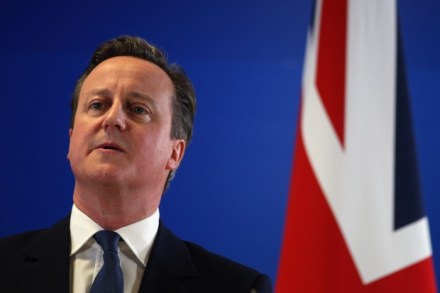
The language that President Barack Obama used was evidence of skulduggery, Nigel Farage declared. ‘The UK is gonna be in the back of the queue’ if it leaves the European Union, Mr Obama said, standing next to David Cameron in front of a gilt and stencilled Victorian wall in the Foreign Office. There! Americans say stand in line, Mr Farage suggested, so Mr Obama must be delivering words fed to him by the snake Cameron. Some reports had Mr Obama saying at the back of the queue, unconsciously adjusting his words to the British English idiom, rather than in the back of it, as though it were an estate car

Sex worker

‘Of course,’ said my husband in his worst smirky way, as though waiting for an appreciative chuckle, ‘as soon as she found out he was a politician, she broke off the affair.’ That was not the only unoriginal remark about poor old John Whittingdale, who last week admitted to going out with a woman for six months without realising that she was a prostitute. Hearing about the thing on Sky News, I thought its use of sex worker for the woman was an eccentric example of political euphemism. But then I found the BBC using sex worker, and even reputable newspapers. The Times too called her a sex worker. In

Illegitimate

‘The Archbishop of Canterbury has discovered he is the illegitimate son of Sir Winston Churchill’s last private secretary,’ Charles Moore told us last weekend. As a bonus in this Trollopean tale we learnt that, by Church of England canon law, ‘men born illegitimately were for centuries barred from becoming archbishops’, or indeed bishops. The affair also reminded me of Daisy Ashford’s The Young Visiters, in which Bernard Clark writes to the Earl of Clincham on behalf of Mr Salteena: ‘The bearer of this letter is an old friend of mine not quite the right side of the blanket as they say in fact he is the son of a first-rate butcher but

Dreadlocks

‘Why are you filming this?’ ‘For everyone’s safety.’ Those are the last words in a 46-second video that was watched by more than three million people on YouTube last week. The question was asked of the unseen cameraman by a black woman who had been haranguing a white youth at San Francisco State University for wearing dreadlocks (or the best he could manage with his weedy hair). I’ve written about being safe in universities before, but this incident focused on cultural appropriation, which is a new crime discovered by people who think it in fact misappropriation to adopt the cultural expression of another ethnic group. Search me. Of course the

Gender fluid

Benjamin Franklin thought that an excess of electric fluid gave rise to positive electricity, and a deficiency of the fluid to negative electricity. ‘New flannel, if dry and warm, will draw the electric fluid from non-electrics.’ By an electric he meant substances such as glass, and indeed the air. I’m not sure how much we think of electricity as a fluid today. James Thurber’s mother worried that it would run out of the sockets unless one left a plug in them, but she was perhaps unusual. Flann O’Brien put forward the similar theory that darkness was due to the accretion of ‘black air’. Fluid mediums persisted in our world view because it was hard

Cock

On the Radio 4 news at 11 o’clock last Saturday morning there was a joky report about roosters in Brisbane. The cocks, it said, were annoying people with their crowing. The news at noon called them not roosters and cocks, but cockerels and fowls. I wrote here in 2005 about the advent of the ‘Year of the Cockerel’ and suggested that cock would soon be unusable because it put everyone in mind of a rude word for penis. Things have got worse since then. Mealy-mouthed folk who say cockerel simply ignore its meaning, which is ‘a young cock’. It’s like calling all cats kittens. Oddly enough, the Oxford English Dictionary says

Leap in the dark

‘They all laughed at Christopher Columbus,’ sang my husband flatly, ‘when he said the world was round.’ I wasn’t going to tell him yet again that George and Ira Gershwin were wrong and everyone knew the world was round when Columbus set off. But there is a connection between Columbus’s name and the leap in the dark that he took in his voyage — and which David Cameron says ‘outers’ want to take today. I’ll stick to language, since this is not a political column. That very English word leap has no affinities in languages outside the Germanic family, unless, some scholars say, it is related in origin to the

Why ‘my’?

It used to be ‘Your M&S’. That was presumptuous enough. Now, when you drive past Earls Court exhibition hall, pathetically covered in plastic sheeting while being demolished to make way for a high–quality, mixed-tenure residential neighbourhood, the hoarding tells you you’re going past ‘My Earls Court’. You can read all about it on myearlscourt.com. No, it is not my Earls Court. And nor will I like it more if you try to tell me it is mine. The same with Church Street, London NW8: there’s redevelopment here, too, and it’s being flaunted as ‘mychurchstreetnw8’. No it’s not. Stop trying to make me take psychological ownership of your so-called urban renaissance.

Purifying the gymnasium

When Friedrich Nietzsche was offered a professorship in classical philology at the university of Basel in 1869 he was so happy he burst into song. He was only 24 at the time — a year younger than Enoch Powell, who became a professor of Greek at the university of Sydney aged 25 — and looked forward to a brilliant academic career. Three years later, when he delivered the six lectures contained in this book, he was already showing signs of disillusionment. His teaching duties included six hours at the local gymnasium — the German equivalent of a secondary school — and he wasn’t impressed by what he found there. To

Special status

‘Special status?’ said my husband. ‘You mean like executioners, butchers and undertakers in Japan?’ I hadn’t suggested that, but had been thinking aloud about the phrase which, according to David Cameron, now describes Britain’s position in Europe: special status. My husband once went to Japan, which, he thinks, makes him an expert. He learnt about the ancient monkey performances given by people called Burakumin, a sort of untouchable. Apart from performing with monkeys, which was banned in the 20th century, they have been associated with unclean trades such as those he mentioned. Special, as I have remarked before, is slippery. The special relationship between Britain and America has at times

Creaky voice

My husband, not surprisingly, finds it extremely annoying. It, in this instance, is the use by women of creaky voice. If you don’t recognise the trend immediately imagine a youngish woman (not me) finishing a sentence with the phrase ‘really shiny leather’ and creaking, like a door, as she says the vowels. The trait is also known as vocal fry, as if it were produced by a chip-fryer. It is a feminine characteristic by a proportion of two to one. Reese Witherspoon was heard doing it to the phrase ‘truly heinous angora sweater’ in the film Legally Blonde as long ago as 2001. Recently I’ve heard Emma Barnett on Woman’s

Beware

My husband pointed with his stick, which he carries not to steady himself but to cudgel pedestrians out of his way, and said: ‘What am I supposed to do about that?’ His question was in response to a notice posted up on the wall by a platform at Vauxhall Underground station: ‘Due to our works. Beware of noise. Beware of smell.’ It is part of the current conflation of the meanings of be aware and beware. The confusion runs both ways. That Underground notice was intended to make passengers aware that there would be noise and smell (of burning perhaps), so that they would not flee in alarm. A flight

Not even a thing

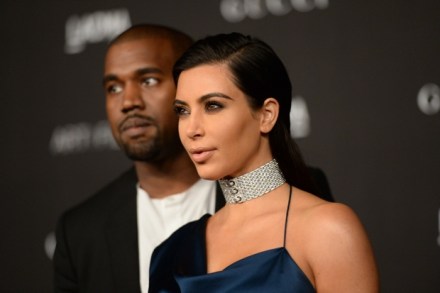
Last summer Kim Kardashian, who already had a daughter called North (surname West), announced that she was expecting a boy. She put a photograph on Twitter of herself pouting, captioning it: ‘Pregnancy lips’. Some Twitter-followers asked: ‘Pregnancy lips? Is that even a thing?’ The Cambridge Advanced Learner’s Dictionary has since adopted that example as the locus classicus of the phrase Is that even a thing?, and variants such as Is that a thing? or That’s not a thing. Professor Ben Yagoda of the University of Delaware has poked around on the internet and found, like other people, the phrase being used in 2001, in a television situation comedy called That ’70s

Peak

Near Victoria Station in London they began to build a tower-block advertised as ‘The Peak’. I expected it to resemble Mont Blanc. After a few floors, it was finished, and the top of the façade projected like the peak of a baseball cap. I felt cheated. Peak is a vogue word that itself has gone through peak usage. Earlier this month, Steve Howard, Ikea’s chief sustainability officer (yes, the chief one), said in a seminar: ‘In the West we have probably hit peak stuff. We talk about peak oil. I’d say we’ve hit peak red meat, peak sugar, peak stuff, peak home furnishings.’ It was an engaging observation, but poor

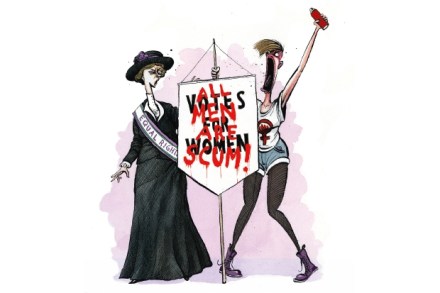
Irony alert: 'rabid feminists' want themselves removed from the Oxford English Dictionary

As if to make a massive display of their dearth of self-awareness, Twitter feminists have spent the past few days nagging the Oxford English Dictionary over its definition of the word ‘nagging’. They have also rabidly denounced its definition of ‘rabid’. And they have deployed shrill lingo to slam its definition of ‘shrill’. To nag a dictionary in a shrill and rabid way over its entries for ‘shrill’, ‘rabid’ and ‘nag’ suggests feminists’ irony deficiency has reached life-threatening levels. Or maybe they’re having a cosmic laugh. Never have I been more tempted to view the new, media-led feminism as a Chris Morris-style send-up of buzz-killing liberals than I have while reading

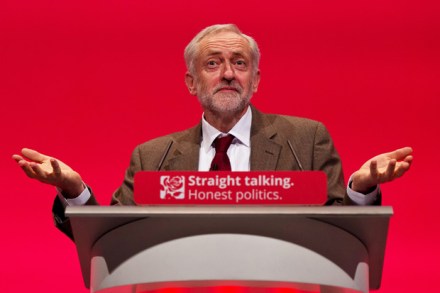
Corbynglish as a second language: a political dictionary of terms

Corbynterpretation [n]: The inevitable process of debate, after Jeremy Corbyn is interviewed, over what he actually meant. Does the Labour leader believe the killing of Osama bin Laden was a tragedy, or not believe this? Would he like Britain to negotiate with Daesh or would he be opposed to that happening? Would he, or would he not, abandon the Falkland Islands? As in, ‘Well, that’s a matter of Corbynterpretation’ or, ‘No, no, those remarks have been totally misCorbynterpreted.’ In order to Corbynterpret [v] one must first consider 1. Whether the Labour leader brought up the disputed view himself (invariably not) 2. Whether the Labour leader clearly said ‘yes’ after somebody

Chattering classes

When the much missed Frank Johnson (1943–2006), once editor of The Spectator, wrote in 1980 that ‘the peculiar need for something to be frightened about only seems to affect those of us who are part of the chattering classes’, I think that ‘those of us’ meant himself, and me and you, dear reader. It is true that, as the Oxford English Dictionary remarks, the phrase was ‘freq. derogatory’ of ‘a social group freely given to the articulate, self-assured expression of (esp. liberal) opinions about society, culture, and current events’. But between the establishment of the literati (in John Evelyn’s day) and the unexpected development of the twitterati (in our own),

Why 'safe' is Dot Wordsworth's word of the year

‘Makes me feel sick,’ said my husband, referring not to the third mince pie of the morning (in Advent, supposedly a penitential time of preparation), nor to accepting a glass of champagne after having earlier accepted a glass of whisky at another house. No, what made him feel sick was the seasonal greeting: ‘God bless, and be safe.’ For once, I agreed with him. It was bad enough to be exhorted to drive safely or even stay safe during periods when terrorists had eased off a bit (after peak IRA, but before 2001). But now, with a fashion for shooting civilians in unexpected places, to be told to be safe