Labour party

Brotherly love | 22 July 2010

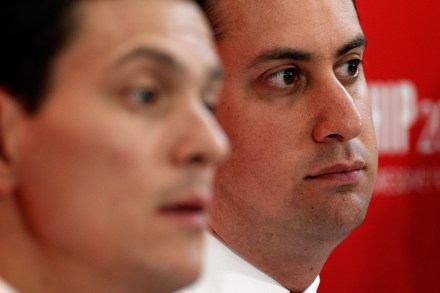
Ed Miliband will give his second preference vote in the Labour leadership contender to his brother, he tells the New Statesman’s Jason Cowley.   The Ed Miliband interview is part of a really rich set of profiles of the Labour leadership candidates. Diane Abbott inadvertently reveals that it is David Miliband who is taking the duties of a future Labour leader most seriously with her complaint that he is the leadership candidate who insisted on a meeting to find out what the duties of the victorious candidate would be at conference.    Both Eds offer quite left-wing prospectuses. Ed Balls argues that Labour didn’t lose because it lost touch with

Abbott’s radio silence

Anne McElvoy’s report for the Today Programme on the Labour leadership this morning is well worth listening to. It featured all the usual suspect and some classic moments—Tessa Jowell damming Ed Miliband with faint praise and Ed Balls’ henchmen Charlie Whelan going out of his way to praise Andy Burnham—but the really memorable bit came when McElvoy asked Abbott about her decision to send her son to private school. As with her infamous interview with Andrew Neil, Abbott simply refused to answer. There was just a period of dead air. Abbott’s refusal to answer this question, a not unreasonable one, is even more bizarre when you consider that at a

Will the Lib Dems Become the Stupid Party?

Frailty, thy name is coalition. Right? That still seems to be what many people think. Take Simon Heffer’s column today, for instance in which he concludes: Whoever wins – and, at the hustings, the benign mood towards Miliband E is at the moment palpable, precisely because of his low profile during the Brown terror – it will signal a proper re-engagement of political battle, the end of the Government’s extended honeymoon, and the presentation of the first real challenges to the Coalition. The planned constitutional reforms will be the stumbling block for the Government, and should be the new leader’s prime target, even more than the economic strictures. After all,

The SNP was responsible, all the way

A little odd, and certainly inconvenient, that al-Megrahi still lives and breathes. Then again, Scotland’s a notoriously unhealthy place and a bit of desert air probably did him some good. Ensconced in Washington, David Cameron will have taken some flak for the Lockerbie bomber’s compassionate release, for which he has the perfect riposte: terrible business, but nothing to do with me. His second line of defence is constitutionally watertight: the decision was Holyrood’s alone. The Lockerbie Papers suggest that al-Megrahi’s inclusion in a Prisoner Transfer Agreement was a precondition of any deal between the UK and Libyan governments, as Saif al-Islam Gadaffi maintains. That PTA overrode Scottish jurisdiction; the SNP

Growing opposition to the alternative vote

The indispensible Anthony Wells has news of the latest You Gov poll. Voting intentions are by the way at this stage of the parliament, but the Tory lead holds at 7 points on 42 percent. Of far more interest is the narrowing gap of those in favour of the alternative vote. As Anthony notes: ‘Up until now it has shown a pretty consistent lead for AV of around about 10 points, in last night’s figures referendum voting intention had narrowed to AV 39%, FPTP 38%. Very, very early days of course and there is no reason to think polling this far out has any predictive power, but the initial lead

Gove kills two birds with one stone

Michael Gove may be a pip-squeak but he has an imperious voice and that formidable quality of both sounding and being enormously clever. With a faint note of arrogance, he bossed a potentially difficult interview on the Today programme this morning. Tired of defending himself against Ed Balls’ dishonest maxim that what’s good for bureaucratic process is good for children, Gove changed tactics. He described his bill as a ‘permissive piece of legislation’ and linked it directly to the Blair-Adonis Academy reforms, which were frustrated by a regressive coalition wedded to the educational status quo. Gove emphasised that the cuts to the school building fund (drawn up by Balls in

Right-on Mandelson

We’ve reached the Mandelson overload zone, but he makes one vital observation in an interview with Matthew Norman: ‘We drove them (the Tories) further and further to the Right, and Cameron is driving us ever more to the Left. You only win general elections from the centre and we’re sleepwalking into a trap. We need to wake up. There’s still a little time for a leader to emerge from the pack.’ The Labour leadership election was always going to be determined by the left wing of the party and the unions. The assumption was that David Miliband would campaign from the right, but even he favours a permanent 50 percent

Who still believes in Peter the Great?

Asks Jeff Randall in a pugnacious column for the Telegraph. The memoirs, Randall argues, have finally exposed the conceit that Mandelson was a tactical genius. Randall says that Mandelson was a devious and divisive backroom spinner. Well, he ain’t the Prince of Darkness for nothing. But Mandelson’s career and political persona were fashioned in a bygone era. Today, ambitious homosexuals climb the greasy pole out in the open – both in terms of their careers and their sexuality, (David Laws was an exception in the latter case). Mandelson’s modus operandi was determined by the conclusion that the 1980s were not an era for gays in politics, whether preening or discreet.

Clegg and the coming of liberal conservatism

Nick Clegg is a liberal, and just in case you’d forgotten that fact he gave a speech today in which the word features some 64 times.  As it was made at the think-tank Demos, it’s a touch more wonkish than his recent efforts on cutting back the state – but still worth a read for those who want a general sense of how the coalition sees itself. The main purpose of the speech is, I suspect, political.  It says, to any of Clegg’s sceptical colleagues, that the government’s agenda is liberal, liberal, liberal all the way.  From cutting state spending to Michael Gove’s schools reforms, the goal is to “disperse

The Balls deterrent

There have been many interviews with Peter Mandelson this week, but I don’t think any of them have got as much out of him as Patrick Wintour has in today’s Guardian: ‘For he is quite clear in the interview that Labour would be probably be in power now if it had been possible for Brown to be replaced by a consensual alternative. “If you really force me, I think probably it would make a 20 to 30 seat difference to the result. They would have gone to 280 and we would have gone up to 270. They probably would have been the largest party, but not by a decisive margin.”

Governments’ wasteful ways

It was inevitable that the government’s re-organisation of NHS management would incur a large upfront cost, but I didn’t expect quite such a large figure. £1.7bn has been siphoned off to pay for the re-structuring of NHS commissioning, seven times more than the planned target for management cuts according to the BBC. This is a godsend for the opposition, obviously. Insulating the NHS budget from cuts may have been a political masterstroke in 2007, and ‘I will cut the deficit, not the NHS’ may have been a sharp election slogan. But it is idiotic to ringfence the NHS simply to re-arrange the bureaucratic furniture and destabilise the system. We’ve been

Ed Miliband pitches for social responsibility

Reading Ed Miliband’s piece in today’s Times on how Labour can win back southern voters, I was struck by this section: ‘We need to be clear that part of the job of social democratic politics is to conserve those things in society that free-market Conservatism would destroy. Our communities are too precious to be dictated to by markets. Take the example of how our towns have changed. If you travel through the market towns of the South, too often you find them dominated by late-night bars, clubs and betting shops, even when local people want a more friendly place to live.’ Ed Miliband has made this kind of argument before,

The unions start to swing behind Ed Miliband

Bear with me, CoffeeHousers, while I return to the Labour leadership contest. You see, the GMB has this afternoon announced that it is backing Ed Miliband for the job – which is a fairly significant intervention. This is first endorsement from one of the major trade unions, and it overshadows the support that David Miliband has received from lower league organisations. The question now is whether Unite and Unison will follow GMB’s lead. Many expect that they will. The influence of the unions in internal Labour elections has, in the past, been overstated. But there’s reason to believe that they’ll wield quite some power over this contest.  As Medhi Hasan

McFadden talks sense

Pat McFadden, the sullen-looking Shadow Business Secretary, has given an important speech to the Fabian Society. He said: ‘Fight the cuts is a tempting slogan in opposition, and there are indeed some that must be fought. But if that is all we are saying the conclusion will be drawn that we are wishing the problem away.’ He is the first shadow minister to recognise that Labour’s current approach is counter-productive, and Ed Balls’ philosophy is suicidal. He notes: ‘In fact, that is the position the Tories and the Lib Dems would prefer us to adopt. They want Labour to retreat to its comfort zone and allow them to say that

Labour still don’t get it

As Pete asked at the weekend, will Labour ever start love-bombing the Lib Dems? Ed Miliband has mumbled that he wouldn’t oppose a possible Lib-Lab coalition, but that’s about it. According to the irreproachable Lord Mandelson, David Miliband and Ed Balls were opposed to a coalition and presumably remain so. Labour has greeted the government’s Liberal Democrats with jeers and contempt, particularly over the VAT rise, which passed last night without amendment. Now, John Denham, an arch-pluralist who has long dreamt of forming a ‘progressive coalition’, has told the Fabian Review that Nick Clegg would be the price of any Lib-Lab coalition. Only Mandelson seems to have grasped the brilliance

Balls clutches at straws

Many CoffeeHousers will have heard Ed Balls’ preposterous performance on the Today programme this morning. We have transcribed it below, to put it on the record. Three things jump out at me. The way that Balls is the last purveyor of Brownies, still talking about new jobs when all of the new jobs can be accounted for by immigration. Next, the way he airbrushes his record to strip out all the disasters. It was the Balls-Brown economic model which rigged the Bank of England so it would keep rates artificially low, flooding the economy with dangerously underpriced debt and putting not just the government but the whole economy on a

Would Britain buy Balls?

Asks Iain Martin, and I suspect he’s back in Rentoul territory. It is, nonetheless, a question that merits more than a cursory no in reply. For all his egregiousness, you know where Balls stands: in the crude but distinctive colours of the old left. He is convinced that any approach to spending cuts other than his own will precipitate a double-dip recession. As Iain puts it: ‘Balls is also calculating that the second half of a double-dip recession is on the way and is staking out ground on which he can be the one to proclaim to the country: I told you so.’   In terms of Britain’s economic debate,

Still spinning

According to the Spectator’s literary editor, Peter Mandelson wrote the most boring book review ever published by the Spectator. I imagine he did. You don’t read the Mandelson memoir; you wade through it in leaking gum boots. The lack of illumination is nothing compared to the faceless prose. Mandelson cannot evoke the personality of Alan Clark’s or Chris Mullin’s diaries. Form is crucial in that memoirs justify and diaries observe. Clark’s love of Mrs Thatcher and his self-importance match Mandelson’s love of Blair and his preening conceit that there was a ‘Third Man’ at the heart of New Labour’s tenure in office – Mandelson spent most of it in exile.

Tony Blair, everywhere

To be honest, these Mandelson memoirs are already losing their lustre. I was planning to do a summary of this morning’s revelations, as yesterday – but swiftly lost the will. It’s not that this first draft of New Labour’s history is unappreciated, of course. But so much of it is just plain unsurprising: ministers thought Labour was cruising for an electoral kicking; Alistair Darling proposed a VAT hike; David Miliband was considering running for the leadership in 2008; and so on and so on. Sadly, it’s not quite enough to enliven this grey morning in Westminster. One general observation does emerge from the latest extracts, though: the omnipresence of Tony

Ed Balls is now a caricature of Ed Balls

Meanwhile, in other Labour news, Ed Balls has just jumped into the deep end without any armbands.  Speaking to the BBC this lunchtime, everyone’s favourite Labour leadership candidate said that he didn’t – and doesn’t – approve of Labour’s plan to cut the deficit in half “through spending cuts.”  As if to underline the point, he added that he’s reluctant to identify cuts until after “this huge risky experiment has been tried on our economy by the Conservatives and the Liberals”.  So he’s got the fiscal insanity and anti-Clegg positions nailed, then. Coupled with Balls’ grandstanding on schools cuts, there’s a gruesome possibility that this rhetoric could boost his appeal