Labour party

Clegg stands up for deficit reduction

From our UK edition

Cleggologists will mark down the Deputy PM's speech today as a typical effort. There was basically nothing in it that was new – but Clegg still put it across with more punch, and more persuasively, than most of his colleagues could manage. All of the slogans and pre-announced policies added up to something that sounded, fleetingly, like a plan for growth. Although we'll still have to wait for Vince Cable's review to see the outlines of that plan shaded in. Clegg's main point was straightforward enough: that the government has to, and will, go beyond deficit reduction to stoke the embers of the British economy. He then ranged across everything from the national infrastructure to – a theme of this week – endowing the British workforce with skills.

Miliband angles for the youth vote

From our UK edition

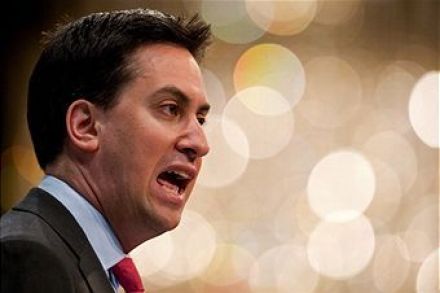
For those who don't have the inclination to delve behind the paywall, Ed Miliband's interview with the Times can be summarised in four words: think of the children. Yep, the Labour leader is out a-courting the youth vote – and who, really, can blame him? The recent student protests have made Westminster's strategists realise that these people aren't apolitical after all. It was inevitable that someone would try to reach out to them. The problem for Miliband is that he doesn't really have a prospectus to offer. He rattles off three familiar policies – a graduate tax (of uncertain design, and even more uncertain worth), votes at 16, more apprenticeships – but concentrates on simply attacking what the government is doing.

Labour’s gravest military blunder

From our UK edition

Labour is often seen as having presided over the erosion of the British military, squandering money on Cold War equipment and sending under-equipped soldiers to far-away battlefields. But away from the public's scrutiny an even greater lapse occurred - the nation's cyberdefences were left undermanned while the threat grew daily. As William Hague will tell the Munich Security Conference: "Along with its numerous benefits, cyberspace has created new means of repression, enabling undemocratic governments to violate the human rights of their citizens. It has opened up new channels for hostile governments to probe our defences and attempt to steal our confidential information or intellectual property. It has promoted fears of future ‘cyber war’.

A new golden rule

From our UK edition

The last few days have given us enough evidence for a new economic rule: the better the news about the economy, the less we'll see of Ed Balls. As Tim Montgomerie notes over at ConservativeHome, the shadow chancellor was plastered right across the airwaves when last week's growth figures were announced. This week – when the economic omens have been more encouraging – not so much. On Tuesday, as Fraser blogged, we had a record rise in manufacturing activity. Yesterday, there were heartening figures for the construction sector. And, today, the services sector has followed suit, with its strongest showing for eight months. Here's the graph for all three: Sterling has soared on today's news.

PMQs live blog | 2 February 2011

From our UK edition

VERDICT: What a refreshing change that was. After several weeks of Punch 'n' Judy rivalry, the two party leaders finally put down their batons and stumbled upon a new way to do it. Much of the credit must go to Ed Miliband, for asking pacific questions about Egypt and Afghanistan in the first place. But credit, also, to Cameron, for answering them in a straightforward and statesmanlike manner. The rest of the House, for its part, was stunned into silence by this peculiar scene. Some of the blood rushed back into proceedings with the backbench questions, and as Cameron directed attacks at Ed Balls, but this must still go down as the most decourous PMQs in recent memory. Less spice, more meat – not a bad trade-off in this case.  1231: And that's it.

IFS say Labour’s policy would mean higher interest rates

From our UK edition

From the start of the financial crisis, the Conservatives have argued that when a country¹s finances are in a mess, the best way to manage demand is through monetary activism and fiscal responsibility. Going into this crisis, Britain¹s finances were indeed in a mess. We had the biggest structural deficit among major developed economies (according to the IMF, OECD, oh, and Alistair Darling). To claim there was no structural deficit is to oppose the truth. The principles of monetary activism and fiscal responsibility underpin the approach to the recovery too. By dealing with the fiscal mess, we can keep interest rates lower for longer, and avoid the sorts of financial meltdown seen in Ireland and elsewhere.

All across the political spectrum

From our UK edition

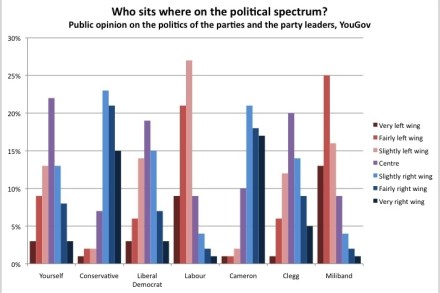
Yesterday's polls may seem like yesterday's news – but it's actually worth returning to YouGov's effort from, erm, yesterday. It contained some distinctive questions, and results, all set around the left-right spectrum. How left wing is the Labour party? How right wing is David Cameron? That sort of thing. Of course, as Anthony Wells has already pointed out, the old labels of "left" and "right" are of decreasing relevance nowadays. But they do still tell us something about popular perceptions of the parties and their leaders.

Wheeling and dealing over the AV bill

From our UK edition

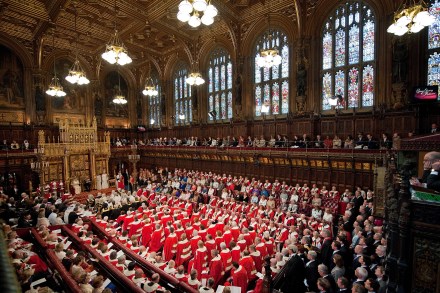
If the AV referendum is to take place on the 5th of May, the legislation paving the way for it needs to have passed by the 16th of February. But this bill is currently being held up in the Lords where Labour peers are objecting to the ‘Tory part’ of the bill which reduces the number of MPs and equalises constituency sizes. The coalition does not have a majority in the Lords, so all the talk of simply ramming the bill through was always slightly unrealistic. But the coalition’s concession that there can be public inquiries into the boundary review has created an expectation that Labour might now drop its opposition. The cross benches, the swing group in the Lords, have been impressed by this concession.

The coalition feels the squeeze

From our UK edition

The Institute for Fiscal Studies are out prowling the airwaves again, and they bring happy and unhappy tidings for the coalition. On the happier side, at least presentationally speaking, is their assessment that, "those being hit the very hardest [by tax and benefit changes] are those on [a] higher level of earnings" – just as Cameron and Clegg suggest. But far less marketable is the IFS's claim that 750,000 people will be pulled into the 40 per cent rate of tax as a result of the threshold being reduced from £37,400 to £35,001 this April.   To be fair to the government, they have at least been upfront about this tax change.

Ed Balls won’t answer the important questions

From our UK edition

So Ed Balls has made his decision. In articles and a TV interview today, he has decided that, instead of apologising for his part in bringing Britain to the state it's in today, he will deny what he did. It was the consensus that Britain had the biggest deficit in the G7 going into the crisis, because that's what the facts show. Contrary to Balls' assertions, Britain ran a structural deficit for the seven years running up to the crisis – the figures are right there in Labour's own Budget red books. And it's the consensus that Labour left the biggest deficit since the war, since it's a fact. Given Balls' role in creating these two disasters, he should try owning up, not covering up.

Ten points about the Ed Balls interview

From our UK edition

Ed Balls gets personal in his interview with the Times (£) today, but not in the way you might expect. For most of the piece he dwells on what the paper calls his "hidden vulnerability" – the effort to contain his stammer. And from there on, the politics seems a touch softer than usual. There are surprisingly few overt attacks on his opponents, and those that make the cut are considerably less violent that we're used too. Which isn't to say that the interview lacks politics. No sirree. Here's a ten-point selection of some of the political highlights (so to speak), with my added comments:      1) Doubling back on a double dip.

Poll catch-up

From our UK edition

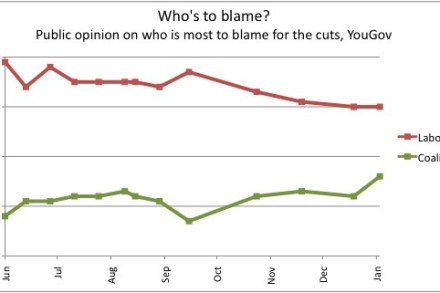
Other sites have already covered this week's opinion poll results, among them Labour's largest lead since September 2007 and the public's confusion over the Big Society. But there are a couple of findings that are worth dwelling on as we drift into the weekend: 1) Labour gaining ground in the blame game. Ok, so PoliticalBetting's Mike Smithson mentioned this a few days ago. But, here at Coffee House, we've translated the numbers into the graph below. It shows that, over recent YouGov polls, Labour have been slowly receiving less and less blame for the spending cuts, while the coalition are receiving more: Expected, perhaps – but still noteworthy, not least because of the obvious political implications. 2) Deficit deniers?

Nimrod: from a symbol of pride to one of decline

From our UK edition

There are contrasting images of Nimrod the Hunter: the mighty king of the Old Testament, and the less fearsome figure of Elmer Fudd. Through no fault of its own, the Nimrod spy plane, the most advanced and versatile aircraft of its type, seems destined to belong in the Fuddian category. Several senior officers have written to the Telegraph, urging the government to reconsider its decision to scrap the aircraft. They argue, not for the first time, that Britain’s defence capabilities are being pulverised by political calculations. (Con Coghlin adds his strategic concerns in the same paper.) The top brass have found an ally in Unite, some of whose members build and maintain the aircraft for a living.

The Lib Dems reject Ed Miliband’s overtures (again)

From our UK edition

What a joy it is to watch Ed Miliband contort and twist so that he can offer a hand of friendship to the Lib Dems. It has been a three-act show, so far. First, during the Labour leadership contest, he described the Lib Dems as a "disgrace to the traditions of liberalism," adding that, "I can see the death of the Liberal party to be honest". Then, he said that he would actually work with those dying Liberals, but only if they ditched Nick Clegg first. And then today, in an interview with the Independent, he suggests that Clegg might be able to stay on, after all. As turnarounds go, this one is predictable and sensible - but it's no less amusing for that. The Lib Dem response has once again come from Tim Farron; almost certainly for the same reasons as before.

PMQs live blog | 26 January 2011

From our UK edition

VERDICT: Ed Miliband had it all, going into today's PMQs: weak growth figures, the uncertain demise of control orders, rising youth unemployment, and more. And yet, somehow, he let most of it go to waste. Barely any of his attacks stuck – or, for that matter, stick in the mind – and Cameron rebuffed them with surprising ease. It helped that the Prime Minister seemed more comprehensively briefed than usual, with a decent compliment of statistics, and one or two sharp lines, at his disposal. (Although, measuring by the Labour cheers, I doubt he will thank Jacob Rees-Mogg for invoking Thatcher immediately after his exchange with the Labour leader.) In the end, a victory for Cameron – although that won't defuse the issues that Miliband should have detonated.

From control to surveillance

From our UK edition

Like husband, like wife. Yvette Cooper has begun shadowing Theresa May where Ed Balls stopped: by lacerating Nick Clegg’s naïveté in believing that control orders should be abolished. There is a faint note of animus in her politicking too. ‘National security,’ she said, ‘should not be about keeping Nick Clegg safe in his job.’ The government invited Cooper's charge with its own crass political calculation. Spinning the new measures as a Liberal Democrat victory could only elicit that response from an opposition that is intent on exploiting the government’s broad weakness on law and order. In fact, as Lord West has remarked, the government has not even come close to rescinding the substance of New Labour's control orders.

Brown takes the opportunity to peddle his “global growth plan”

From our UK edition

As Iain Martin and Guido have noted, Ed Balls – and, for that matter, Ed Miliband – could probably have done without Gordon Brown hovering from the political graveyard to cast judgement on today's growth figures. But hover he has, as the above video of his appearance on CNBC News testifies. It's almost as though he wants to remind people that his spirit lives on in Labour's rearranged top team. As for the content of his interview, it was stodgy mix of the arguments in his recent book and the attacks that Balls was making earlier. "Europe and America, but particularly Europe," he said, "are now implementing policies that are more reminiscent of the 1930s, than reminiscent of the lessons we should have learnt from previous decades.

Ed Balls is Having a Good Day

From our UK edition

Well, the government would have done better to read Fraser's response to the fall in GDP before they went and blamed much of the 0.5% decrease on the inclement weather. Cue "Wrong kind of snow" jokes everywhere. And, frankly, Tories would be laughing all the way to the nearest TV studio had Gordon Brown ever suggested something similar. Better, surely, to agree that the figures are disappointing but stress that they are the first and therefore somewhat provisional numbers that may well be revised in due course. Not a great line to sell but some days you take a beating and just make things worse by trying to wriggle out of it. But what this shows, I think, is how Labour have benefited from Mrs Alan Johnson's adventures.

Ed Balls: I don’t think a double dip is the most likely outcome

From our UK edition

And this, folks, is a day where Ed Balls is having his cake and eating it too. Not only is he basking in the grim light of the growth figures, but he is using the opportunity to recast his own stance on the economy. Speaking on the Daily Politics just now, he de-emphasised the argument that in-year cuts were to blame for today's numbers, instead claiming that people have "changed their behaviour in anticipation of what's coming in the future." And, more ear-catching still, he added: "I don't think [a double dip] is the most likely outcome." This, as Fraser suggested earlier, is surely necessary caution on Balls's part. He can't go too far with the dread warnings, lest the economy pick up again next quarter.

What to make of the GDP fall?

From our UK edition

"Recession here we come, a snow-dabbed double-dip" tweeted Faisal Islam, Channel Four's economics editor. He summed up much of the hysterical reaction. It may spoil a good story, but here is what I suspect the broadcasters won't tell you today. 1. Erratic GDP swings are common when recovering from a recession. Remember how stunned everyone was with the surging quarter three data? Now, we're all shocked by plunging quarter four figures. I'd advise CoffeeHousers to treat these two imposters just the same. After the 80s recession, quarterly growth rates swung between -0.7 percent and 1.5 percent. Following the ERM-induced recession in the 90s, growth rates swung between -0.2 percent and 0.5 percent. A swallow does not make a summer.