Labour party

British jobs for whom? | 28 August 2011

From our UK edition

“More than 400,000 people have been out of work for more than two years, according to analysis of the latest Government data by think tank IPPR.” So runs its press release today, trailed in the Sunday press and the wires. I hope the IPPR didn’t spend too much of their donors’ money on this research, as the figure is updated quarterly and freely available from the DWP website (click here). Add up only three categories: lone parents, jobseekers allowance and incapacity benefit the figure stands at 2.4 million, certainly “more than 400,000”. Worse, at the peak of the boom (Feb07), this figure was even higher at 2.5 million. And yes, it’s a real problem. As the IPPR goes on to say, unemployment is self-reinforcing.

Labour’s new attack strategy: Cameron’s a right-winger

From our UK edition

The Observer has a cracking scoop: a brief document detailing a new Labour plan to attack Cameron. The memo has been written by Shaun Woodward, the former Tory MP and Labour cabinet minister who now heads Labour’s anti-Tory unit. He will report to the shadow cabinet in the next few weeks. He says: ‘At the last election we faced a Conservative party (and a Conservative leader in David Cameron) whose strategic goal was to decontaminate their brand, intending to present themselves as reformed, modern, centrist and pragmatic. Cameron was effective in promoting a perception [that] his party had changed.

Osborne’s crusade

From our UK edition

‘Tax evasion is morally repugnant. It's stealing from law-abiding people who face higher taxes to make good the lost revenue. Those who evade taxes, like benefit cheats, are leeches on society. And my message to those who try to hide their incomes from the Revenue in offshore bank accounts and false declarations is simple: we will find you and your money.’ That was written by George Osborne in today’s Observer. He promises that the deal with Switzerland is “just the start” of his campaign to close tax havens. The rest of the article then relates the coalition’s achievements at reducing tax avoidance by increasing charges on capital gains and non-domiciled taxpayers working in Britain.

From the archives: Cowards colluding with terrorists

From our UK edition

The Libyan National Transitional Council has obtained official recognition from numerous countries this week, but the African Union has refused to acknowledge it. Speaking earlier this afternoon, South African President Jacob Zuma said that ongoing fighting has created a “fluid” situation. The union also said that it wants “an all-inclusive transitional government” incorporating members of Colonel Gaddafi’s administration, which is a bizarre requirement given that so many of the NTC are former Gaddafi stooges: Chairman Jalil, for instance, was Libya's Justice Minister between 2007 and 2011.

Beating Labour’s education legacy

From our UK edition

If it is GCSE results day, there must be a row about government education policy. True to form, the NASUWT — a union whose role often appears to be to make the NUT look moderate by comparison — has come out with a comically hyperbolic statement accusing the coalition of a ‘betrayal of young people’ because of its decision to reform the educational maintenance allowance. What the NASUWT statement ignores is that the real betrayal of young people has been pushing them into doing courses and qualifications that condemn them to a life of low-skilled labour at best. Last year, only 16 per cent of pupils achieved a C or above in English, Maths, a foreign language, a science and one of history of geography.

The schools revolution in action

From our UK edition

Harris Academies, one of the best-known new chains of state secondaries, have today posted an  extraordinary set of results. It's worth studying because it shows how a change of management can transform education for pupils in deprived areas. Pour in money if you like, but the way a school is run is the key determinant. This is the idea behind City Academies, perhaps Labour's single best (and most rapidly-vindicated) policy. The notion is rejected by teaching unions, who loathe the idea that some teachers are better than others. Bad schools are kept bad by the idea that their performance is due to deeply-ingrained social problems, etc. Harris has produced a table showing the results of their schools when they were last run by the council, and this year's results.

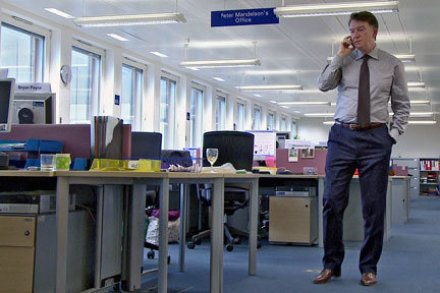
Mandelson and the Lib Dems’ dilemma

From our UK edition

The Prince of Darkness has made a rare foray into the light of public life. He uses an article in today's Times (£) to do a little waspish mischief about the coalition and the Liberal Democrats. He writes: ‘The Lib Dems are beginning to behave like an internal opposition. Staking out positions in the media, drawing public lines in the sand and making threatening noises when something is not to their liking is not the way to address their political problems of the past year. These led to their trouncing in the May elections and the AV referendum.

The riots, Whitehall and universality

From our UK edition

Away from the excitement of Libya and Colonel Gaddafi’s singular definition of ‘tactical retreat’, the post-riots debate continues. The government has announced that unemployed offenders will have to work a minimum 28 hours in their communities for four days per week and spend a fifth day looking for a job. This is part of the plan to bolster the Community Payback Scheme, signalled by Nick Clegg last week. Crispin Blunt, the prisons minister, has described the riots as a “one-off” and said it was vital that community sentences were sufficiently firm and constructive to “break the cycle of crime and encourage a law-abiding life.

EXCLUSIVE: IDS on British jobs

From our UK edition

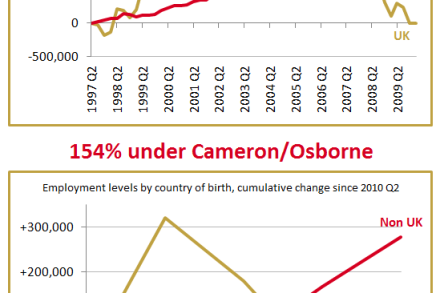
Last week, George Osborne boasted that Britain has the second-fastest job creation in the G7. In tomorrow's Spectator, we disclose official figures showing that 154 per cent of the employment increase can be accounted for by foreign-born workers. We on Coffee House have often questioned Labour's record: 99.9 per cent of the rise in employment was accounted for by foreign-born workers. The graphs for the Labour years and the coalition year are below:     The idea of 154 per cent is strange, so I will reproduce the raw figures below:     Now, no one outside Westminster expects the UK labour market to change the day a new government is elected, but what matters is that the problem still exists.

Gove versus Harman

From our UK edition

The Guardian's Nick Watt already has a detailed and insightful post on last night's Newsnight bout between Michael Gove and Harriet Harman.

The politics of police cuts

From our UK edition

Wow, that was a howitzer of a performance from Boris Johnson on the Today Progamme earlier. And all his shells were aimed at Downing St. Not only did the Mayor of London slander Cameron’s Broken Society thesis, not only did he support Diane Abbott against the jibes of Tory HQ, but he also committed the gravest act of all, given the current climate. He lined up with Labour in attacking the coalition's police cuts. "This is not a time to think about making substantial cuts in police numbers," said BoJo. "I think it would be a good thing if the government had another look," he added, for emphasis.  There's little doubt that Boris has hit upon a potent attack here.

The politics of our discontent

From our UK edition

Even by the normal standards of Monday mornings, this one reeks. Just sniff around you. That burning smell, it's either coming from the global stock markets as they strain against the US downgrade, or from those places in London where the rioting spread last night. Although the destruction in Brixton, Enfield, Walthamstow and Waltham Forest didn't match up to that on Saturday in Tottenham, it still involved fires, missiles and clashes between rioters and the police. Reading the reports and watching the footage online, looting appears to have been one of the most popular sports of the evening. In terms of the short-term politics — as opposed to the slightly more medium-term politics of what can be done to properly fix these problems — two issues stand out.

Ed Miliband needs David Miliband if he’s to make proper headway

From our UK edition

Are the seeping knife wounds healing at last? This morning's Guardian reveals that Ed Miliband has offered his older brother a role as Labour's "unofficial ambassador on university and college campuses", and that David Miliband has accepted. Although party sources tell the paper that "this should not be seen as a sign that [MiliD] is being lined up for an early shadow cabinet return," it surely is a sign that the two brothers are repairing their damaged relationship. From barely speaking to each other to mutually preaching the Labour gospel to a bunch of students. It's progress.   Putting aside the fraternal aspects of the story, it is also an encouraging political development for Ed Miliband.

Universally speaking

From our UK edition

As Paul Waugh notes, James Purnell's article for the Times today (£) is striking for its attack on universal benefits. "I have never bought the argument," writes the former welfare secretary, "that universal benefits bind the middle classes in. It feels too much like taxing with one hand to give back with another." Although this is, in truth, a point that he has been making for some time. He said something similar in a speech back in April. The question, really, is how much Purnell's viewpoint will percolate down through Labour circles.

Lansley’s letter pours fuel on Labour’s bonfire

From our UK edition

Just when everyone is all afroth about the murky connections between the political class and the media, a letter by Andrew Lansley to Danny Alexander has mysteriously leaked to the Telegraph. It was sent two months ago, and it concerns the government's public sector pension proposals. For five pages, Lansley riffs on about why the reforms may not be such a good idea, particularly when it comes to NHS workers. "We face a real risk, if we push too hard," he says, "of industrial action involving staff groups delivering key public services." He suggests that lower and higher paid staff may just opt-out of the pensions scheme altogether, leaving the Exchequer with "reduced receipts in the short term while still having to pay for past pension promises.

Osborne’s summer of pain starts here

From our UK edition

It has mostly been a weekend of terrible and grisly news, especially with the details emerging from Norway about Anders Behring Breivik and his murderous brand of politics. But there was also, behind it all, a slight rebalancing of the British political debate. After weeks of grandmaster-like focus on the phone hacking scandal, our politicians have started talking about the economy again. With the GDP growth figures for the second quarter of this year due out tomorrow, they're all trying to get their spin in early.

Fiona Millar to the Commons…

From our UK edition

Richard Kay’s column in the Mail contains the news, as expected, that Fiona Millar (AKA Mrs Alistair Campbell) is a shoo-in to replace Glenda Jackson as Labour’s candidate for the Hampstead and Kilburn constituency. The seat is very marginal: Jackson scraped in by just 42 votes last time round. But, if Millar were to win the nomination and subsequent election, she’s being tipped for immediate promotion. Kay reports that a ‘senior party figure’ told him that Millar would become Education Secretary ‘within a year’, assuming Labour was in government.

The (non-)effect of Hackgate

From our UK edition

No Labour bounce, no drop in approval for Cameron or his government. That's the impact that two weeks of front pages dominated by the phone hacking scandal on the opinion polls:  Ed Miliband's numbers have improved, which will come as some relief to the Labour leader who suffered a terrible month of polls in June. But despite a 13 point jump in the last fortnight, his net approval rating has only recovered to where it was six weeks ago, and that was hardly a rosy position. Certainly, Ed's response to the scandal seems to have reflected well on him. 49 per cent of the public think he's handled the affair well, compared to 36 and 33 for Cameron and Clegg respectively. Perhaps most strikingly, even Tory supporters think he's done well, by 44 per cent to 35.

Kinnock’s Return!

From our UK edition

Given how roughly he was treated by the press it's not a surprise that Neil Kinnock still thirsts for revenge against tormentors. On the other hand, his appearance on the Today programme this morning when he called for the free press to be suppressed or otherwise outlawed demonstrated that, actually, the press was right to monster him all thos eyears ago. Bagehot says all that needs to be said about Kinnock's ideas which can best be categorised as looopy when they're not sinister and vice versa. This, however, was a truly remarkable statement: What [the rules] require is balance and I think that is all that anyone would possibly ask for in terms of freedom of expression… if we could have a balanced press without any form of public responsibility, that would be wonderful.