Labour party

The Blair-Brown wars continue

It took the Tory party 15 years to recover from the bad blood created by Margaret Thatcher’s forced resignation. So it is, perhaps, unsurprising that five years on, the bitterness from Tony Blair’s being pushed out of office has not yet subsided. Phil Collins, who was a speechwriter to Blair, has today written a scathing piece about Tom Watson, the leader of the so-called curry house coup against Blair. Collins accuses Watson of putting the ‘occupation of internal power’ in the party by his faction above the interests of the Labour party. Watson, who is Labour’s election campaigns coordinator, exerts a huge influence over Labour’s internal processes and candidate selection,

Even Labour is giving up on Ken

Three weeks till polling day and Ken’s supporters are getting desperate. The increasingly poor handling of his tax affairs is pushing the mayoralty ever further from his grasp. Last night’s public debate didn’t produce the repeat of that heated lift incident that the crowd was hoping for. The only issue that provoked real anger was that of Ken’s tax affairs. When moderator Clive Anderson turned to Livingstone to ask about his tax arrangements, the crowd exploded with jeering and shouts of ‘champagne socialist’. Ken floundered, unable to brush off the attack. The latest polling from ComRes also suggests that Ken’s campaign is in serious trouble. Boris has now pushed forward

The resistance to elected mayors shows how badly they’re needed

The old political establishment in the cities is fighting back against the idea of city mayors. They know that a directly elected mayor threatens their traditional power base. As Jill Sherman reports in The Times today, ‘In Nottingham, the Labour council has put up posters around the city to demonstrate its opposition while the Labour group has sent newsletters to residents saying that a “Tory Extra Mayor” will cost £1 million.’ But it is not just Labour councils who are desperately trying to stop yes votes on May 3rd. Lib Dem-run Bristol City Council is also fiercely against the idea of a directly elected mayor. The reason there is so

Right to reply: UKIP won’t prevent a Tory majority

All the recent chatter about UKIP being a big obstacle to a Tory majority in 2015 would be funny if it weren’t so sad. I’m never sure whether those who bring it up really believe it, or whether they’re just desperate to scare their fellow Conservatives into not swinging too far to the supposedly soggy centre. Either way, it simply won’t wash. Basically, the British electorate, like most electorates in advanced democracies, is like one big bell-curve. Most voters like to think of themselves as somewhere in or towards the middle, although there is of course a tail to either side. In PR systems, this tail can be big enough

Has Osborne fully considered his transparency promise?

Will Osborne come to regret his new-found transparency zeal? This week’s saga from the London Mayoral candidates highlights how financial disclosures can not be all they seem. For Osborne to fulfil his promise, we need full details of not just income and tax returns, but also assets in which they are stakeholders and companies through which they work. Brian Paddick’s release is an excellent model to follow, as opposed to Ken Livingstone’s decision to release just a few summary figures. If Team Miliband happened to be on the ball, there is also a great opportunity to pip the government with a universal full disclosure. This would be following Osborne’s own

Transcript: Balls vs Alexander on tax credits

On the Today programme this morning, Ed Balls aired his criticisms of the government’s tax credit changes — which come in tomorrow. He was followed by Danny Alexander, who emphasised the £630 increase in the personal allowance and argued that the measures are necessary ‘to deal with Labour’s economic mess’ and to create a tax and benefit system ‘which encourages and incentivises work’. Here’s the full transcript of both interviews:   James Naughtie: Now, in every set of tax changes there are winners and losers and after today, the end of the tax year, people will be able to assess what the government’s changes to tax and benefits are going

Balls goes on the attack over tax credits

After all the commotion about various policies in last month’s Budget, the focus this morning has shifted to measures announced back in 2010. Why? Because they take effect tomorrow. So Ed Balls is taking the opportunity to hit the government hard on what he calls its ‘tax credit bombshell’ for those on middle and low incomes. Labour are pointing to figures from the IFS, which show that changes to child and working tax credits will outweigh the rise in the £630 personal allowance. In their Budget briefing a fortnight ago, the IFS calculated that the net effect of all the changes coming into force tomorrow would be an average loss

More poll woes for the coalition

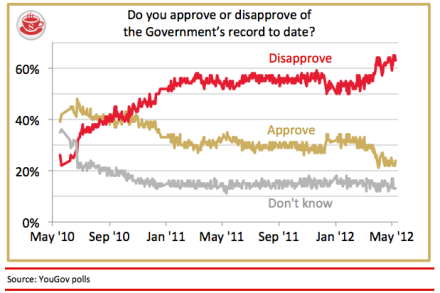
You certainly don’t need polls to tell you that it’s been a bad couple of weeks for the coalition – but we’ve got them anyway. Pete noted on Sunday that the government’s approval rating was at its lowest since the start of this Parliament, and it’s actually dropped another three points since. Today’s YouGov poll finds just 21 per cent giving the coalition the thumbs up, against 64 per cent who disapprove. That’s almost identical to the 20-64 split YouGov found for Gordon Brown’s Labour government back in January 2010. The below graph shows how public opinion has turned against the coalition over the past two years: Today’s poll also

Miliband talks tough

Remember when Ed Miliband couldn’t be found anywhere? Now you can barely get away from him. The Labour leader has been conspicuous by his presence over the past week, whether on the airwaves or in graffiti form (see left, a photo taken on London’s South Bank yesterday). And he’s continued that hi-vis trend today, by launching Labour’s local election campaign in Birmingham. Two things stand out from the speech he gave at that event. The first was his heavy emphasis on the pledges he announced last week: capping railway fares, unfreezing the personal allowance for pensioners, etc. As I blogged at the time, it’s doubtful whether these will actually achieve

Everyone’s a loser

Have the opinion polls ever looked more discouraging, overall, for the Tories during this government? Not that I can remember, although I’m happy to be corrected. Not only does YouGov’s poll for the Sunday Times (£) have Labour ahead by nine points, but there are also some pretty dismal supplementary findings. For YouGov, both David Cameron and the coalition score their lowest approval ratings since the start of this Parliament. For ComRes in the Independent on Sunday, 72 per cent of respondents reckon the government is ‘out of touch with ordinary voters’; 81 per cent say the government created ‘unnecessary panic’ over fuel; and so on. It’s probably no surprise

Lansley’s biscuit bill

If Andrew Lansley thought he could rest easy after passage of the Health Bill, then he’s in for a rude awakening. Yesterday, the shadow Cabinet Minister Jon Trickett busted Lansley’s department for spending £109,017 since January this year to supply its employees and visitors with free refreshments — aka, tea and biscuits. Naturally, Labour aren’t telling the whole story here. The amount being spent has declined under the coalition, from £194,000 for the equivalent period in 2010, to £137,000 in 2011, to that £109,017 figure now. But, still, it’s another classic example of waste during a time of austerity. Perhaps it’s no surprise that obesity is thought to cost the

The Tories shouldn’t gloat about Galloway’s victory

An unedifying week in politics keeps on getting worse. The Tories have this morning sent out a press release headlined ‘Warsi: If Labour can’t win in Bradford, how can they win a general election?’ The full quotation follows further on: ‘If Labour can’t win one of their safe seats in these tough economic times and in a tough week for the Government, how can they win anywhere? Not in half a century has an opposition come back from such an appalling result to win a majority at the next general election.   This tells you everything you need to know about Ed Miliband’s weak leadership.’ It’s characteristic of much of

The pressure is now back on Ed

This morning’s front pages are simply awful for the government: every single one is critical of Downing Street. But this morning everyone in Westminster is again talking about Labour and the pressure on Ed Miliband. The Bradford West by-election has, at least for the moment, changed the subject away from pasties and petrol. Bradford West was a sensational result. Galloway, the former Labour MP, increased the Respect vote by more than 17,000 votes. For Labour to lose a by-election now is a major blow. They seemed to have had no answer to Galloway’s demagogic, sectional campaign. It will be little consolation to them that the Tory vote also collapsed, their

George Galloway is an MP again

‘This represents the Bradford Spring!’ said George Galloway after triumphing in the Bradford West by-election last night. So, let’s get this straight: comparing his victory in one of the many fair elections held in this country each year to the dangerous and fragile struggle for democracy across the Arab world? Yep, that’s right — and it leaves a nasty, bitter tang in the air. But we shouldn’t be one bit surprised. Bluster, exaggeration and provocation are, after all, what Galloway does best. And now he will be able to do these things in Parliament for the first time since May 2010, when he was deposed from the Bethnal Green seat.

Byrne for Birmingham?

Ed Miliband’s shadow cabinet could soon lack a Liam Byrne. The shadow work and pensions secretary is expected to announce his intention to run for the position of Mayor of Birmingham — and he’d quit his frontbench job to do so. There is, of course, one significant ‘if’ hanging over his candidacy: it would depend on Birmingham voting in favour of having an elected mayor in their referendum on 3 May. But given the polls so far, it’s all looking quite likely. If Byrne does go, it would leave more than just a single role for Miliband to fill. He is not just the shadow work and pensions secretary, but

Davis takes the opportunity to strike

The fuel tanker strike is fast turning into a critical moment. The government, which has surprisingly few friends in the media, desperately needs something to move the story on from pasties and the politics of class. Cameron, also, has problems with his own side. On the World at One today David Davis, deliberately, hit Cameron where it hurts. He accused the Cabinet of looking like “they’re in a completely different world”. One thing that the post-Budget opinion polls have shown is just how shallow support for the coalition is: there’s still no sense of who Cameron’s people are. But I suspect that if this strike is beaten, then the Tories

Choice — easy to talk about, a slog to deliver

The birth of the White Paper on public service reform was a tortuous business — but, now it’s been out for several months, the government is keen to make the most of it. David Cameron is launching an ‘updated’ version today, with a few new proposals contained therein. He also has an article in the Telegraph outlining those ideas, including the one that seems to be getting the most attention: draft legislation to give people a ‘right to choose’ their public services. It feels like both an important and potentially inconsequential moment all at once. Enshrining choice in the laws of this land is a powerful symbol that people shouldn’t

The politics of pasties

The row over the so-called pasty tax is a proxy. It is really a row about whether David Cameron and George Osborne get what it is like to worry about the family budget each week.   In truth, I suspect that they don’t. But I think the same probably goes for Ed Miliband, Nick Clegg and the vast majority of journalists. Most of the politics of class in Westminster, as opposed to the country, is the narcissism of small difference.   The best thing the coalition could do now is hold its nerve. The Budget did reveal that support for it is shallow. But, as one leading pollster said to

Your guide to Osborne’s fiscal rules

George Osborne’s two fiscal rules have been around since his very first Budget, delivered almost two years ago, so they’re hardly news. But they do underpin much of what he’s done since, including last week’s statement, so they’re also worth knowing about. Fraser touched on ome of the detail in a post last weekend, but here’s a supplementary guide for CoffeeHousers: 1) The deficit rule. This is the one that seems to cause the most confusion, perhaps because it has often been simplified — wrongly — as something like ‘eliminate the deficit by the end of this Parliament’. Fact is, the ‘end of this Parliament’ doesn’t come into it. And as for ‘eliminating