John minton

A prolonged love affair: The Two Roberts, by Damian Barr, reviewed

For a time, Robert Colquhoun and Robert MacBryde were at the heart of the in-crowd. Stories of Francis Bacon, Lucian Freud and their wartime circle often make reference to the two young painters from Scotland. Feted in the 1940s for their modernist styles – Colquhoun typically portraying figures, MacBryde preferring still life scenes – they later lapsed into painful, drink-sodden obscurity. Damian Barr’s novel, The Two Roberts, is a tender and evocative act of resurrection. It portrays the men’s lives from the time of their first meeting as students at Glasgow School of Art to the moment in the mid-1950s when, penniless and out of fashion, they retreated to an

Lyrical and dreamlike: A World of Private Mystery – British Neo-Romantics, at the Fry Art Gallery, reviewed

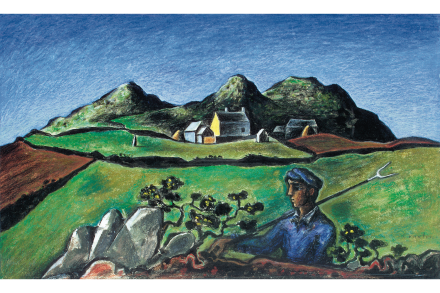
‘My daughter’s moving to Saffron Walden, away from all this,’ said the railway man at Stratford station, gesturing at the tower blocks overlooking the platform. ‘It’s like going back to the 1970s and ’80s.’ For the neo-romantics the pastoral mode was an escape from the grimness of everyday wartime reality Further back, in the case of Saffron Walden’s Fry Art Gallery. Purpose-built by a Victorian banker to house his collection, this gem of a gallery has since been devoted to collecting and showing artists who have lived and worked in north-west Essex, beginning with the group that congregated around Edward Bawden and Eric Ravilious in Great Bardfield from the 1930s.

Alive with innovation: British art between the world wars

When I mentioned the subject of this book to someone reasonably well-informed about 20th-century British art, the response was: ‘Isn’t that all portrait and still-life paintings?’ Well, perhaps if you’re looking exclusively at the contents of the Royal Academy Summer Exhibitions – and even there landscape was another popular choice. But actually the period was alive with innovation – with abstraction and surrealism infiltrating and balancing out a new kind of realism. Art was a melting pot of competing attitudes, drawing equally on native traditions and stimulating foreign influences, principally Cézanne and Picasso. In her enjoyable new book Frances Spalding identifies ‘a recurrent tension… between a precarious stasis on the