Iraq

I bear a charmed life, which must not yield to one of woman born

From our UK edition

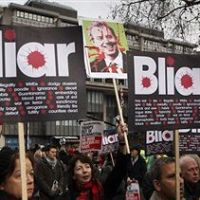
If Tony Blair were to go to the newsagents to day to see how his performance is being reported on the front pages,  he'd be in for a pleasant surprise. He does not feature - certainly not in the biggest sellers. The extra-curricular activities of John Terry make the the lead story on the Mail, the Sun, the Daily Telegraph and the Daily Mirror. Blair himself is relegated to the inside pages on most.  Of all today's press coverage, The Times is probably the most damaging. "Tony Blair was branded a murderer and a liar last night,". But even Blair-hating papers like the Daily Mail find it hard to compete with the John Terry story, which journalists have known about for days but been unable to report (I gather that there are more explosive revelations to come).
Tony Blair: The Next Labour Prime Minister?

From our UK edition

There has been a general consensus that Tony Blair was a class act in front of the Chilcot Inquiry. Even those who see him as a liar and a war criminal must have been impressed by the way he handled himself - although choosing to show no contrition in a room of people that included the bereaved parents of fallen soldiers was a mistake.  I was not a supporter of the war. Like most people in the country I was an agnostic: I hoped the removal of Saddam would lead to a democratic domino effect across the middle east, but I thought it probably wouldn't. I thought it far more likely that an invasion would lead to the three-way split of the country into Kurdish, Sunni and Shia enclaves. I wasn't entirely right about that either.

Blair wants to tell Iranian tales

From our UK edition

Iran. That’s the news story which poor Mr Blair is trying to spin to the panel – but they don’t pick up on his hints. It would have all been all right in Basra – he’d like to say - if it hadn't been for those pesky Iranians. As Prime Minister, if he blamed Iran in public then that would have had implications. He’d have had to follow up on it. But now he wants to tell us, or he would if those chaps on the panel would kindly probe him on it. When he was talking to Baroness Prashar he tried to start: “If what you’d ended up having was an indigenous violence or insurgency, or criminality and looting and so on…” She wasn’t interested “We’ll come to that later…” and handed over to Chilcot.

Blair on the rack

From our UK edition

Not so good for John Rentoul: it’s WMD time and Blair’s body language spoke volumes. His movements were almost involuntary. The glasses were on and off, the brow furrowed, the head wagged and jagged in the manner of an amphetamine junky going cold turkey, and the hands were more intrusive than Andrew Marr’s. In round one, Blair was as languid as Dirk Bogarde; he was more like Daniel Day-Lewis second time round. That said, the line holds. As Iain Martin notes, it is extraordinary that Blair “didn’t focus a great deal” on the intelligence he received.

Blair, the Special Relationship and the Clash of Civilisations

From our UK edition

So far so good for John Rentoul: Blair’s walking it, but there have been intriguing moments. The suggestion that Blair’s foreign policy was motivated solely by vanity is false. The former Prime Minister’s thinking is extremely coherent. That is not to say that he is right nor to deny his obvious vanity, or to overlook that this may simply be Blair in matinee idol mode. But he subscribes to an ideology. He stated, once again, that he saw 9/11 as an attack on “us”, not just America. The language is redolent of Samuel P. Huntingdon’s Clash of Civilisations. Blair perceives a band of religious fanatics and a crucible of oppresive rogue states which desire the West’s destruction.

A composed and calculated Blair takes round one

From our UK edition

So, what do we make of round one? Blair looks younger, in a strange way. A shorter haircut. But all those thespian mannerisms that I had forgotten about are still there - and are being used to full effect. A complete mastery of his facial expressions – which, for Blair, do the communicating. He can torn on anxiety, bemusement etc on tap.The quizzical look, the mock concern. The pause, as he thinks about something (or pretends to). It wouldn’t surprise me if he was faking the slight shaking of the hands which Joey Jones at Sky has just picked up.   We have seen the usual Blair lawyerly hair-splitting habit: “regime change” is not the same as wanting to “remove” Saddam – etc. Blair will, today, throw up something for a headline.

There were real, human costs to containment

From our UK edition

On Today this morning, Nick Robinson said that Tony Blair would point to improvements in infant mortality and the like. Today then cut back to the studio where a reporter analysed this claim. The reporter disputed the validity of this claim and said that sanctions had ‘skewed’ the numbers. But the sanctions were a consequence of Saddam being in power. As long as he was there, there were going to have to be sanctions to contain his ambitions. Dennis Halliday, a UN official who resigned over sanctions, said that four to five thousand children a month were dying because of sanctions. There are intellectually respectable arguments on both the pro and anti-war sides. But to claim that the containment status quo was cost free is simply not accurate.

Why does the Iraq war still fascinate the politics of the present?

From our UK edition

This week has seen confirmation that social mobility has stagnated, that the economic recovery is dangerously anaemic and that peace in Northern Ireland is threatened. Yet a conflict that was declared won nearly 7 years ago has been ever present on the frontpages. Bagehot is not at all surprised that the Iraq war remains definitive: ‘There is one way in which, despite the inquiry, Iraq has come to seem a less definitive issue: in Mr Brown’s handling of the public finances, it has a rival for the status of Labour’s worst mistake. Yet Iraq remains the most important single decision the government has made. Even taking a generous view of its behaviour—that it was cavalier and naive, rather than actively mendacious—the war remains an enormous stain.

Blair’s real crime

From our UK edition

As Tony Blair prepares to sit in the dock tomorrow, I suspect he knows he’ll walk it. The focus is on the case for war and how it was spun – which will be his Mastermind specialist subject. Nor will anything new be uncovered. As one of the journalists whose summer holiday was eaten up by the Hutton Inquiry, I have been getting a sense of deja lu throuhout the Chilcot Inquiry – and Hutton was more informative because he exposed emails written at the time. They had more meaning and impact that the hazy recollections we hear now. The real story is one that Chilcot has unearthed almost accidentally: the betrayal of Basra.

Goldsmith’s advice strikes at the heart of all that is wrong with cronyism

From our UK edition

Yesterday, I wrote that Jack Straw’s savagery in response to Goldsmith’s original advice bespoke of personal animosity. That may well be so, but Goldsmith’s testimony reveals that he was long convinced of his initial advice’s validity. Blair was exasperated with his friend’s stubbornness: “your advice is your advice,” he said pointedly. Yet eventually Goldsmith changed his mind. Why? Well plainly the government wanted him to because they thought he was wrong. Chronology is important here. Goldsmith wrote a note to Blair dated 12 January 2003 (three months before the invasion) reiterating his objections. Later in the month and at someone else’s suggestion, Goldsmith met Greenstock, who wanted to put the Attorney General right.

Lawyers dancing on Pinheads: Iraq Edition

From our UK edition

I remain unpersuaded that there's much point to the Chilcot Inquiry and the stramash over Lord Goldsmith's interpretation of the legal case for toppling Saddam does little to change that. Paul Waugh has a nice, if somewhat scathing, summary here. But the case against the war's legality is a) pretty irrelevent now and b) rests upon the dubious proposition that the French, Russian and Chinese governments had what amounted to a veto over US and UK policy and that without their approval the invasion/liberation of Iraq was not merely unwise but illegal.

Has Brown got anything to hide?

From our UK edition

Proof positive that Brown listens, sometimes at any rate. The Prime Minister will give evidence to the Chilcot Inquiry before the election. Chilcot has been resolute in his wish to keep politics out of the probe, which suggests that No.10 may have put in a call following the mounting clamour for Brown to appear. Brown is something of master in expressing defiance with a single line: “I have nothing to hide,” he averred on Wednesday. Might this sudden decision prove to be, as Sir Humphrey might have said, courageous? As Daniel Korski noted two weeks back: 'Brown’s role in the Iraq War, not that of Blair, that is the most obscure part of Britain’s modern history. As chancellor, Brown was the second most powerful man in government. He held the purse strings.

Poor communication is damaging the Afghan mission

From our UK edition

He may be a chateau-bottled shyster, but there is no better communicator of policy than Alastair Campbell. He has penned an article in the FT arguing that the lesson that should have been learned from the Iraq war was how to communicate strategic ideas and objectives. The lack of clarity that came to define Iraq now afflicts Afghanistan: ‘It was hard to discern that approach in the run-up to the Afghan surge being announced, or after it. The surge should have been followed by co-ordinated communications across the alliance. That job is not being done with the vigour and consistency that it should, and the systems of co-ordination have weakened since Iraq.

Geoff Hoon, silent assassin

From our UK edition

And so it came to pass that nothing came to pass. Geoff Hoon gave evidence to the Chilcot Inquiry on the same day as a convention of anaesthetists visited the QE Conference Centre. Perhaps their presence contributed to the somnolent proceedings. Beneath the apparent narcolepsy, Hoon made two important points. First, he was convinced that the intelligence contained in the two dossiers established the threat of WMD “beyond doubt”, which will assist Blair when he gives evidence, especially after Alastair Campbell’s recent ‘clarification’.

Jack Straw: The Ultimate New Labour Politician

From our UK edition

He's the man who managed to be the campaign manager to Tony Blair and then Gordon Brown. Just after the election-that-never-was in 2007 he let it be known that he had counselled against a snap election. Now the Sunday Times publishes the memo he sent to Tony Blair suggesting that the war might turn out to be a bad idea. Jack Straw: the man who always covers his back. In fact, Straw let the existence of this memo be known shortly after the war turned nasty. I considered it common knowledge when I wrote about it in 2007 and I'm pretty sure John Kampfner talked about it in his book Blair's Wars. The point is that Straw expressed serious doubts a year before the outbreak of war, but still continued to support the intervention.

Will Chilcot Ever Reveal a New Fact?

From our UK edition

As far as I can tell the Chilcot Inquiry has yet to unearth anything that hasn;t been public knowledge for years. Today it's Jonathan Powell's turn to confirm Stuff We Already Knew. As Paul Waugh reports: But perhaps more interesting is the detail he gave of the trip to Downing Street by Dick Cheney a month before in March 2002. Little has so far been revealed about this crunch meeting, which may well have coloured Blair's actions from then on. The Veep, the most senior hawk in the White House at the time, dropped into Number 10 ahead of a tour of Middle East allies on which he wanted to test opinion of the impact of a war on Iraq. At the meeting - and this is the first detail of its contents from Powell - Blair set out some of the "unintended consequences" of military action.

Fighting terror with the National Security Council

From our UK edition

Since September 11, Britain has lost one war and is not winning another. But the question of why this is the case remains depressingly low down the agenda. There is remarkably little interest in why the “British army was defeated in the field in southern Iraq”, to quote Gordon Brown's and David Miliband’s favourite counter-insurgency expert, David Kilcullen. Today, the Tories launched their green paper on national security with speeches by Pauline Neville-Jones and David Cameron. The document is a mixed bag. But the Tories deserve credit for squarely facing up to the fact that Britain is now an “incubator of extremism and an exporter of terrorism”.

The growing threat of a military coup in Iraq

From our UK edition

Predictably, insurgency in Iraq has intensified as the March elections near; its scale and frequency was not predicted. Alastair Campbell beamed as a benevolent Uncle when talking about Iraq on Tuesday but Coalition diplomats fear for the democracy’s future.  British ambassador to Baghdad, John Jenkins, told the Chilcot inquiry: “Iraq faces a real possibility of a military coup...Although I think where we are at the moment is much better than where we thought it was going be back in  2004-05 you only need look at the history of Iraq to understand that a realistic threat still exists.

Just like old times

From our UK edition

As Paul Waugh notes, it was just like old times. Alastair Campbell told us all to grow up and trust in Tony. Naturally, controversy about the dossier was the product of over imaginative hacks, and Campbell asserted that the caveats of experts are nothing compared to a PM’s need to take major decisions. It was a sensational spin operation. Inspired by Uriah Heep, Campbell cast himself as the humblest of functionaries amid grand events. In doing so he was unremittingly arrogant, almost to the point of delusion.