Iran

Iran’s threshold power

From our UK edition

The discovery that Iran's regime has, yet again, deceived the international community and secretly built an additional nuclear facility has made world leaders re-focus on the issue. On Friday, the US, UK and France said the UN had to be given immediate access and urged tough new sanctions. Even Russia expressed concern. Today, the Iranian regime's  response came. According to Ali Akbar Salehi, who heads the Atomic Energy Organisation, Iran will keep its uranium enrichment level at up to five percent - much lower than bomb-grade. "We don't want to change the arrangement of five-percent enrichment merely to produce 150 to 300 kilos of 20-percent (enriched) fuel," ILNA news agency quoted the nuclear chief as saying.
The Persian Problem

From our UK edition

The news that Iran has a second, secret nuclear installation can hardly be considered a surprise. Nor, alas, is there anything surprising about Charles Krauthammer's reaction to Barack Obama's decision to make nuclear proliferation an issue at the UN General Assembly: What did he accomplish? Nothing. This is really quite surreal. As we speak, the Iranians are spinning thousands of centrifuges and developing uranium. The American delegate at IAEA announces that Iran already has enough uranium to construct a bomb. It's testing its missiles, flouting all U.N. resolutions, as are the North Koreans. And the response of America?

US efforts to engage Iran appear to be over

From our UK edition

New York The reaction of the Obama administration to the discovery of a secret, underground Iranian nuclear plant strongly suggests, as the Washington Post points out, that the administration has given up on engagement. Attempts to engage with the Iranian regime were always likely to be futile. But Washington had to show the international community, and the American public, that it had tried. The criticism you can make of the administration is that its effort took too long, nine months when the Iranian nuclear clock might have as little as 18 months left on it.  Now, the focus turns to sanctions. Can the UN pass sanctions that block gasoline imports, a vital first step in increasing the pressure on the regime? Russia appears to be taking a tougher line on Iran.

Gordon Brown gets something right!

From our UK edition

Gordon Brown is expected to offer to decommission one of Britain’s four Trident submarines as part of nuclear non-proliferation discussions at the UN today. The Times has the details: ‘Mr Brown will signal tomorrow that he is ready to negotiate at a meeting of the UN Security Council on nuclear non-proliferation. It follows President Obama’s decision to ditch the US missile defence shield in Eastern Europe. That move, and Russia’s delighted response, has bolstered hopes that a new non-proliferation treaty could be agreed next spring. Officials travelling with the Prime Minister to New York insisted that there was no question of surrendering Britain’s independent nuclear deterrent.

Following a strike, would Iran close the Straits of Hormuz?

From our UK edition

In most discussions about what would happen following a strike on Iran it is taken as a given that the Iranians would close the Straits of Hormuz, through which 90 percent of Persian Gulf oil exports pass. The thinking goes that this would lead to a huge spike in world oil prices. But an interesting article in the new issue of Foreign Policy argues that it would be far harder for Iran to close the Straits than is commonly assumed. It points out that oil tankers can travel through 20 miles of the Straits rather than just the 4 mile official channel, that oil tankers are actually not that vulnerable to mines and that tankers’ large bow waves would make it impossible for most small boats to get close enough to launch an attack.

The West must prepare contingency plans to bomb Iran

From our UK edition

Chuck Wald, a retired US Air Force General who was the air commander for the US response to the 9/11 attacks, has an important op-ed in the Wall Street Journal today about Iran. Wald argues that while no one wants to see the military options explored before all others have been exhausted, it would be a mistake to think that there are none. He argues that even the mere act of a military build up might persuade the Iranian regime that the cost of continuing with their nuclear programme would be being bombed and thus persuade them to give up. Alternatively, a naval blockade could deny Tehran the petrol imports it needs, bringing its already teetering economy to a halt.

Iran’s Red Line? A Case for Caution, Not Action

From our UK edition

As is customary, James and I disagree about Iran. Or perhaps we merely have different ideas about what constitutes the most important Persian questions. James, I think (and I'm sure he'll correct me if I'm wrong), places the nuclear issue above all others. I'm more agitated by the nature of the regime in Tehran. That is, I doubt that we can prevent Iran from acquiring a nulear capability at some point and that, while it would certainly be preferable if Iran didn't have the bomb, we might have to get used to the idea that it will. It's also quite possible, perhaps even probable, that a new regime in Tehran (if and/or when that happens) will also want nukes. This would make sense, given that Iran feels it is being threatened by outside, hostile powers.

Looking for Laku in Nicaragua

From our UK edition

More evidence emerges to support the notion that Scoop is really a work of non-fiction. This time it's in the form of this report in the Washington Post: For months, the reports percolated in Washington and other capitals. Iran was constructing a major beachhead in Nicaragua as part of a diplomatic push into Latin America, featuring huge investment deals, new embassies and even TV programming from the Islamic republic. "The Iranians are building a huge embassy in Managua," Secretary of State Hillary Rodham Clinton warned in May. "And you can only imagine what that's for." But here in Nicaragua, no one can find any super-embassy. Nicaraguan reporters scoured the sprawling tropical city in search of the embassy construction site. Nothing.

Iran’s Dubček moment

From our UK edition

Even though the Second Iranian Revolution may, for the time being, be quelled by the Mullahs, many different foreign policy factions in the West see the events of the last few weeks as good for their preferred Iran policy. Writing in the Guardian, Jonathan Freedland argued it has helped the anti-war contingent. Now that the world has seen how freedom-yearning Iran's youth is, how can anyone condone a bombing campaign against Iran's nuclear facilities that may kill some of the Twitter-using students? But a very senior US official, who spoke on background, told me that the State Department, at least, see the incipient revolution as good for its potential post-engagement Iran policy.

Iran Solidarity

From our UK edition

David T over at Harry's Place blog has drawn my attention to this post from "habibi". I'm happy to endorse the message. "This Thursday is the tenth anniversary of the brutal repression of students in Iran. Today a new round of repression is underway in Iran.Here is something you can do about it. An anniversary demonstration at the Iranian embassy in London is scheduled for this Thursday, starting at 6 PM. Please wear green and come along to 16 Prince’s Gate, SW7. The nearest Tube station is South Kensington.The only point – and I hope this leads other British bloggers to echo this call – is to show solidarity with the Iranian people.

The waning authority of the Iranian regime

From our UK edition

Reuel Marc Gerecht, a former CIA Middle East hand, has an interesting analysis of the huge news from Iran, the Association of Researchers and Teachers of Qum have declared the election invalid and the Ahamdinejad government illegitimate. What will happen next is crucial but unpredictable. Gerecht speculates that: “If Khamenei tries to crush Qom in the way that Khomeini crushed Grand Ayatollah Shariatmadari in Tabriz in 1979/80, he'll probably push Qom into open rebellion. If he tries using the Guards Corps as a vehicle of oppression against the clerical establishment, he would surely risk his office.

Massive development in Iran, Qum begins to turn against the regime

From our UK edition

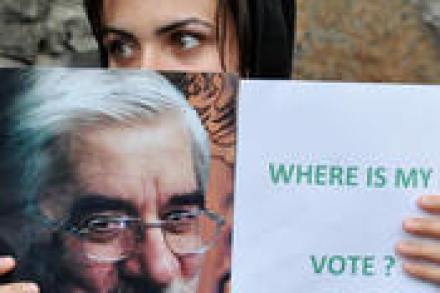
The situation in Iran might have been knocked off the front pages in recent days and the regime does seem to have regained control of the streets. But things are clearly not over yet. The New York Times today reports that the “most important group of religious leaders in Iran [Association of Researchers and Teachers of Qum] called the disputed presidential election and the new government illegitimate on Saturday”. This is the most important development since Iranians started to protest in numbers against the obvious rigging of the result. If Qum is turning against the regime, it is in real trouble. [I’m baffled that this story isn’t leading the news here].

Yvonne Ridley and Press TV

From our UK edition

I thought my old friend Yvonne Ridley was just taking the money from the clerical fascists as a presenter at Iranian state channel Press TV. I didn't realise she had been spouting the Iranian regime's line on the election.  But here's her reply to my post to her Facebook page asking her when she was going to resign: "What I find particularly upsetting is the inference that the working class and poor living in rural areas don't really count -- that their votes are inferior to the elite classes in north Tehran... maybe it's 'cos I'm a working class lass from Tyneside." I must say it's the first time I've encountered Yvonne's class consciousness.

More worrying news from Iran

From our UK edition

I'm just catching up with the latest New Yorker over brunch, and would recommend that CoffeeHousers read their eyewitness account of the Tehran protests: it captures the scale and sweep of the opposition to Ahmadinejad, as well as the brutality of the state response. Elsewhere, the latest news coming out of the country makes for a worrying addendum.  An Iranian newspaper has said that Mir Hossein Mousavi should be tried for treason; which sounds ominously like an prelude to even more oppression and antidemocratic action.  As always, it's worth keeping an eye on developments.

Maziar Bahari and Press TV

From our UK edition

The latest outrage committed by the Iranian state broadcaster Press TV is its coverage of the arrest of film maker and journalist Maziar Bahari. Maziar, a Canadian-Iranian, was arrested on June 21 and paraded on TV nine days later "confessing" to his role in a western plot to destabilise the Iranian regime. He had provided footage of the crackdown on protestors to Channel 4. I am loathe to encourage readers to look at the Press TV site, so check out the story at The Spittoon, an excellent website opposed to clerical fascism. The author of the piece, "shikwa", concludes: "How can anyone continue doubting the bias of Press TV which spews this rubbish at the behest of its clerical-fascist backers? [...

The Washington Delusion

From our UK edition

In one sense, of course, John McCain is correct to say: "The president saying that we didn't want to be perceived as meddling, is, frankly, not what America's history is all about." And while one may say that, more often than not, the United States has been one of, for want of a less crude way of putting it, the Good Guys even that country's admirers must acknowledge that this has not always or universally been the case. And that has led to problems. It also, frankly, makes one pretty happy that John McCain ain't President.

Talking Tough on Iran

From our UK edition

If you knew that you were likely to be framed by the police, would you go ahead and commit the crime anyway, reasoning that you had nothing to lose? Would that be the sensible thing to do? Then, at trial, suppose you decided that, even though you were innocent of the charges brought against you, it would be sensble to behave in a manner that gave the jury reason to suppose that you might in fact be guilty after all. Would that be a sensible policy? That's the rough-and-ready comparison I'd draw with the question - still vexed, it seems - of how to talk about events in post-election Iran. Plenty of commenters and other folk, such as Tim at Conservative Party Reptile, argue that no-good has come from taking a measured, even softly-softly approach.

Commentariat v Bloggertariat event

From our UK edition

Really interesting debate on who is winning the Blog/Comment War last night at Edelman HQ in Victoria Street. I tried to argue that they are part of the same continuum. I have never seen them as particularly antagonistic.  I suggested that we are yet to see a "classic" or "great" blog posting in the way that you have memorable comment pieces that stay with you for life. Peter Beaumont's Observer piece about Iran at the weekend is one such article. There has been some good discussion of the debate at journalism.co.uk and Mark Reckons. Mark (a Lib Dem blogger) has challenged my assertion that there are no classic blog posts and given some examples. Iain Dale, a lively panel member, has blogged about it as one might hope.

David Cameron Fails his Persian Exam.

From our UK edition

Iain Dale, however, thinks Cameron passed with flying colours. I suppose it was merely a matter of time before the "Why Won't Obama Come to the Aid of the Protestors?" meme spread to this side of the Atlantic and now, courtesy of the good* Mr Dale, it has. And apparently Gordon Brown and David Milliband havel also failed to help the Iranian regime by offering sufficiently forceful denunciations of their behaviour. That's not what Iain wants, but it's what would have happened if the President, Prime Minister and Foreign Secretary had followed his advice. Iain's post is headlined "What Would Thatcher & Reagan Have Done About Iran?

Blogging the Revolution

From our UK edition

I was playing cricket* yesterday, so wasn't able to follow events in Iran too closely. Happily, Andrew Sullivan's blog means that it's easy to catch-up. Andrew, of course, has been at his considerable best these past few days, but yesterday's marathon live-blog was something else. Newspapers, at least in this instance, are now the second draft of history; blogs, Youtube, camera phones and Twitter are the first. Reading Andrew's live-blog - a compendium of tweets from Iran, video footage, stills photography, commentary and links to other sources of information around the web - is a pretty draining experience; producing it must have exhausted Andrew and his brace of helpers, Chris Bodenner and Patrick Appel. It really is living history.