Interviews

For the workers?

From our UK edition

One of the defences that Labour types are mustering over Unite is, bascially, that it's better to be funded by a body which represents some two million workers than by Ashcroft type figures who may have their own personal agendas. In which case, the question is: do Charlie Whelan and his coterie really represent the views and interests of Unite's members?  And, in answer, it's worth pulling out two snippets from today's papers. EXHIBIT A, courtesy of Danny Finkelstein: "A Populus poll of Unite members last year showed the majority preferring David Cameron to Gordon Brown and opposing Unite donations to Labour.
In the name of the father | 20 February 2010

From our UK edition

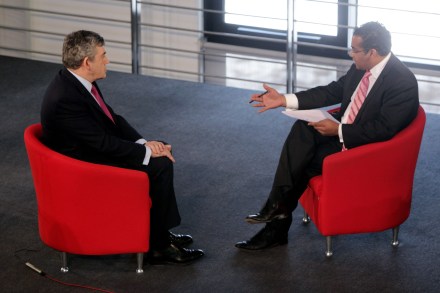
“I’m not perfect” Gordon Brown said in his speech today – knowing that, in a couple of hours, we’ll hear details of the many ways he is not perfect, when the first extracts of Andrew Rawnsley’s book are published. He has got his defence in early on Channel Four news. Here is a transcript: Q: You know tomorrow there are going to be a whole slew of new allegations being made by Andrew Rawnsley, so let's hear about you at work. Do you get angry at your staff? Do you swear at them? Do you throw things? GORDON BROWN: If I get angry, I get angry with myself. Q: Do you throw things? GORDON BROWN: No, I throw the newspapers on the floor or something like that, but please… Q: Have you ever hit anyone? GORDON BROWN: I have never hit anybody in my life.

Will Brown’s next interrogators be the public?

From our UK edition

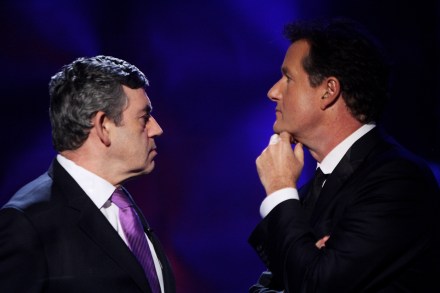
So what next for the new, more human, Gordon Brown (as seen on TV)?  Well, according to today's Times, there are some ministers who want him to take the show on the road.  The idea is to let voters tackle Brown directly - but about the topics Piers Morgan kinda skipped over: the economy, MPs' expenses, Afghanistan, and all the other big stuff.  And the hope, in turn, is that this "masochism strategy" will make the public respect Brown more. Would it work?  Well, just like the Morgan interview and its wider impact, that's something which is difficult to pre-judge from the confines of Westminster.

The best publicity Brown is ever likely to get

From our UK edition

Brown is very lucky to have a friend in Piers Morgan. He did him a great service in the ITV interview tonight - and while it would have made CoffeeHousers nauseous (if they watched it), it will be the best television the PM will get this year and probably ever. Mark my words: the Labour Party will not produce anything that shows Brown in such a sympathetic light. It was powerful, I'd say, because it was not party political propaganda: Morgan genuinely likes Brown and did his utmost to project the human side of him. Those hours of coaching from Alastair Campbell paid off. He kept smiling in a credible way - telling anecdotes in exactly the way that he does, in private, when he's trying to charm people.

Brown and Blair, together again

From our UK edition

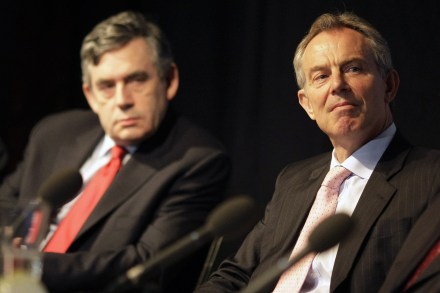
Strange that there's really only one major political point arising from Gordon Brown's interview in the Standard today.  But, then again, maybe that is the point.  Like the PM's interview with the News of the World a few weeks ago, the emphasis is far more on the personal than anything else: his relationship with Sarah Brown, the death of his daughter Jennifer, his upbringing, and so on.  We even learn why his handwriting is so bad ("due to the way he was taught to write at school," apparently).  And with a TV appearance alongside Piers Morgan in the schedules, it does seem that Brown is keen to present a more human front. As for that political point, it's Brown's confirmation that Tony Blair will play a "major role" in Labour's election campaign.

Publishing the serious case review in the Edlington case is the best way to prevent more awful mistakes

From our UK edition

The Edlington case is shocking and depressing to think about. But I would urge you to watch Gavin Esler’s interview of Ed Balls on Newsnight where he challenged Balls over his reasons for not publishing the full case review. Newsnight, who were leaked a copy of the full case review in the Edlington case, pressed Balls on why the full report was not being published when the summary was misleading and did not highlight some of the biggest problems. Balls, as the government does whenever it is challenged on this point, invoked the support of the NSPC, Lord Laming (whose record, as Iain Martin points out, isn't that great) and various other members of the establishment.

Cameron has the positioning right – but fiscal questions remain<br />

From our UK edition

Here, CoffeeHousers, is my take on this morning's Cameron interview: 1. General demeanor: excellent, articulate, confident. The complete opposite from Brown. It does make you think that he should wipe the floor with Brown in the TV debates. 2. “Last week we saw William Hague and George Osborne going to Afghanistan together. First shadow Chancellor, the man who is going to be in charge of the money, on the frontline seeing what is going on in Afghanistan”. Indeed, but the NHS pledge and deficit cut pledge imply deep cuts to the military. To govern is to choose, and Cameron has made his choice: NHS spending before the military.

A tale of two interviews

From our UK edition

So, at the end of a hyperactive week in politics, we've got a pair of interviews with Brown and Cameron.  The PM chats with the News of the World, while Cameron appeared on the Marr sofa earlier. One general similarity between the two interviews stands out: neither is particularly confrontational. Rather than chiding Labour after Alistair Darling's admission yesterday, Cameron adopted a more conciliatory tone, saying things like: "If [the government] ... set out reductions that we think make sense we won’t play politics with it, we’ll say yes."  And, for his part, Brown only nods towards the "big choice" to be made at this year's election, and doesn't mention the Tories once.  Quite rare that, for Gordon.

Darling’s honesty is good news for the country – but tricky news for Labour

From our UK edition

Well, well, well - Darling's Times interview, which James reported earlier, sure is a significant moment, and one which more than deserves a place on the spending cut timeline which I put together last week.  In fact, let's see what it would look like alongside a few of the most recent entries: 9 December 2009: Pre-Budget Report 2009 forecasts Public Sector Net Borrowing of £176 billion, and Public Sector Net Debt of £986 billion, in 2010-11. 10 December 2009: Alistair Darling puts in a bizarre performance on the Today programme, claiming that the PBR implies that departmental budgets would remain “pretty much flat.” 10 December 2009: The IFS works out that the PBR implies departmental budget cuts of around 19 percent over three years.

Things the Speaker shouldn’t discuss in public

From our UK edition

As Andrew Sparrow says, it's well worth reading Iain Dale's interview with John Bercow in the latest issue Total Politics.  It's a fun read, mostly because the Speaker is remarkably candid – a quality that's normally to be admired in a politician.  But I can't help thinking that he made a mistake in admitting this:   "I received various approaches from various senior people in the Labour party saying: 'Aw, you know, we'd love to have you on board. We think you're being discarded by the Conservatives. We think you'd be quite at home with us.' Senior people, not in a formal setting, but people sidling up to you – ex-ministers, current ministers, backbenchers, whatever.

Why not just scrap ID cards, then?

From our UK edition

So the protracted, wheezing death of ID cards continues, with Alistair Darling admitting in today's Telegraph that: "Most of the expenditure is on biometric passports which you and I are going to require shortly to get into the US. Do we need to go further than that? Well, probably not." The government are letting it be known that this doesn't contradict their existing policy, but their shifting rhetoric remains striking.  Last year, we had the then Home Secretary, Jacqui Smith, proposing that British citizens should be able to choose between a card and a biometric passport.  Earlier this year, Alan Johnson said that ID cards wouldn't be compulsory for British nationals, after all.

Blair admits to misleading the British public over Iraq

From our UK edition

It has taken eight years, but Tony Blair has finally leveled with the British public and admitted that the WMD thing didn’t really matter: he wanted to depose Saddam Hussein anyway. That's what he has said in a BBC interview, presumably to pre-empt his appearance before the Chilcot inquiry. His chosen confessor: Fern Britton. His medium: BBC1 on Sunday. It has been trailed to the newspapers, including tomorrow’s Times. As it says: "He said it was the 'threat' that Saddam presented to the region that was uppermost in his mind. The development of weapons of mass destruction was one aspect of that threat. Mr Blair said that there had been 12 years of the United Nations going 'to and fro' on the subject, and he noted that Saddam had used chemical weapons on his own people.

How Cameron responded

From our UK edition

A quick post to point out that Fraser's interview with David Cameron - to which CoffeeHousers contributed questions - will be appearing in tomorrow's issue of the magazine.  We'll also be making the article free to all website users tomorrow morning, so you can read the full thing then.  In the meantime, here's a selection of the quotes within it, so you can get a sense of what the Tory leader had to say for himself: Thoughtful radicalism: "What you need is thoughtful radicalism. Prepared radicalism. It needs to come from a solid and strong base. Compare Margaret Thatcher’s trade union reforms with Ted Heath’s.

Brown’s new dividing lines are merely muddled hypotheticals

From our UK edition

Reading the transcript of Gordon Brown’s interview with the FT one is struck by how little of a domestic policy message Brown has. Say what you like about Labour’s mantra in 2001 and 2005 of Labour investment versus Tory cuts but it was clear. By contrast, Brown’s attempt to explain his new dividing lines to the FT is distinctly muddled. Brown’s main line is that things could have been a lot worse without the government’s action. But that is, of course, a hypothetical. It also seems doubtful that the public will share this view or forget who was Chancellor in the decade before the crisis. Brown then moves on to what he thinks will be the battleground for the next election.

Gove pushes his agenda

From our UK edition

If you can divert your attention away from the Ashes for a second, then I'd recommend you read John Rentoul's fascinating interview with Michael Gove in today's Independent on Sunday.  The two most eye-catching passages concern Gove's "ultra-Blarism" and his thoughts on foreign policy.  The Blairism first: "And when I ask if it is wise to paint himself as a Blairite, given the former prime minister's latter unpopularity, he says: 'He's not as popular as he deserves to be, and he's emphatically not as popular within Labour as he deserves to be – amazing ingratitude on their part.