Germany

Filming the Final Solution

In July 1986, nine months before he died, I met the Italian author and Auschwitz survivor Primo Levi at his home in Turin. He was in shirtsleeves for the interview and the concentration camp tattoo 174517 was visible on his left forearm. (‘A typical German talent for classification,’ he tartly observed.) If This is a Man, Levi’s chronicle of survival, offers a warning to those who deliver facile judgments of condemnation: only those who have survived the Nazi camps have the right to forgive or condemn. Attempts to recreate the Final Solution on screen were mostly a ‘macabre indecency’, said Levi. The 1978 Hollywood television soap opera Holocaust, starring Meryl

Who needs governments?

On 26 October last year, the Spanish government shut up shop in preparation for a general election. This duly took place in December but then a strange thing happened: after all the build-up, the arguments, the posters and the television coverage, the result was… nothing. The various parties were so balanced, so mutually distrustful and ill-assorted that no government could be formed. Since last October, therefore, there has been no government in Spain. One can imagine that the average political correspondent would think this a terrible problem, maybe even a crisis. The Financial Times has referred to Spain ‘enduring’ months of ‘political uncertainty’. This is assumed to be a matter

Obama warns of countries who ‘use trade as a weapon’. Like USA over Brexit?

President Obama has taken his European tour to Germany, where he touted the ‘indisputable’ benefits of an EU-US free-trade pact. Speaking at the Hannover Messe Trade Fair, Obama noted the importance of an agreement as a bulwark against the likes of Russia ‘at this time of uncertainty, including here in Europe, when others would use trade and energy as a weapon.’ Trade as a weapon? You don’t say. Obama’s remarks in Germany came shortly after his visit to Britain, where he bludgeoned Brexit campaigners with the implied threat that Britain would ‘go to the back of the queue’ for a US trade pact if it left the EU. Obama followed that press

A poem for Erdogan

At the end of last month, a German comedian appeared on German television and read a poem mocking Recep Tayyip Erdogan, the president of Turkey. Jan Böhmermann’s satire was directed, among other things, at the laws President Erdogan has been using to lock up his critics. Turkey — which David Cameron is still fighting to bring into the EU — now has some of the world’s most repressive speech laws. Numerous journalists have been arrested for ‘insulting’ President Erdogan and he has even been known to ban Twitter in the country when corruption allegations against him and his family have surfaced online. Yet until Mr Böhmermann came on the scene, one might

Introducing ‘The President Erdogan Offensive Poetry Competition’

Nobody should be surprised that Turkey’s President Recep Tayyip Erdogan has instituted effective blasphemy laws to defend himself from criticism in Turkey.  But many of us had assumed that these lèse-majesté laws would not yet be put in place inside Europe.  At least not until David Cameron succeeds in his long-held ambition to bring Turkey fully into the EU. Yet here we are.  Erdogan’s rule now already extends to Europe. At the end of last month, during a late-night comedy programme, a young German comedian called Jan Böhmermann included a poem that was rude about Erdogan.  Incidentally the point of Mr Böhmermann’s skit was to highlight the obscenity of Turkey already trying to

Just join Germany

An argument you sometimes hear from those sitting on the Brence (the Brexit fence) is that it’s a pity the EU couldn’t have stayed the same as it was when we first joined it in 1973. Back then, say the Brence-sitters, it was a trading bloc with only nine members, which made sense. Greece wasn’t a member, nor were Spain and Portugal, never mind Lithuania, Latvia and all those other countries ending in vowels. But if we could go back to that better arrangement — play fantasy politics, as it were — would we, with hindsight, want it to include France and Italy, two of the original nine? Their economies

Portrait of the week | 17 March 2016

Home In the Budget, George Osborne, the Chancellor of the Exchequer, kept talking of the ‘next generation’. He outlined cuts of £3.5 billion in public spending by 2020, to be ‘on course’ to balance the books. Personal allowances edged up for lower taxpayers, with the higher-rate threshold rising to £45,000. A ‘lifetime Isa’ for under-40s would be introduced. Corporation tax would go down to 17 per cent by 2020. Small-business rate relief was raised: a ‘hairdresser in Leeds’ would pay none. Fuel, beer, cider and whisky duty would be frozen. To turn all state schools into academies (removing local authorities from education), he earmarked £1.5 billion. He gave the go-ahead

Is more multiculturalism really the cure for the EU’s problems?

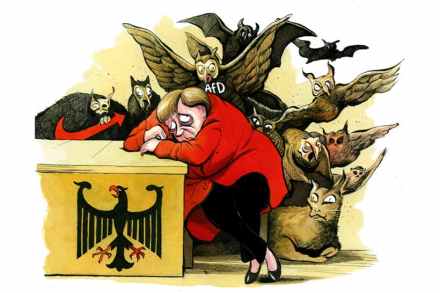
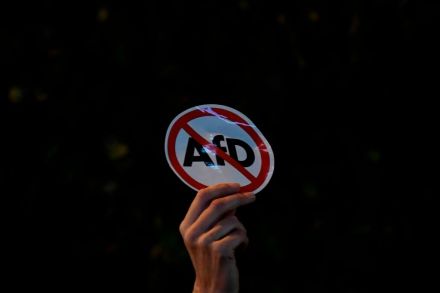
Germany is on its feet again; the country’s answer to Ukip, Alternative Für Deutschland, made huge gains at the polls, winning a presence in three state assemblies. The shadow of Auschwitz looms over all European politics on the subject of immigration and race, but obviously more so in Germany, and many people are worried. Their growth in popularity may have something to do with the chancellor’s decision to invite one million and counting people from the wider Middle East, in an gesture historians will probably see as the grandest act of folly of early 21st century history. Some people are worried that, along with FN, Ukip and Trump, AfD are

Even the Germans are starting to despair of their country’s migrant policy

A rather impressive performance by Alternative für Deutschland (AfD) in Germany’s regional elections. Second in Saxony-Anhalt and double digit percentages in Baden-Württemberg and the Rhineland-Palatinate. Today’s papers have tended to conclude that despite AfD’s shock success, the elections were nonetheless a triumph, of sorts, for Angela Merkel’s policy towards migrants, if not for her party, the CDU. I can’t say that I see it like that. For a party which did not exist four years ago to take a quarter of the votes in one lander is a remarkable expression of dissatisfaction with the status quo. Add into that the fact AfD is held in some suspicion as being exclusively middle-class, if not

Right-wing populists surge in Germany’s state elections

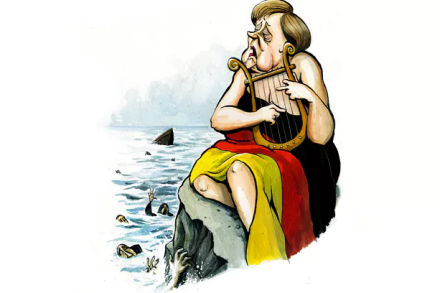
Angela Merkel continues to reap the whirlwind. In this weekend’s elections Alternative für Deutschland (AfD) has emerged as the fastest-growing political insurgent party since 1945. It has managed to enter all three state parliaments – with over 10pc of the vote in Baden-Württemberg, Rhineland-Palatinate and almost a quarter of the vote in Saxony-Anhalt, more than double the centre-left SPD. It focused its campaign as a protest against Merkel’s migrant policy, a policy that paid off. Its success is more than just another example of Europeans letting off steam. Imagine if Nigel Farage declared that police should be ready to shoot migrants trying to make it from Calais to Britain; saying: ‘I don’t want to do

The Spectator’s notes | 10 March 2016

Surely there is a difference between Mark Carney’s intervention in the Scottish referendum last year and in the EU one now. In the first, everyone wanted to know whether an independent Scotland could, as Alex Salmond asserted, keep the pound and even gain partial control over it. The best person to answer this question was the Governor of the Bank of England. So he answered it, and the answer — though somewhat more obliquely expressed — was no. For the vote on 23 June, there is nothing that Mr Carney can tell us which we definitely need to know and which only he can say. So when he spoke to

A civilisation under siege

[audioplayer src=”http://rss.acast.com/viewfrom22/thedeportationgame/media.mp3″ title=”Douglas Murray and Don Flynn from the Migrants’ Rights Network discuss deportation”] Listen [/audioplayer]There are two great deportation games. One is the carousel which Rod Liddle describes — but even this, for all its madness, pales alongside the border-security catastrophe unfolding on the continent. Thanks to geography and a few sensible decisions by our government, Britain has so far been spared the worst of the migrant crisis. But we should pity most of the other European countries, because they are losing control not just of their borders but of their civilisation and culture — the whole caboodle. Defenders of Europe’s disastrous recent border policies are keen to point

Driven to extremes

Imagine if Nigel Farage declared that police should be ready to shoot migrants trying to make it from Calais to Britain; saying: ‘I don’t want to do this, but the use of armed force is there as a last resort.’ And imagine that in spite of this — or perhaps because of it — Ukip were to overtake the Labour party in a national poll to become the most popular opposition party. This, in effect, is what is happening in Germany. The words above were spoken by Frauke Petry, leader of Alternative für Deutschland (AfD), the insurgent party which is threatening to make large gains in state elections in three

Why are Amnesty keeping the details of their plan to bring in more migrants secret?

The head of Amnesty, Kate Allen, was busily talking the most terrible balls on the radio this morning. In an interview on the Today programme she reminded everyone of how bad the situation in Syria is and indulged in the usual Conservative-bashing by arguing that Britain wasn’t doing enough to alleviate the refugee situation. Despite spending more than almost any other country on regional solutions to the humanitarian catastrophe and a commitment to take in 20,000 refugees over 5 years, Ms Allen particularly lamented that we were ‘not joining with the rest of Europe.’ Seemingly unaware that most of the ‘refugees’ flooding into Europe are not Syrians and not refugees, she

Low life | 11 February 2016

The hotel reception was lit by three gloomy low-wattage light bulbs. It should have been six but the management was economising. The hotel’s nod to the city carnival was a single balloon strung from one of the empty bulb holders. I let my backpack drop from my shoulders and checked in. WiFi, said the receptionist, cost extra. The WiFi registration process was as insanely convoluted as buying illegal drugs. Room number dreiunddreissig was on a shabby corridor with two other doors. The room was dismally cold and small. It was bare of every amenity one normally expects to find even in a cheap hotel room, except for a bed, a

EU officials find that most of the ‘refugees’ are not refugees. What a mess

Even EU officials are now finally admitting that a lot – or, rather, most – of the people we have been calling ‘refugees’ are not refugees. They are economic migrants with no more right to be called European citizens than anybody else in the world. Even Frans Timmermans, Vice President of the European Commission, made this point this week. In his accounting, at least 60pc of the people who are here are economic migrants who should not be here –  are from North African states such as Morocco and Tunisia. As he told Dutch television:- “These are people that you can assume have no reason to apply for refugee status.” Swedish officials are

Our leaders should read history books – but not just ones about the Nazis

If I was in charge of the Home Office I’d employ someone whose sole area of expertise was Hitler’s Germany and whose only job was to keep an eye out for any vague echoes of Nazism, however fatuous, in the working practices of the government or its contractors. This would have avoided Monday’s controversy over asylum seekers being made to wear red wristbands in order to receive free meals, because being asked to wear ID to qualify for things is exactly like being a Jew in Hitler’s Germany. A chilling echo, as many people commented. I imagine the reason for this policy is that it’s more convenient than asking someone with a not

By downplaying social problems, multiculturalists help extremism to flourish

Ross Douthat’s 10 points about immigration is recommended reading for anyone sitting on the fence or who tends towards the open border position; even if you disagree, you’ll at least have an idea of what the opposition believe. Personally I agree with it all anyway and my opinions on the subject are as frozen in aspic as my musical tastes and haircut. Not that many people are likely to change their minds, of course, this being a subject more of the heart than the head, on both sides of the debate. I’d go as far as to say it that immigration has become a sacred idea, and that many believe multiculturalism

Taharrush Gamea: has a new form of sexual harassment arrived in Europe?

The Swedish and German authorities say they have never encountered anything like it: groups of men encircling then molesting women in large public gatherings. It happened in Cologne and Stockholm, but is it really unprecedented? Ivar Arpi argues in the new Spectator that it may well be connected to a phenomenon called ‘taharrush gamea’, a form of group harassment previously seen in Egypt. So what is taharrush gamea, and should Western police be worried? Here’s what we know. ‘Taharrush’ means sexual harassment – it’s a relatively modern word, which political scholar As’ad Abukhalil says dates back to at least the 1950s. ‘Gamea’ just means ‘collective’. Taharrush gamea came to attention in Egypt in 2005, when

Sweden’s shameful cover-up

   Stockholm It took days for police to acknowledge the extent of the mass attacks on women celebrating New Year’s Eve in Cologne. The Germans were lucky; in Sweden, similar attacks have been taking place for more than a year and the authorities are still playing catch up. Only now is the truth emerging, both about the attacks and the cover-ups. Stefan Löfven, our Prime Minister, has denounced a ‘double betrayal’ of women and has promised an investigation. But he ought to be asking this: what made the police and even journalists cover up the truth? The answer can be discovered in the reaction to the Cologne attacks. Sweden prides