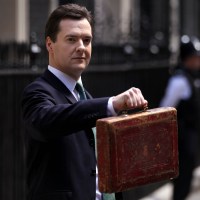
George osborne

What Harriet Harman won’t tell you

From our UK edition

By her usual standards, Harriet Harman was quite effective in her response to George Osborne's Budget earlier.  She was clear, direct and had a few gags at Vince Cable's expense.  And she also benefitted from what, on the surface, was a strong central attack: the Office for Budget Responsibility, she said, has downgraded its jobs forecasts on the back of the Budget.  And so, she followed, this is a Budget which destroys jobs. But there were a few things that Harman wasn't letting on.  First, as Jim Pickard points out at the FT, the OBR forecasts haven't shifted by all that much from their previous incarnation.  And, second, they are still more optmistic than most independent forecasts (conveniently collected by the Treasury here).
Unspectacular, but quite effective

From our UK edition

Well, that was excitingly unexciting.  There was little in George Osborne's Budget that we didn't expect, either in terms of rhetoric or policy.  But it still felt new and different nonetheless.  Here we had a Chancellor setting out exactly how much spending he will cut, and putting plenty of emphasis on both our deficit and debt burdens.  It drew a stark contrast with the Brown years, and was a solidly understated performance in itself. There will be plenty of attention paid to the hike in VAT, and rightly so.  But there were some macroeconomic forecasts which were just as eyecatching.

Budget 2010 – live blog

From our UK edition

1343, PH: Harman has sat down now, so we'll draw the live blog to a close.  I'll write a summary post shortly. 1342, FN: I wish I could trash Harman's response, but it's actually quite good.  Many a Tory would be secretly cheering her trashing of the LibDems. "The LibDems denounced early cuts, now they're backing them - how could they support everything they fought against, how could they let down everyone who voted for them?" Again, a fair point. "The LibDems used to stand up for people's jobs, now they only stand up for their own." Her main point - that forecasts for unemployment have risen - is a fairly strong one if true. Osborne did indeed shy away from admitting to VAT rise plans in the election campaign.

George Osborne must put spending cuts ahead of tax rises

From our UK edition

In 2009, Britain borrowed more, as a share of its national income, than any country that isn't being bailed out by the IMF and the Eurozone (Greece) or already making drastic spending cuts (Ireland).  That huge deficit is the critical challenge to our economic stability that George Osborne needs to tackle with the Budget today.  We have got away with high borrowing so far on the understanding that cuts are coming now the election is out of the way.   If you think tax hikes are the answer, then you're asking the wrong question.  Our present fiscal crisis is built on a decade of bumper rises in spending, not tax cuts.  Over the last decade, spending rose from 36.6 per cent of GDP to 53.4 per cent this year according to OECD data.

Back into the black

From our UK edition

George Osborne has an historic opportunity to begin to turn the UK's public finances back into the black. As Reform noted in an alternative budget released last week, while this will require making the toughest spending choices for a generation, history will smile on him if he does this in the right way. What the right way is will largely reflect three key things. First, George Osborne's Budget needs to be ambitious in its timeframe for reducing the deficit. Setting out to, say, simply "eliminate the bulk of the structural deficit in the term of this Parliament" will not be enough. Delay will make fiscal consolidation harder as interest payments on debt and the costs of unreformed programmes and entitlements will continue to rise.

Osborne makes the “progressive” case

From our UK edition

During the Brown years it was "stability," but it looks as though the watchword for Chancellor Osborne's first Budget will be "progressive".  This is the word that's being bandied about behind-the-scenes, and the coalition seems confident that it has the policies to match the rhetoric.  As the Guardian reports today, it's likely that the personal income tax allowance will be raised by £1,000 or so, to help shield the least well-off from tax rises elsewhere.  And the paper quotes a Tory aide saying that the richest will pay more, "both in absolute terms and as a percentage of their income." Whether he drops the p-word or not, the arguments behind it are comfortable territory for Osborne.

Osborne looks to the long-term

From our UK edition

There are plenty of details for Budget-spotters to look out for tomorrow, but among the most important is just how far Osborne reaches into the future.  The current expectation in Westminster is that he will offer quite a few glimpses into the long-term.  A possible commitment to reduce the main rate of corporation tax to 20 percent over the next five years, perhaps.  Or similar provisions for making the first £10,000 of income tax-free. There are, of course, economic and political motives behind this.

The two sides of the VAT question

From our UK edition

There are two main aspects to the VAT issue: one distasteful, the other less so.  The distasteful one is the issue of whether the government has a mandate for hiking VAT in tomorrow's Budget.  Of course, government is often the art of the unexpected, so we shouldn't be surprised to see measures implemented that weren't explicitly raised in the election campaign – particularly when it comes to tax rises.  But all the claims that there were "no plans" to raise VAT do jar against reports like: "Osborne insisted the budget measures would be spread fairly across society, suggesting capital gains tax will rise and promising a new banking levy.

Who is prepared to cut, and who isn’t?

From our UK edition

One of the leitmotifs of this Parliament  – and something which, by many inside accounts, is helping the coalition immensely – is the willingness of the civil service to wield the axe within their own departments.  And now, courtesy of Reform and the Institute of Chartered Accountants, a new survey suggests that this mentality may stretch beyond Whitehall.  It quizzes public sector "finance decision makers," and the headline finding is that: "82 per cent of respondents think further savings can be made within their organisation in the next year without affecting the current level of service they provide.

Nick Clegg’s Big Week

From our UK edition

With the cuts comes the candy: the sweet-tasting morsels which, it is hoped, will prevent tomorrow's Budget from being too much of a collective downer for the nation.  We're already hearing that a council tax freeze will be pencilled in for next year, and you can expect a few more treats besides. National insurance, for instance, is looking like an obvious candidate. From George Osborne's perspective, these sunnier measures will serve a two-fold purpose.  Like I say, it will be hoped that they keep the public on board with the government's project: stick with us, the message will run, and you'll get more of this in future.  But they will also be used to bind the coalition together.

Osborne’s massive opportunity

From our UK edition

I’m quite optimistic about George Osborne’s budget – in the same sense that one might have been optimistic when Churchill took over from Chamberlain. Not because the situation is good, or because you think the road ahead will be easy or enjoyable, but because the road no longer leads to disaster. Not that Osborne is a Churchill – even though he will have his own fair share of blood, sweat toil and tears for us on Tuesday. I’m pretty confident he’ll head in the right direction, and at the right speed. I discuss this in my News of the World column today, but will say a little more here: 1. This Budget will probably mark the point when the UK started to recover. For two months now, the economic data has been favourable.

The Budget: compromise and non-compromise

From our UK edition

It's hard to overestimate the significance of Tuesday's Budget. George Osborne's statement won't just determine the course of our economy for the next few years, but also the political life of this government. Spending cuts and tax rises may not inevitably "fracture the coalition," as Peter Oborne puts it in the Mail today. But they certainly have the potential to. Happily for the coalition, the current political mood is so geared towards fiscal restraint that there will be little immediate opposition to Osborne's general plans.  That will come once the effects of spending cuts are felt in individual constituencies  – months, even years, down the line.

Cameron previews the austerity budget

From our UK edition

Tick, tock, tick, tock: only three-and-a-bit days to go until George Osborne's long-anticipated austerity Budget, and the coalition is gearing up its efforts to prepare us for the worst.  Exhibit A is David Cameron's interview in the Times this morning, which contains few pleasantries and a whole heap of stern talk  – particularly for those in the public sector.  As the PM puts it: "There is no way of dealing with an 11 per cent budget deficit just by hitting either the rich of the welfare scrounger … there are three large items of spending that you can't ignore and those are public sector pay, public sector pensions and benefits.

A good war

From our UK edition

As Allister Heath notes in City AM this morning, Mervyn King has had a good war. Well, not so much a good war as a profitable peace. King contributed to the domestic crisis by sustaining very low interest rates whilst ignoring asset prices. Brown may have forced the Governor’s hand, but King was groggily supine until a sovereign debt crisis threatened. George Osborne is dismantling Gordon Brown’s regulatory imperium. King is the major beneficiary as the FSA is subsumed by the Bank of England. How will exercise that power? Obviously, time will tell; but monetary tightening will moderate excess (and spruce up banks' balance sheets) in the short-term.

Osborne gets upfront about our debt burden

From our UK edition

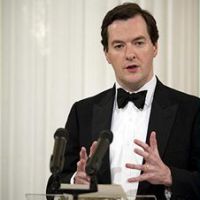
A couple of weeks on holiday, and there's plenty to catch up on.  First, though, George Osborne's speech to Mansion House yesterday evening.  In terms of substance, it was fairly radical stuff.  And it's encouraging that so many of the Tories' solid plans for reforming the financial regulatory system have survived the coalition process.  But, really, it was one simple, little sentence which jumped out at me.  This: "Debt [is] set to still rise even at the end of this five year Parliament." "So what?" you may be thinking, "we knew that already."  Ah, yes, but we've rarely heard a politician be quite so upfront about our debt position before – at least not voluntarily.

Darling pulls a fast one

From our UK edition

Alistair Darling has just forced George Osborne to the dispatch box to explain the regulatory measures that he will announce at Mansion House later today. Osborne confirms that some powers will return to the Bank of England and that an independent commission, under Sir John Vickers, will take into account competing views on capital, leverage and liquidity requirements. Retail and investment banking will be split under the new arrangements. This is effectively the end of the tri-partite system. Alistair Darling defends the tri-partite system in its entirety, arguing that no one will understand from 'this dog's breakfast' who now regulates the banks - talk about undermining confidence, which the opposition was condemning less than half an hour ago.

How Hughes will play the coalition

From our UK edition

Simon Hughes is an experienced campaigner, whose reputation is deservedly blemished by a handful of duplicities – Peter Tatchell, denying a referendum on the Lisbon Treaty and the like. Hughes has just appeared on the Daily Politics and, very subtly, split the Lib Dems from the Tories. It was very simple: the Tories are responsible for all that’s bad and the Liberal Democrats are benevolent. First, Hughes dissociated the Liberals from tax rises: "I hope that the chancellor's hearing the voices that says VAT is not the right tax to change in the budget next week." Those voices are, of course, his ‘colleagues in the Treasury’ – an enlightened check on George Osborne’s excess.

Osborne’s headache

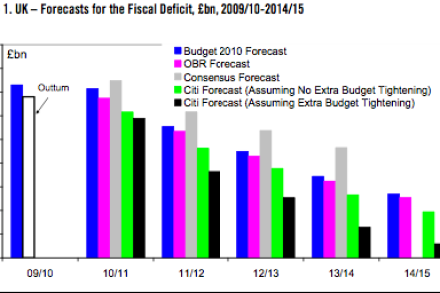
From our UK edition

The below chart sums up the extraordinary announcement from the Office for Budget Responsibility. George Osborne did his best to maintain the “things are worse than we thought” line but the reverse is true. Unemployment, inflation, the deficit – everything is better than not only the Treasury forecast but better than the market had been preparing for. (And Citibank, which compiled the graph, thinks things will get better still – because the economy will keep surprising in the upside).   I have a piece in the Daily Telegraph saying that this will be deeply irritating for Osborne.