George osborne

Debt as a threat to national security

From our UK edition

Today’s papers carry news that British nuclear submarines are going to be replaced: a strong indication that the government will replace Trident with a like-for-like deterrent in 2016, contrary to the wishes of the Liberal Democrats. Philip Hammond appeared on the Sunday Politics earlier today to answer questions from Andrew Neil on Trident and manpower cuts to the army. Hammond said that the Trident decision has not been taken. The government is, he said, simply ensuring that Britain can implement whatever decision is taken. On army cuts, he said, ‘We [Britain] will still be able to make a major contribution to a cross-alliance operation.

The return of Osborne’s good spirits — and his cat

From our UK edition

The most important event today is the Greek election, with its huge implications for the future of the Eurozone. But this morning, the political class is chattering about George Osborne because of the poll which Fraser blogged about earlier. Osborne is one of the more self-aware politicians that you’ll meet. One colleague says, only half-jokingly, that Osborne’s mood is the best guide there is to the future prospects of the government.  In recent weeks, Obsorne has not been in good form—his post Budget woes and the never ending crisis in the Eurozone appeared to be getting him down. As one person who works closely with him remarked to me recently, ‘That Tiggerish glint in his eyes had gone.’ But Osborne’s mood has improved in the last week.

Osborne, class and competence

From our UK edition

The Sunday Mirror and the Independent have jointly commissioned an opinion poll which finds that George Osborne is ‘too posh’ to be chancellor. This just happens to fit the prejudices of both newspapers, and I for one do not believe it. Poshness certainly obsesses Tory strategists, and Gordon Brown sometimes played the class card because he saw how much agony it caused them. But Brown’s card was not the winning trump he hoped for because the British public is not as obsessed about class as the British elite. That’s why it backfired when Labour tried a class strategy in the Crewe by-election campaign. That by-election suggested that the average British person cares more about competence than class. This is Osborne’s present problem.

Language, politics and debt

From our UK edition

The myth that George Osborne has held firm on his deficit reduction plan persists. When I was on Question Time last month, Alan Duncan said that Osborne may have changed some policies but he had not budged an inch from the deficit reduction programme. This was not a porkie; he genuinely believes this to be true. And even in today’s FT, economics editor Chris Giles describes the government’s strategy as ‘maxing out on stimulus measures, short of relaxing deficit reduction.’  In fact, Osborne tore up his deficit reduction plan ages ago, but to minimum press comment.

Osborne leans on King

From our UK edition

What we saw at the Mansion House last night gave us some hints of where British economic policy will go if the Eurozone start to fragment. For the moment, Osborne is persisting in getting the Bank of England to do the heavy lifting using monetary policy rather than attempting a fiscal stimulus. The first line of defence is what one source described to me as ‘highly active monetary policy.’ The fact that the chancellor has persuaded the notoriously prickly Bank Governor to offer loans against weaker security is a definite success for him and a sign that he’s developed a far better relationship with King than either Brown or Darling.

Osborne’s debt spiral

From our UK edition

‘If we lose sight of the central role of debt in this crisis, we will come to the wrong conclusions about how to respond,’ said George Osborne last night — before announcing another massive tranche of debt. The Mail and The Telegraph put it at £140 billion, the Times and the FT at £100 billion and Bloomberg at £5 billion a month. ‘The government, with the help of the Bank of England, will not stand on the sidelines and do nothing as the storm gathers.’ CoffeeHousers may hear an echo of Gordon Brown’s language here, contrasting advocates of a Keynesian spending plan with the ‘do nothing Conservatives.

Osborne, competitiveness and confidence

From our UK edition

George Osborne will formally unveil the government’s banking reforms in a speech at Mansion House later this evening. The reforms are in line with the recommendations of Sir John Vickers’s Independent Banking Commission (ICB), as laid out by the Treasury, which published this White Paper earlier today. For those who’ve forgotten, Vickers suggested splitting retail and investment banking through a Glass-Steagall-type ‘ring-fence’ mechanism that would protect retail, SME deposits and overdrafts while commanding that the ring-fenced part of the bank is not dependent on other departments for liquidity.

The View from 22 – is HS2 the rail to nowhere?

From our UK edition

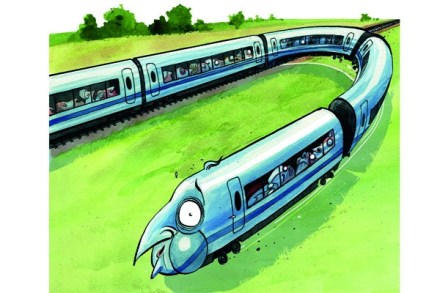
Is High Speed 2 headed for the sidings? In our cover feature this week, Ross Clark examines why the ambitious infrastructure project — designed to boost Northern cities — has all but disappeared from the government's agenda. Despite the chancellor's 'boyish enthusiasm for fast trains', the project has lacked the essential support from private business. Now, more pressing issues have taken charge.   In our View from 22 podcast this week, Ross explains why the Tories were once so enthusiastic about the High Speed link to the North: 'It was a way for the Tories to say — as part of their decontamination  of the Tory brand — look, we're putting the interests of the North above these posh home owners in the south?

Tory minister: HS2 is ‘effectively dead’

From our UK edition

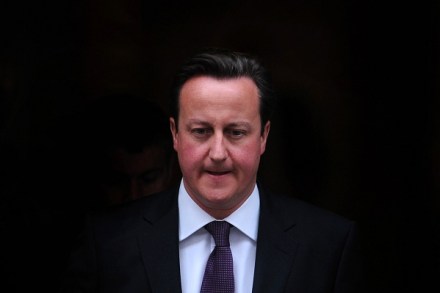
Why was David Cameron so lukewarm in his endorsement of HS2 at PMQs today? (In response to a question about the project's future, he offered, 'I believe we should go ahead with HS2', which is rather than different to asserting that it will go ahead.) The project is – as one Tory minister has told The Spectator – ‘effectively dead’. Ross Clark has investigated why in the cover story of tomorrow’s issue. Here’s what he found: 1). George Osborne has turned against it. The chancellor and Tories’ strategic brain was once HS2’s biggest cheerleader, but experience of office has made him realise that Britain’s limited airport capacity is a bigger threat to economic growth.

Dissenters against Osborne

From our UK edition

George Osborne has much to ponder this morning. First, there is the small matter of his evidence to the Leveson Inquiry later today (assuming that someone can check Gordon Brown's loquacity), which will prove diverting for those who remain gripped by those proceedings. Then there is the larger matter of the £80bn Spanish bank bailout. Osborne has welcomed the rescue, arguing that the Eurozone must survive and thrive if Britain is to prosper. His analysis is that the crisis on the continent is impeding domestic recovery. Fraser argued yesterday that this is a half-truth which verges on being a conceit. A number of Conservative backbenchers share Fraser’s scepticism and they have loosed-off volleys of criticism at the chancellor in today’s press.

Leveson summons the big dogs

From our UK edition

Gordon Brown, Sir John Major, Ed Miliband, Harriet Harman, Alex Salmond, Nick Clegg, George Osborne and David Cameron will appear before the Leveson Inquiry next week, for what will be the inquiry's last week of evidence. All eyes, of course, will be on Cameron, who is due to appear on Thursday. He will be embarrassed once again by his past proximity to disgraced News International executives, and his handling of the News Corp BskyB takeover. He previewed his likely answers on BSkyB in an interview with Andrew Marr last week. He said that his intention was for Vince Cable to marshal the bid, but that was scuppered by Cable’s preposterous comments about ‘declaring war’ on the Murdochs, made to Telegraph journalists posing as concerned floozies.

Osborne’s City safeguards

From our UK edition

Before David Cameron’s trip to Berlin later today, George Osborne appeared on the Today Programme to emphasise that in the event of a Eurozone banking union, Britain would require safeguards.   Given the importance of finance to this country, Cameron and Osborne can’t accept anything that creates a two-tier single market for financial services. The Tory leadership is also acutely aware that it was this issue that led to Cameron vetoing a proposed treaty last year. It would be politically dangerous for Cameron to do anything that could be characterised as undermining his own veto.   One option being floated by some Tory Eurosceptics is a British veto on financial services.

Egan-Jones cuts UK credit rating

From our UK edition

Even as the Queen’s Diamond Jubilee BBC Concert rocked on outside Buckingham Palace (amid the slightly worrying news that the Duke of Edinburgh is in hospital), some bad economic news came in — rating agency Egan-Jones has cut the UK’s credit rating to AA-minus with a negative outlook, from AA. ‘The over-riding concern is whether the country will be able to continue to cut its deficit in the face of weaker economic conditions and a possible deterioration in the country's financial sector,’ Egan-Jones said in its statement, according to Reuters. ‘Unfortunately, we expect that the UK's debt-GDP [ratio] will continue to rise and the country will remain pressed.

Watch out, Dave

From our UK edition

There is a cracking scoop in today’s Mail on Sunday. An anonymous Tory backbench MP has excoriated George Osborne’s performance as Chancellor. The MP repeats many of the arguments made by Fraser on Thursday, as the latest lines of the Budget were excised. Osborne is, apparently lazy, uninterested in economics and hubristic. The MP implies that Osborne’s mind is not sufficient to pull this off as chancellor. He writes: ''[Nigel] Lawson used to say that he had to work 18 hours a day and virtually gave up alcohol just to keep on top of things when he was Chancellor. And he had a formidable intellect to start with.

Osborne versus wind farms

From our UK edition

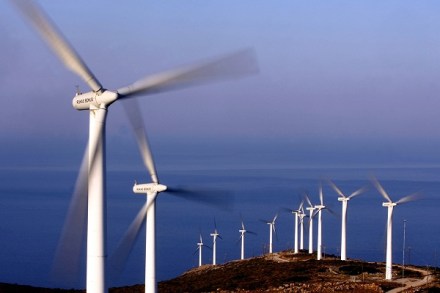
Here’s a U-turn that we can all welcome: felling the wind farms. Matt Ridley described, in a Spectator cover story some while ago, how George Osborne has turned against them. Today, the Observer has more details, saying that Osborne is:     As Ridley argued, wind farms are a ‘monument to the folly of mankind’, representing the triumph of ideology over reason. We could not afford them in the boom years, and we certainly can’t now. The subsidies make a small number of rich people even richer, and a huge number of companies are doing very well from the renewable energy racket. But if you apply rational analysis to it — ie, how much energy does it produce for the money it costs? — there is no reason at all. They generate just 0.

Osborne’s falling star

From our UK edition

It’s tempting to see comedy in the government’s 30th U-Turn, but there’s a more serious side to this. It fits a pattern: act first, think later. The lack of special advisers in government is part of the problem. Even in the Labour days, I argued for more and better political appointees to help a reforming government get its agenda through. But the problem this time was George Osborne’s chillaxing approach to being Chancellor, coupled to what seems to be a casual disregard for detail. This approach was embodied in his decision to join Cameron on White House jolly the week before delivering his shambolic Budget. It makes you wonder if his growth strategy (or what purports to be his growth strategy) has had enough thought put into it.

Osborne’s gambles

From our UK edition

There is now a general acceptance that the Tories’ 2015 election manifesto will contain a pledge, dare one say a cast-iron guarantee, that voters will be offered a referendum on Britain’s relationship with the EU. James first revealed this in his magazine column a few weeks ago. The aim is to see off the surge from UKIP, prevent Labour from opportunistically seeking Eurosceptic ground, and to counter Boris Johnson’s popular adoption of the People’s Pledge. Since then it has been taken as read that George Osborne is responsible for this gambit, which is reasonable given that he is the Tories’ chief strategist, and a likely contender in a future leadership bid.

A good day to…

From our UK edition

While Jeremy Hunt was casting about, trying to save his political life at the Leveson Inquiry, the Treasury issued its latest u-turn: the expected volte face on charitable giving. Interestingly, the Sunday Times' Isabel Oakeshott reveals that yesterday she arranged to meet 2 senior Treasury officials this morning, but the meeting was postponed earlier today, which might suggest that the decision to drop the controversial tax change was taken at very short notice. If so, what does that say about the Treasury's view of unfolding events at the Leveson inquiry? Where, in addition to the pressure on Hunt, George Osborne has been implicated in elements of the BSkyB deal by Hunt while under stern examination from Robert Jay QC. In terms of the u-turn, there are two schools of thought.

How did it all get so complicated?

From our UK edition

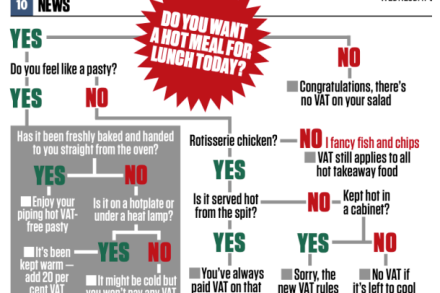
Further to Pete's blog on the new rules about pasties and VAT, the below graphic from today's City AM sums it up perfectly. It does, of course, make the case for tax simplification — which is what George Osborne was trying to do in the first place.

So let’s get this straight…

From our UK edition

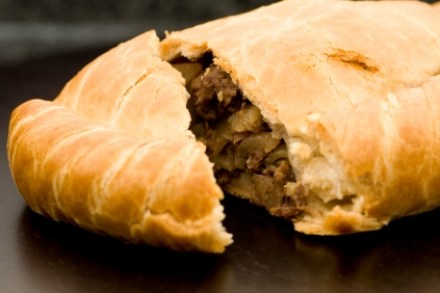
After today’s VAT changes: a) If you walked into a pasty shop and bought a pasty that has been kept hot in a cabinet (or in foil, or on a hot plate, or whatever), then you WOULD pay VAT. b) If instead that pasty had come straight out of the oven, then you WOULD NOT pay VAT. c) If the pasty was cold, or had been left to cool, you WOULD NOT pay VAT. d) If the pasty was cold, and then reheated in an oven or microwave before being handed over, then you WOULD pay VAT. e) If the pasty was being kept hot in a cabinet when you ordered it, and then it was taken out to cool before being handed to you, would you pay VAT or not? It wouldn't have cooled naturally from exiting the oven, as the government seems to specify — but it has been left to cool, after all.