Gaza

Is a Saudi-Israel deal now off the table?

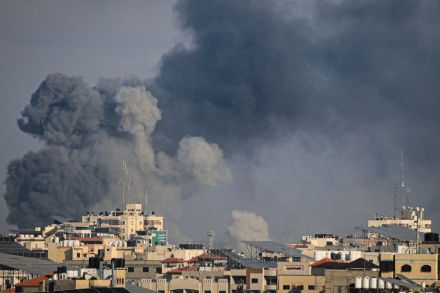
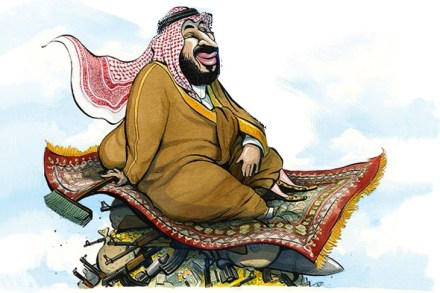
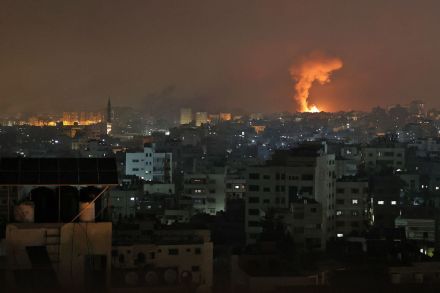
Joe Biden can point to a few concrete foreign-policy accomplishments during his presidency thus far. Ukraine would be in far worse shape against Russia were it not for the financial, economic and military assistance the White House has provided. Washington has also done a commendable job getting Japan and South Korea back on speaking terms after years of bickering. Yet both of these items are tactical in nature and aren’t going to bring Biden into the history books. Shepherding a comprehensive normalization agreement between Israel and Saudi Arabia, however, just might. That was, until an unprecedented Hamas-led attack into Israel threw a wrench into his plans.

saudi

Pro-Hamas protests sweep the US

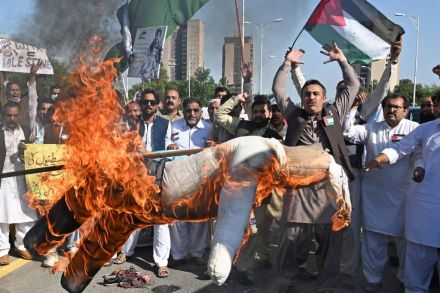
As the bodies of hundreds of Israelis lay freshly butchered by Hamas terrorists, the group’s supporters from around the world celebrated — including by mourning the dead terrorists and cohosting a rally with a designated terrorist group — and urged them to “globalize the intifada.” The rallies sprouted up almost immediately after Hamas stunned Israel by launching a surprise attack, likely with Iranian assistance, on the fiftieth anniversary of the Yom Kippur War. The images of Israeli grandparents and infants being held hostage, and of Israeli villages being wiped out shocked the world. It wasn’t just Israelis who were murdered, however; nine Americans have already been confirmed among the dead, along with German, French and Cambodian citizens.

hamas

Can Israelis trust the UN?

From our UK edition

You probably think you’ve heard every story there is to hear about people getting fired over their tweets. Well, here’s the story of Sarah Muscroft. She’s got them all beat. Until last Friday, Muscroft was the head of the UN Office for the Coordination of Humanitarian Affairs in the Occupied Palestinian Territory (OCHA). For 72 hours beginning on 5 August, Islamic Jihad fired 1,000 rockets into Israel and Israel responded with 170 counterstrikes, with the terrorist group citing as its pretext Israel’s targeted killing of two of its senior commanders and the arrest of dozens of its members. Eventually, a ceasefire was brokered with the assistance of Egypt.

Priti Patel’s Hamas ban doesn’t go far enough

From our UK edition

It’s been a rough old week for Hamas. The UK announced plans to proscribe the organisation, Justin Bieber ignored its call to cancel his 2022 concert in Tel Aviv, and even the recently friendly Labour party has vowed that it ‘does not and will not support BDS’. One minute, you’re going about your business, trying to drive the Jews into the sea, and the next you’re being treated like you’re the bad guy. Priti Patel’s decision to add Hamas to the Home Office list of terrorist organisations corrects a 20-year-old error which saw the Izz al-Din al-Qassem Brigades — Hamas’s paramilitary wing — outlawed in 2001 but the rest of the organisation unaffected.

The war Israel is losing against Hamas

From our UK edition

The Gaza conflict is bloody, brutal, and genuinely heartbreaking, but it is also perfunctory. This is a fight in which the military battle is predetermined: Hamas cannot win, and Israel cannot lose. What happens in between is almost balletic in its endless predictability. Hamas fires rockets, Israel fires back; Hamas targets Israeli cities; Israel bombs buildings in which Hamas hides and stores weapons. So what’s the point? Well, apart from Hamas needing to show strength – and Israel needing to, in the words of its security experts, 'mow the grass' by periodically degrading Hamas’ military capabilities – there is a wider battle raging. This fight isn't about missiles or rockets but about narratives; to fight you need a reason.

The problem with the New York Times’ Gaza coverage

From our UK edition

While war raged between Israel and Gaza, the New York Times published a powerful montage of 64 minors said to have been killed in the conflict so far. Under its famous motto ‘All the news that’s fit to print’, and with the headline ‘They Were Just Children’, America’s paper of record informed us that ‘they had wanted to be doctors, artists and leaders’, and invited us to read their stories. It was impossible to look at those innocent faces without feeling deeply distressed.

How London became a hub for Hamas

From our UK edition

As the dust settles over Gaza, and Israel’s Iron Dome sensors cool, minds inevitably turn to the lessons that can be learned from the 11-day conflict that cost hundreds of lives. Foreign Secretary Dominic Raab, the American secretary of state Antony Blinken, and other international dignitaries have visited the region and offered their carefully calibrated support for ‘both sides’ delivering high-handed lectures on the ethics of asymmetric warfare in densely populated urban sprawl. Sadly, however, the British government has become part of the problem. It may have deep military and security ties to the Jewish state, but there lurks an elephant in the room. London itself has been allowed to become one of the world’s most important Hamas hubs.

We need to talk about anti-Semitism among the West’s Muslims

I’ve spent a good part of my adult life writing about US policy towards Israel and the Palestinians. To put all my cards on the table, I’m firmly in the camp that the US should adopt a less one-sided policy that puts firm conditions on the military aid that we give to Israel in order to pressure the country to respect Palestinian human rights. But there is a certain trap that a lot of the left tends to fall into when they take sides in conflicts such as these — where you have a weaker party quarreling with a much stronger party.

anti-semitism

Elite anti-Semitism at the Boston Globe

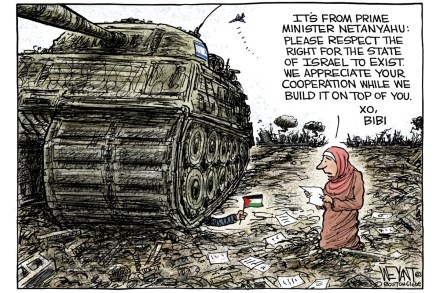
Some people think the vicious attacks on Jews happen only in Times Square or in Los Angeles restaurants. Not so. They think the apologists for these crimes are limited to the Squad and extreme leftists, some of whom actually tweeted it is wrong even to condemn anti-Semitism. That sewer of hatred would be dreadful enough, but the problem is bigger than that. The thugs on the street have some ideological backing from the mainstream media and, of course, universities. Take a truly noxious cartoon in the Boston Globe, one of America’s most prominent newspapers. It appeared in the May 22 print edition (page A9) and online on May 21. The drawing and text by Christopher Weyant efficiently consolidated elite hatred of Israel and Jews into a neat, toxic mix.

boston globe anti-semitism

Will they let in Gazans at the Soho House Tel Aviv?

A regular column by an anonymous whistle-blower operating deep within the heart of the Social Justice Movement. To protect their identity, they will go under the code-name ‘They/Them’. Wokeyleaks is a confidential news leak organization for anyone who wishes to divulge classified information (and hilarious anecdotes) about woke culture without fear of getting canceled. To any would-be Edward Snowflakes out there: leak your woke-culture war crimes to wokeyleaks@protonmail.com. We promise to protect our sources. Having spent a lot of time in Brooklyn, I find it easier to understand Israel’s occupation of Palestine not as a ‘religious conflict’, but as a kind of militarized gentrification.

soho house tel aviv

The disinformation war continues between Israel and Hamas

From our UK edition

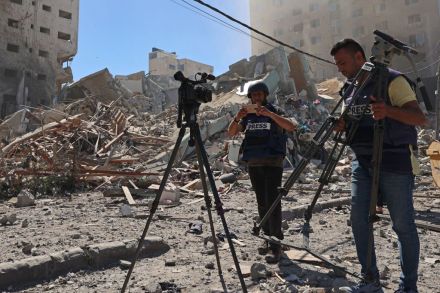
The ceasefire between Hamas and Israel has started, and the gates to Gaza have opened for the international press. Now a new battle will begin over numbers and ratios. There will be calls for investigations, and endless debates about who ‘won’. Israel’s claims of precision targeting will come under scrutiny, but so too should Palestinian accounts, including claims of mass civilian deaths. At least 243 people are reported to have died in the Gaza Strip during Israel’s military action, including a reported 65 children. These figures rely on claims by the Gaza Health Authority – an unreliable body under Hamas control.

How Israel won the war

From our UK edition

Golda Meir, Israel’s first female Prime Minister, once said that when forced to choose between being ‘dead and pitied’ or ‘alive with a bad image’, her country would opt for the latter. Now that Israel and the Gaza militants have agreed a ceasefire after 11 days of fighting, these words ring truer than ever. Both sides will now strive to present a ‘victory picture’ to their peoples and to the world. But while Jerusalem may have lost the propaganda war – anti-Israel feeling and antisemitism is surging both in Europe and the United States – it emerges from this conflict the strongest, its security boosted by a hugely degraded enemy.

Why do parts of Britain erupt whenever Israel defends itself?

From our UK edition

There has been a huge amount of comment in recent days on the latest round of exchanges between Israel and the terrorists of Hamas and Islamic Jihad in Gaza. As usual whole slews of celebrities and other important figures on the international stage have lamented the fact that Israel has put so much effort into the defence of its own citizens. As usual these ignoramuses cry about 'disproportionate' death tolls. As though it would all be a lot fairer if Israel turned off the Iron Dome system for a night or two and let the increasingly sophisticated weaponry of its enemies rain down, unmolested, upon its people. But all this, and much more, has been rehearsed a thousand times before. From the UK there is only one interesting observation that can be made about this conflict.

Hamas, not Israel, is to blame for the latest bloodshed

From our UK edition

I was born in the Jordanian-occupied Old City in Jerusalem and lived in a UN refugee camp from 1966 until 1999. During the First Intifada, I worked for B’Tselem, the Israeli Information Centre for Human Rights in the Occupied Territories, and in 1996 I founded the Jerusalem-based Palestinian Human Rights Monitoring group. With my background in Palestinian campaigning and as a resident of East Jerusalem today, you might assume that I am against Israel’s current military actions. But this could not be further from the truth. The blame for this month’s bloodshed lies solely at the feet of Hamas. Those who wish to divert attention from Hamas’s war crimes would like to blame the latest conflict on a complicated legal dispute in the Sheikh Jarrah neighbourhood.

The decline and fall of the Associated Press

Once, long ago, in a land far away, the best journalists tried to stand aloof from the stories they reported. The idea was simple and powerful. If journalists tried to be neutral and kept their reporting separate from their opinions, analysis, and speculation, then the public would believe them. Those days are long gone — and the media’s credibility is gone with them. Journalists and media organizations are now smack in the middle of many stories they cover, in part because they want to be. They want to spin them, to set ‘the Narrative’. Imbued with this new mission, many journalists have become partisan protagonists.

associated press

Hamas’s rockets are killing Palestinians too

From our UK edition

Israel’s military action in Gaza is widely reported daily across the world. Images of hundreds of rockets lighting up the skies over Israeli cities and of the rubble of destroyed buildings in the Gaza Strip are once again part of the daily cycle of print and broadcast news. But most reports are thin on details of Israel’s military activities. What exactly are their aims? How are they pursuing them? And how much success are they having? Often Israel’s military activities seem baffling to the wider world. The country’s reluctance to give a detailed, running-commentary on every strike frustrates journalists and citizens, who then assume the worst of motives for these unexplained acts.

Don’t compare Israel to Hamas

From our UK edition

No, not this time, Boris. The Prime Minister’s ‘both sides’ response to the terrorist attacks on Israel underscores how Western political elites — left, right and centre — lose all critical reasoning when it comes to one tiny strip of land in the Middle East. Israel is under assault from Hamas, the Islamist mafia that runs Gaza like 19th-century Sicily. This follows tensions over the policing of holy sites during Ramadan; a spate of violent street incidents between Israelis and Palestinians; marching and incitement by the Israeli far-right; Palestinian rioting in Jerusalem; and Arab-Israeli rioting outside the capital.

Israel’s worrying descent into violence

From our UK edition

I didn’t hear the boom on Monday night. I didn’t hear the siren either, due to some loud renovations. Sitting at my desk in the bomb shelter in my flat that doubles as a home office, I found out we were under rocket attack by reading about it on Twitter. With the blast door and inch-thick steel window plate closed, I waited for the all-clear. A few minutes later, minor damage was reported to a house just outside Jerusalem, hit by shrapnel from a rocket that flew 40 miles from Gaza. Others were intercepted by the Iron Dome anti-rocket system. A dramatic end to Jerusalem Day, when Israel celebrates the reunification of the city under Israeli rule in 1967.

How Netanyahu gains from the death of Baha Abu al-Ata

There’s a lot going on in Israel. Due to indiscriminate rocket fire from Palestinian Islamic Jihad in Gaza, schools in many Israeli cities, including Tel Aviv, were closed on Tuesday. Some have already been closed for Wednesday. The rockets target anyone and anything, and give everyone, young or old, the same amount of time, usually under one minute, to seek cover. Thanks to the shelters and Iron Dome, an air defense system which today had an interception success rate of 90 percent per the IDF, these rockets typically result in few Israeli deaths. But the collective psychological trauma of constantly being under fire is impossible to measure.

gaza palestinian islamic jihad baha abu al-ata

The art of the bad deal

On the late afternoon of September 29, 2000 (nearly 20 years ago now), I took a cab from Jerusalem into Bethlehem to visit with an old friend and his family, the owners of a well-known Bethlehem hotel. The streets were bustling; buses filled with tourists roared up the main Jerusalem-to-Bethlehem road towards the Church of the Nativity (the reputed birthplace of Jesus), and the city’s gift shops were jammed. My plan was to stay the night, but my friend (a Palestinian Christian who’d moved to Bethlehem from Philadelphia), shook his head: ‘No room at the inn,’ he said, and smiled at his joke. ‘In fact, you won’t find a room anywhere in the city.’ I was surprised. In all of my years traveling to the West Bank, Gaza and Israel, I’d never had trouble finding a place to stay.

jared kushner time gaza