Friendship

Do I have too many friends?

From our UK edition

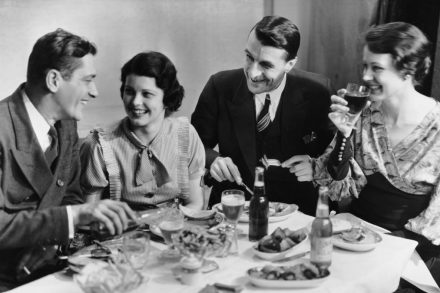
Can one have too many friends? I asked myself this question as we prepared yet another dinner party for ten people, at which I ate and drank far too much as usual. Forget bikini body – it’s kaftan time in Saint Tropez at the moment for me. We’ve been at our villa in the South of France for nearly three months this summer and during that time we have hosted 34 guests, who stayed anywhere between three days and two weeks. We’ve hosted two daughters, one son, in-laws and cousins, several dozen friends and one baby granddaughter, and they have kept Percy and me on our social toes. But we really truly enjoy it, as most of the time the majority of our guests know how to behave in other people’s homes. However, some most definitely do not.

In search of kindred spirits: An Absence of Cousins, by Lore Segal, reviewed

From our UK edition

In Lore Segal’s An Absence of Cousins, Nat Cohn, a fellow at the Concordance Institute, a small college in Connecticut, browses through a children’s novel during a staff meeting and exclaims: ‘We don’t write stories like this any more. Chronic plot deficiency is our problem.’ The problem for contemporary novelists is that tightly woven plots of cause and effect belie the way their readers experience the world. Like her compatriot Elizabeth Strout in Olive Kitteridge and Olive Again, Segal addresses it by featuring a single protagonist, Ilka Weisz, a young Austrian émigrée, and various recurring subsidiary characters, in a series of closely interlinked stories.

Next time, I’m swimming to Calais

From our UK edition

Friends in Calais invited me to their baby’s birthday party. He’s a year old. They suggested an overnight stay and I planned to reach France by about mid-afternoon and have a stroll, visit the sights, buy a bit of tat for the nipper and a litre of plonk for the proud parents. Clouds of sweet diesel vapour enveloped me. My pulse quickened. In the 1970s, it all smelt like this The morning express sped me south and I was entertained on board by the Bing-Bong Pixie who referred to the train as ‘this 10.02 service from London Victoria to Dover Priory’. She recited the name of every stop on the line and repeated it twice each time we reached a new station. Her chirpy tone concealed a rather malevolent side.

My (surprisingly) decent proposal

From our UK edition

‘Like being chained to a lunatic.’ That’s how a man feels in relation to his libido. And the lunatic latches on to anything, irrationally, and without warning. In Cambridge recently I dropped into a lecture given by a beautiful historian, Lea Ypi, from Albania, whose discourse included this observation about revolutionaries: ‘Once they attain power they lose all interest in revolution.’ Good point. Her blonde hair spilling over her shoulders absorbed far more of my attention than her political reflections and I was desperate to speak to her afterwards, but I had no way to orchestrate a meeting. She raised one eyebrow at me suggestively.

My friends keep dumping me

T.S. Eliot was wrong. April is not the cruelest month — January is. It’s cold and bleak and days end in premature darkness. And worst of all, it’s the month when friends start to dump you. OK, maybe not you, but definitely me. Here was my January dump tally: two ex-girlfriends, one lover, five friends (three I thought were close friends) and one person I never wanted to be friends with in the first place. And get this: I do what’s called “befriending” for a local charity. It involves calling people who feel lonely and isolated on the phone and talking with them. The woman I’d been befriending for over two years suddenly said to me, “Please don’t call me anymore. This relationship isn’t working for me,” and just hung up. There were no thanks. No goodbye.

friends

Dear Mary: should I ever pay for dinner on a date with a feminist? 

From our UK edition

Q. I took a girl out for dinner last week to a rather expensive restaurant. At first we got on well but then the conversation went on to politics and I spent the next 45 minutes listening to a fourth-wave man-hating feminist. Despite her stance that women should share every opportunity that men have (which I agree with incidentally), when the bill came she didn’t even gesture to put her hand in her pocket. Was I right to be so annoyed? – N.F., London SW7 A. I ran this past another fourth-wave feminist. Her view was that the girl’s ideology was not incompatible with your paying for her dinner on the grounds that ‘he probably suggested the restaurant and he is probably on a much higher salary than she is’.

A study of isolation: The Late Americans, by Brandon Taylor, reviewed

From our UK edition

The Late Americans, Brandon Taylor’s second novel, follows the lives of a group of friends living in Iowa City over the span of a year. Early on, Seamus, a poet completing his master’s degree, imagines an ‘indifferent God... squinting at them as they went about their lives on the circuits like little automata in an exhibit called The Late Americans’, and this is a fine description of the novel. Each character is the focus of a chapter, and we watch as Seamus, Fyodor, Ivan, Timo, Noah, Bea, Fatima and Daw’s lives overlap, in bars, seminar rooms and dance studios, while they negotiate their place in a world determined by their race, class and wealth.

The case for culling friends

From our UK edition

Since I’m so old – 64 this summer – Facebook has always been my preferred form of social media. But if I was a softer soul there’s a feature on it that might really tug at my heartstrings: 'See your memories.' Because many of mine – going back more than a decade – are now blank of any actual memory: 'Content not available.' I know what these were: photographs of me with ex-friends (they’d always take the selfies, as I don’t have a camera-phone) who I’ve fallen out with and who have since deleted the photographs. In 90 per cent of cases, I’d say that I was the one who caused the falling-out.  If I’m being honest, I don’t miss any of them.

The close friend I never really knew

From our UK edition

I have just read an extraordinary new book. It’s by a close and old pal whom I’d count as one of my best friends. He was my lodger in London for ten years. His book is autobiographical. And I now realise I never knew him at all. In Don’t Ask Me About My Dad, Tom Mitchelson charts a life story that is entirely strange to me, and shocking. And yet the weird thing is that I know many of the people in it – or thought I did. His late father, Austin, who helped launch the Sunday Sport, I met and thought a likeable if flaky chap, and good company. He turns out to have been the most appalling wife-beater, liar, drunkard and debtor.

Friendships and rivalries in the golden age of Oxford philosophy

From our UK edition

Though it is startling to think of it now, analytic philosophy was once considered a promising subject for satire on mainstream television. When Beyond the Fringe was broadcast in 1964, the viewing public could apparently be relied upon to recognise the archetype of the post-Wittgensteinian linguistic philosopher being impersonated by Jonathan Miller and Alan Bennett. The discursive style on display was anguished, effete and reflexively pedantic; the setting, a kind of implied common room (the only atmosphere this particular creature was able to breathe); the repartee hopelessly clogged with qualifications and smug little obiter dicta and minutely alert to exquisite verbal distinctions of doubtful relevance to the point in hand.

The other cancel culture

London, England We discuss and denounce the cancel culture of the woke all the time, but there’s another type of cancel culture that we never mention — the cancel culture of our friends. We cancel each other all the time. You arrange to meet someone and suddenly — you’re canceled! It happened again to me last week. I’d arranged to see a good friend when, a few hours before our meeting, up popped a text that read: “Sorry. Have to cancel x.” She offered no explanation. No signs of regret or guilt. Not even the suggestion that we reschedule our meeting. She wanted to cancel and so, I was canceled. In some ways this is nothing new.

cancel

Amsterdam explores friendship in a complicated world

David O. Russell is one of a small handful of directors whose involvement with a project is enough to get me to see it immediately. From the offbeat energy of Silver Linings Playbook to the tangled period drama of American Hustle, his films are tightly edited and always thick with talented actors. Amsterdam, his latest, is no exception. While it’s thematically fluffy and periodically tends toward the indulgent, it's never anything less than entertaining. There are far worse ways to spend a few hours, especially in the midst of a cinematic drought. Picking up in 1933, Amsterdam is the tale of two injured World War I veterans, slightly disreputable doctor Burt Berendson (Christian Bale) and successful attorney Harold Woodman (John David Washington).

Dear Mary: How do I get my friends to leave after a dinner party?

From our UK edition

Q. We have made available our mews cottage – 30 yards from our main house – to a woman with small children, who has had a tough time recently through no fault of her own. She will be staying pending her divorce. Our problem is that she keeps asking us to dinner. We like her and she is a good cook and we understand that she is trying to give something back since we are not charging rent. However, our lives are just too busy to see even our very best friends more than once a month. We can’t use any of the normal excuses, e.g. that we are away or have people ourselves, because she can see us from her window. What do you suggest, Mary? – Name withheld, London W2 A. Decide to write a book. Why not actually write one?

Why your more successful friends will drop you

From our UK edition

You might have noticed the numerous glowing pieces by friends of Salman Rushdie about their ‘brave’ and ‘brilliant’ friend. I too would like to write a glowing piece about my brave and brilliant friend Salman Rushdie, but there’s one little problem: I’m not a friend of his. In fact I don’t have any famous novelist friends. I used to. There was the occasional lunch with Nick Hornby and the odd debauched evening with Will Self. I’ve drunk whisky with Norman Mailer and smoked pot with Ken Kesey, author of One Flew Over the Cuckoo’s Nest. (And I have a lovely thank-you letter from Edward St Aubyn – does that count?

Dear Mary: How can I find out whether old friends fancy each other?

From our UK edition

Q. How can I find out, without making things awkward, whether one of my close male friends fancies one of my close female friends? They have known each other for years but until recently were both in long-term relationships. Now she has developed a major crush on him. Is there a way I could help to move things forward? It is too risky to tell him directly, because if he’s not interested, it could spoil the whole dynamic of our group. – Name and address withheld A. Wait till you are alone with the male friend and scrolling on your phones. Randomly mention the female’s name, e.g: ‘Oh wow, X is running in a marathon today!’ Then, in an absent-minded manner: ‘Hey – weren’t you guys an item back in the day?

Dear Mary: Can I ask our hosts to look for my husband’s tooth in the flowerbed?

From our UK edition

Q. My 74-year-old husband was having drinks in the garden of some young clients when he bit down on an olive with a huge stone in the middle. He heard a crack and picked the stone out of his mouth – along with what he thought was a splinter of tooth – and threw the bits into the flowerbed. This morning his dentist told him he had thrown away a whole crown. While he could repair the crown, it will cost £500 to create a new one. Although I would have no qualms in asking someone of our own age to scrabble through a flowerbed looking for a 74-year-old man’s tooth, I feel that a beautiful twentysomething girl would be repulsed by the request. We live too far away to drive back and look ourselves. – Name and address withheld A.

Dear Mary: How do I stop a mutual friend giving my contact details to a man I don’t like?

From our UK edition

Q. Everyone was divine at a very jolly lunch I attended in the Cotswolds with the exception of one person, who everyone else seems to know and like, but about whom I have always had a mild phobia. Fortunately I didn’t have to sit anywhere near him but when I wrote to my host he told me this particular man had asked for my contact details. I really don’t want him to make contact with me. How can I duck out of this in a diplomatic way, Mary? – N.H., Gloucestershire A. You will have to just say ‘do pass them on’. If an invitation from the feared figure is then forthcoming respond immediately. Thank him with enthusiasm but explain that since you owe so many people a return of hospitality, you have had to impose a strict rule upon yourself.

A twist on the American classic: The Sidekick, by Benjamin Markovits, reviewed

From our UK edition

On the cover of The Sidekick, just below a broken basketball hoop, a quote from Jonathan Lethem suggests Benjamin Markovits is a ‘classic American voice’. Open the book and the first sentence – ‘I was a big slow fat kid but one thing I could do was shoot free throws’ – confirms the kind of American classicism we can expect: Salinger-conversational, Updike-melancholic, Roth-confessional. Male and white, in short. A decade ago, when The Sidekick is largely set, this would be hardly worth mentioning, but for a new novel to stand on such patriarchal shoulders now feels curiously old-fashioned.

A podcast with real emotional heft: Philippa Perry’s Siblings in Session reviewed

From our UK edition

Have you ever taken a piece of advice? I’m not asking a rhetorical question. Have you ever once in your life been given a piece of advice that you’ve then acted on? I ask this question a lot at parties, and generally find the answer is: ‘No, not that I can think of.’ It may be that when we take good advice, we begin to imagine we came up with the idea in the first place. It may be that we always just do whatever it is we were always going to do. All I can say for sure is that if you ask: ‘What’s the best piece of advice you’ve ever given someone else?’, people will keep you there all night. Best Friend Therapy bills itself as a chat between two best friends that will impart the blessings and insight of therapy.

Mismatched from the start: One Day I Shall Astonish the World, by Nina Stibbe, reviewed

From our UK edition

First the bad news: Nina Stibbe’s new novel does not feature Lizzie Vogel, the engaging narrator of the trilogy that made her name as a comic novelist after she’d first published some extremely funny letters written during her stint as a nanny in a north London household in the 1980s. Man at the Helm (2015) is the novel Dickens lacked the generosity to write, in which tribute is paid to the creative value of a chaotic childhood presided over by what the conventional world calls an unfit parent. The two which followed covered just a year of Lizzie’s teens and early twenties. The fact that our beady-eyed chronicler remains on the threshold of adult life ensures an atmosphere of optimism, despite the dark strain of jeopardy running through each of the books.