French election

The failure of Marine Le Pen

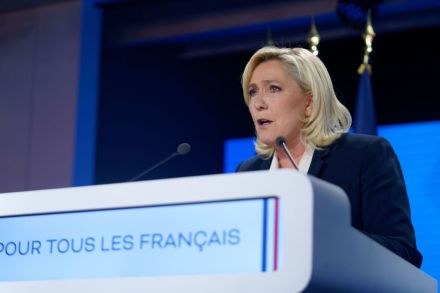
Following her second-round loss to Emmanuel Macron in France’s presidential elections last month (it was her third loss on the national stage), Marine Le Pen has announced her candidacy for the National Assembly. She hopes to win Pas-de-Calais’ eleventh constituency in June — a seat she won in 2017 — to oppose Macron’s policies in the French parliament, along with her National Rally (RN) colleagues. But she is unlikely to have much leverage. In the last parliamentary elections, the National Rally (then the National Front) won eight seats out of 577. The latest poll by Harris Interactive has them winning 65 to 95 seats this year, compared to 338 to 378 seats for Macron’s re-branded Renaissance party, which would give Macron an absolute majority.
The French have voted for the lesser of two evils

From our UK edition

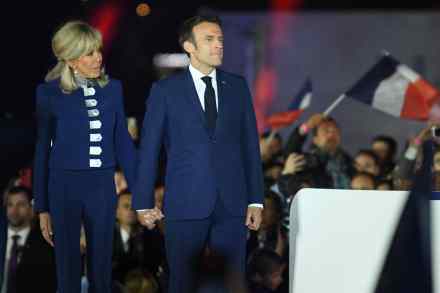
Few scenes of jubilation as Emmanuel Macron was re-elected President. French voters held their noses and voted without evident enthusiasm for five more years. French exit predictions, based on actual voting, not exit polls, are invariably lethally on target. As the polls closed they forecast 57.6 per cent for Macron, 42.4 per cent for Marine Le Pen. The official result will be certified on Tuesday but there’s no doubt. Le Pen’s political career should now be over. Yet in her combative concession speech, she sounded as if she would go on and on We were supposed to pretend that we didn’t know who had won the French presidential election until after 8 p.m. when the polls closed in the bigger cities.

Macron appears unassailable

From our UK edition

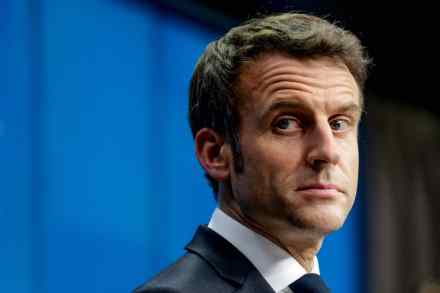
Emmanuel Macron, the President of France for whom few voters have expressed much affection, is suddenly the leader of a nation (and by dint of his presidency of the European Council, the EU) in a de facto state of economic war with Russia. He is wiping the floor with his opponents in the forthcoming presidential election, benefiting from the congruence of international events and his refusal to descend into the electoral arena. With 38 days to go before the first round of voting, the oxygen has been sucked out of the campaign. Macron’s efforts to diplomatically defuse the Ukraine crisis plainly failed – yet his approval ratings have skyrocketed, to over 50 per cent in one poll yesterday. His opposition is in danger of being reduced to a state of near irrelevance.

How democratic are the French elections?

From our UK edition

There are just 59 days to go until voters turn out for the first round of the French presidential election and it is not even clear who will make the starting gate. For now, all the pundits and the bookies are predicting the re-election of President Emmanuel Macron. But the real story is about how French democracy operates. General de Gaulle designed the Fifth Republic to keep extremists out of the Elysée. So, to get into the presidential election, a candidate must present the Conseil Constitutionnelle with 500 sponsorships (parrainages) from geographically dispersed senior elected officials. The real story is about how French democracy operates Previously this was not a problem.

France’s provocateur is coming to London

From our UK edition

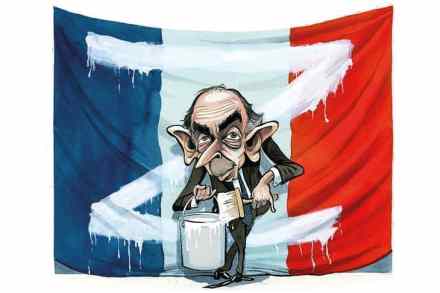
Five years ago, London’s affluent French poured their dosh into the campaign of Emmanuel Macron. This time around, supporters of France’s rising provocateur are trying a similar tactic. Eric Zemmour is the Tucker Carlson of French media. A potential rival to Marine Le Pen, he is planning a visit to London in October. His undeclared but badly concealed French presidential campaign has the backing of 'Generation Z', a shadowy group of French political consultants and fundraisers, who are looking at the monied expatriates of South Kensington and seeing potential campaign money. If Macron’s people aren’t spooked by Zemmour, they aren’t acting like it I profiled Zemmour in the magazine in March.

Le Pen is just another establishment politician

From our UK edition

One Saturday in March, I attended an anti-lockdown rally in central Paris. I was there partly out of journalistic curiosity but also out of solidarity with those Frenchmen and women who believed it was high time life returned to normal. What struck me was the similarity between the protestors and those I had walked with in 2018 in the early weeks of the yellow vest movement in Paris — overwhelmingly middle-aged blue-collar workers. The yellow vests famously had no leader because it was a protest movement that arose not out of any strong political conviction but from what the French call ras-le-bol: despair at what was perceived as an arrogant and out-of-touch political class who seemed intent on punishing the poorest in society.