France

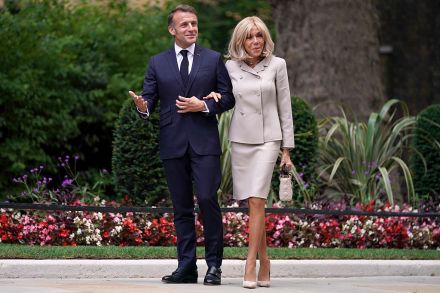
There’s something hypocritical about Macron attacking Musk

From our UK edition

Europe’s leaders rounded on Elon Musk on Monday as the American tech billionaire continued to air his views on the state of the Old Continent. Although Musk – who in a fortnight’s time will be president Donald’s Trump efficiency tsar – has focused most of his ire on Britain, he’s also endorsed Alternative for Germany (AfD) in a newspaper column ahead of next month’s parliamentary election. Norway’s prime minister, Jonas Gahr Store, said in an interview that he finds it ‘worrying that a man with enormous access to social media and large financial resources is so directly involved in the internal affairs of other countries’. According to Store: ‘This is not how it should be between democracies and allies.

How French absolutism powered a techno-progressive revolution

From our UK edition

The Enlightenment is back. Despite the best efforts of the past decade of handwringing about cultural imperialism and wailing over machismo, money and majesty, the future keeps crashing in. The Science Museum has now laid its cards on the table with Versailles: Science and Splendour. Think gilt, not guilt. Is there anything in our lives that could compare to witnessing the first successfully grown pineapple? It’s marvellous, and unusual these days, to visit an exhibition and feel the colossal force of history without anyone bashing you over the head with infantile morality tales. Expanding on a 2010 display at the Palace itself, lead curator Anna Ferrari ought to be saluted for this unabashed celebration of genius – perhaps with a three-hour firework display.

Macron governs only for himself

From our UK edition

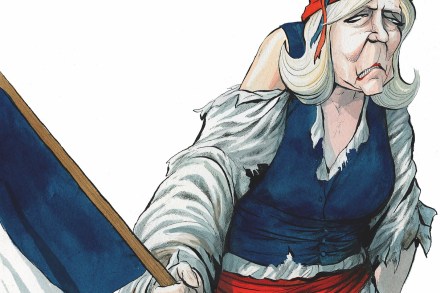
Emmanuel Macron will this afternoon host the leaders of France’s political parties as he searches for his fourth prime minister of the year. The last one, Michel Barnier, fell last week after just three months in office. Not everyone, however, has received an invitation to the Elysée Palace. Marine Le Pen is persona non grata after her National Rally party joined the left-wing coalition in last Wednesday’s vote of no confidence in Barnier’s government. Macron hasn’t forgiven Le Pen, although he is more conciliatory towards the left-wing parties that conspired to bring down his government. The Communists, the Greens and the Socialists will all enjoy the president’s hospitality this afternoon.

Macron is the author of his own despair

From our UK edition

‘Notre-Dame has been restored to its full level of glory, and even more so,’ said the President-elect Donald J. Trump this week, as he confirmed that he would be honouring Emmanuel Macron with his presence for the big reopening of France’s most famous cathedral on Saturday. ‘It will be a very special day for all!’ Just like Trump, Macron relishes such stately occasions, and it would be churlish to deny him credit for Notre-Dame’s impressive reconstruction following the devastating fire that shocked the world in 2019. Paul McCartney has reportedly been given an ‘exceptional authorisation’ to sing ‘Imagine’ within the sacred walls, while the rapper Pharrell Williams will perform outside.

The good soldier Maczek – a war hero betrayed

From our UK edition

Who could forget the Polish squadrons in RAF Fighter Command when, in the 1969 film The Battle of Britain, a British squadron leader, frustrated by the excited radio chatter on being allowed into action at last, orders ‘Silence! In Polish!’ Or the Polish Parachute Brigade at Arnhem, whose commander, Stanislaw Sosabowski, played by Gene Hackman in A Bridge Too Far (1977), thinking the venture disastrous, growls ‘God Bless Field Marshal Montgomery’ as he jumps from his Dakota? Commander Eugeniusz Plawski, the captain of the Polish destroyer Piorun which first spotted the Bismarck and charged at her to draw fire, might be better known if he had featured in the 1960 film Sink the Bismarck! – but that wasn’t expedient, with the honours going instead to a Royal Navy officer.

Banning Marine Le Pen from politics would be a grave mistake

From our UK edition

Paris prosecutors last week recommended that Marine Le Pen be jailed and banned from public office for five years. The court also wants similar sentences for 24 members of the party who, along with Le Pen, are accused of misusing public funds. The prosecutor accuses Le Pen of using money intended for EU parliamentary aides to instead pay staff who worked for the party between 2009 and 2016. The defence’s argument is that it’s hard to differentiate between what constitutes EU work and party work as the two often overlap. The judges will study the evidence and a verdict is expected in early 2025.

It’s rich of the French to call Trump ‘vulgar’

From our UK edition

There has always been a touch of snobbery in the way the French elite regard American politics. The word one reads and hears most often in the mainstream media is ‘vulgarity’. This is particularly true of Donald Trump, who is abhorred as much by the right-wing press as by the left. ‘Trump, vulgarity on the loose,’ was the headline in a recent article in the centre-right Le Figaro. This snootiness is long-standing, but it became more acute two decades ago during the war in Iraq. France’s refusal – correct, as it turned out – to join George W. Bush’s ‘coalition of the willing’ led to a torrent of abuse in Washington. The French were labelled ‘cheese-eating surrender monkeys’ and in some restaurants French fries were rechristened ‘Freedom Fries’.

There’s more to Bordeaux than fine wine

In the seminal Casablanca, there is a classic moment when the Humphrey Bogart character is asked how he ended up there. Bogie, doing laconic and world-weary as only he could, replies, “My health. I came to Casablanca for the waters.” When Claude Rains’s iconic Captain Renault purrs, “Waters? What waters? We’re in the desert!” Bogart’s response is simple. “I was misinformed.” This exchange occurred to me when I recently visited Bordeaux, a city with awe-inspiringly beautiful architecture, some of France’s most stylish places to shop and eat, situated teasingly close to the beaches of the Atlantic coast. Yet if you attempted to tell anyone that you’d come to Bordeaux for history, couture or coastline, you’d get the Bordeaux version of “What waters?

Bordeaux

Small-town mysteries: A Case of Matricide, by Graeme MacRae Burnet, reviewed

From our UK edition

The gifted writer Graeme Macrae Burnet makes a mockery of the genres publishers impose on credulous readers. The author of two ostensibly literary novels (both longlisted for the Booker prize), Burnet has also written a trilogy of self-declared thrillers. Yet the concluding volume, A Case of Matricide, demonstrates literary talent of the highest order. It features the same protagonist as in the two earlier volumes – Inspector Georges Gorski, chef de police in Saint-Louis, a provincial French town near the Swiss border. Divorced from his wealthy wife, whose father is the corrupt and powerful mayor of Saint-Louis, Gorski lives rather sadly with his mother, who suffers from increasing dementia.

A fashion series made by people who hate fashion: Apple TV+’s La Maison reviewed

From our UK edition

I’m a bit disappointed – déçu, as we Francophiles like to say – with La Maison. When French TV drama is good it can be very, very good, as we saw with Spiral, Les Revenants, and, maybe the best series ever made about spies, Le Bureau. But La Maison is not in their league. This is a shame because its milieu is not one that has been explored that often in TV serials – and it’s something that a French production really ought to have handled brilliantly: haute couture. Judging by the fancy Parisian settings and general patina of Succession-style luxe, it hasn’t been short of a reasonable budget. What lets it down is that it appears to have no real love for or understanding of its subject matter. This is a fashion series made by people who hate fashion.

Move over, Mrs Bennet – I’ve seen two daughters married in less than a month

From our UK edition

Provence A few days before my middle daughter’s Oxfordshire wedding this summer, my youngest announced that she and her fiancé, who’ve been together for years, were getting married within weeks. They’re moving abroad and bringing their wedding forward would help, she said. Two daughters married in less than a month. Mrs Bennet would be proud or envious. On hearing the news I panic-booked an easyJet flight to Edinburgh for the day before the youngest’s wedding, only to realise it got in at midnight, just 12 hours before the ceremony, and had to abandon that and rebook for the previous day.

Pornography and the truth about the Pelicot case

From our UK edition

There have been protests in 30 cities across France, people marching in outrage over the case of Dominique Pelicot who drugged his wife Gisèle and raped her and invited more than 70 other men – strangers – to come to his house and rape her too. Pelicot is a monster, a modern-day Bluebeard. But what has shocked France most is how very many normal Frenchmen he was able to find, in and around his Provencal village, who were up for having sex with an unconscious woman. If the feminists of France really want to stand with Gisèle, they’d educate their sons to abstain from porn A firefighter, a painter, several businessmen… every week as the trial continues another set of these ordinary men shamble into the courthouse in Avignon and make their bad excuses.

Why French students want English uniforms

From our UK edition

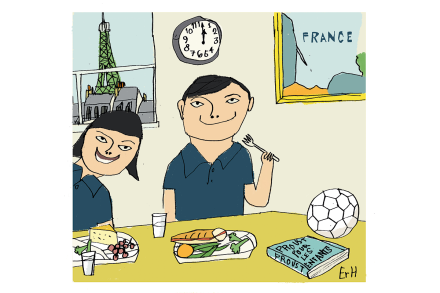
Béziers, France The École Mairan in Béziers in southern France is a happy neighbourhood elementary school housed in a superb renovated 19th-century hôtel particulier. In the middle of the medieval city, surrounded by both great houses and humbler tenements, it is attended by 120 pupils aged six to 11. There are the children of Algerian and Moroccan immigrants and the children of distinguished Biterrois families, with a sprinkling of Spaniards, Italians, Ukrainians and one American. Mairan is one of four schools in Béziers, and 100 in France, where this autumn children have started wearing school uniforms. So I went to Béziers to have a look. ‘The children love their uniforms.

The joy of hiring an old banger

From our UK edition

There is always much to look forward to on a holiday with friends in France (the day one supermarket sweep, boules under plane trees, foie gras on demand); but, for me, one of the greatest joys is the hire car. That’s entirely due to my indulging in the niche pastime of driving around in the worst, most clapped out vehicle possible. You can do this quite easily in France using an Airbnb-style platform called Turo which allows you to go directly to the – usually bemused – owner and, for not very much money, drive off in whatever they have to offer you. And so it was that I found myself this summer burbling down vineyard-flanked routes départementales in a 32-year-old, one-litre Peugeot with paint flaking off and every panel dented.

Will France’s school uniform experiment foster égalité?

From our UK edition

As the new school year begins in France, pupils across the country are putting on school uniforms for the first time in decades. In a pilot program spearheaded by the government, approximately one hundred schools across the country are testing whether uniforms can reduce bullying, improve classroom tranquillity, and foster equality. While some see uniforms as common sense, others – particularly on the political left –dismiss them as a superficial fix to deep-rooted social issues. The schools participating in the experiment are primarily located in right-leaning towns, where support for the initiative has been strongest, while more left-leaning areas are resisting uniforms. Brigitte Macron, herself a former schoolteacher, is said to be strongly in favour of uniforms.

The end of the Orbán era

Over the headline “Peace Mission,” a recent cover from the conservative Hungarian periodical Mandiner shows an awkwardly photoshopped Viktor Orbán mediating between a bemused-looking Vladimir Putin and a grim Volodymyr Zelensky. Behind Orbán, a map of the world connects Kyiv, Moscow, Beijing, Washington and Budapest. One of these capitals, as they say, is not like the others. Even before Ukraine’s Kursk offensive, the chances of Orbán’s July trips to Kyiv and Moscow producing a peace settlement were slim. The Mandiner cover, however, is a revealing window into the mindset of Orbán’s conservative fans. The idea of a Hungarian prime minister mediating between squabbling great powers is both attractive and plausible to many of Orbán’s fervent supporters.

Orbán
cookbook

Culling cookbooks

How do you choose ten cookbooks out of more than a hundred collected over sixty years? With difficulty. After my beloved husband Richard died, I decided that the only place I would want to live without him was in Meursault, France. The most difficult part was having to leave behind my cookbook collection. For a food writer, it was a daunting challenge. Here is what made the cut. I obviously couldn’t get rid of my father Bob Jones’s The Outdoor Picture Cookbook, published in 1954 and launched to Americans over their morning coffee on NBC’s Today show. He demonstrated how to cook his famous grilled chuck steak as Arlene Francis and Dave Garroway looked on with a bevy of buckets at the ready in case of fire.

The mystique of Henry V remains as powerful as ever

From our UK edition

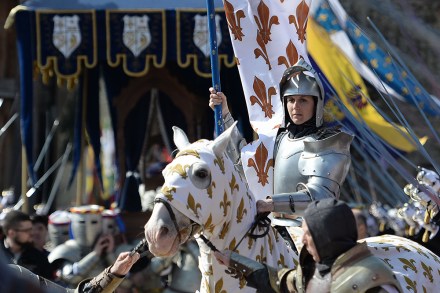
A rare portrait of King Henry V of England painted in the early 16th century shows him in profile. This unusual angle may have served two purposes. One was as a rather outdated emulation of Italian profile portraiture, with its blunt references to the might of imperial Rome; the other was to hide a disfiguring scar from a dangerous wound suffered at the battle of Shrewsbury in 1403. Henry was only 16 at the time of the battle, and it was a brutal way to earn his spurs. An arrow had penetrated his cheek six inches and lodged at the back of his skull. He was lucky to have survived both the wound and its treatment. But Henry was on the winning side; the defeated forces of Henry ‘Hotspur’ Percy were cut down ruthlessly.

My dinner date with the detective

From our UK edition

Provence ‘What do you mean?’ I wanted to ask the man who told me last autumn it was time to move on. I hoped he didn’t mean find a new boyfriend. I like him and his wife a lot and it was meant kindly – so I kept quiet as we stood in their kitchen and they gave me instructions for my weekly visits to check the house after they left for winter. But it stung. Jeremy was still with me night and day in everything I did. I tried not to let my face fall a second time when the man told me he was paying someone else to drive his Aston Martin back to England. I wanted to ask the same question of another man, a widower friend of a friend, who said, in an otherwise ordinary message: ‘This isn’t an offer or a request, but how do you feel about sex?

What’s gone wrong at the National Theatre?

From our UK edition

Now we have a Labour government, it would be nice to feel repertory will return to the National Theatre. It used to be possible to come to London for a week and see six plays. Audiences loved it. New writing spoke to old in ways which enriched both. Today, you’re more likely to see Ibsen, O’Neill, Molière and Marlowe in the West End. What happened to the library of world drama? The new practice is to offer only a couple of straight runs, sometimes first-rate. So there’s nothing to stop any random producer saying: ‘Hey, the Lyttelton seems to be empty this autumn, can I hire it to do one of my shows?’ Shaw and Granville Barker wanted to assert that theatre was art, not commerce. The model was European, not American.