Food

Tel Aviv it ain’t

From our UK edition

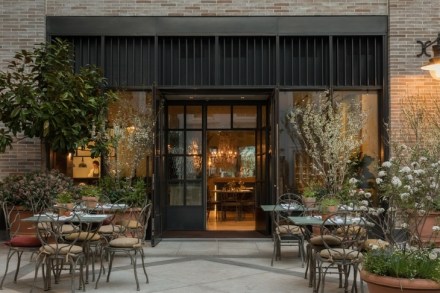
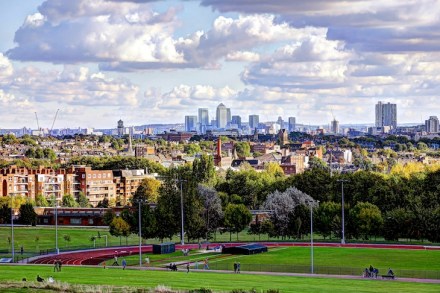
Café Hampstead is a new café in — big reveal! — Hampstead, the gaudiest of the old villages on the hills around London. Hampstead was once, mysteriously, home to progressives too many to type; refugees from Belsize Park carrying their most precious back copies of the LRB in plastic sacks. Why did they live in Hampstead? What for? They have moved out now, or died, and the truth died with them. We will never know what it was that they thought they wanted, or saw; whether it was always betrayal, or the wife made them do it. You can mock, and I do, but Hampstead is less interesting without them; there is little to laugh at these days, even if it is usual to see James Corden and Ricky Gervais in the street, looking for things to put in their mouths.

Leigh-on-Sea

From our UK edition

I have fallen in love with the c2c, a whisker of a train that is never delayed. It operates between London and Essex; Fenchurch Street and Shoeburyness. Its name stands for ‘anything you want it to’, according to the company’s website — everything from ‘capital to coast’ to ‘commitment to customers’. Over the past year, I have become a complete convert, a cheerful champion of the c2c as it whisks me into Essex and on to the north side of the Thames Estuary, where I like to walk with a man called Malt. Joseph Conrad, who lived in Stanford-le-Hope, a town near Tilbury on the c2c line, wrote: ‘The estuaries of rivers appeal strongly to an adventurous imagination. This appeal is not always a charm.’ True.

The best whisky distillery tours in Scotland

From our UK edition

Speyside Speyside, north of Aberdeen, is the true heartland of whisky. From Cragganmore, with its complex blends and exclusive clubroom (think roaring fire and lots of antlers) for connoisseur whisky tastings, to Glenlivet, which sits in a remote glen and organises a variety of tours, from classic distillery poke-arounds to luxury samplings. Speyside is also home to Strathisla, which is the oldest working whisky distillery in Scotland (established in 1786) and, with its distinctive pagodas, may also be the most beautiful distillery in the country. The recent success story of the region is Copper Dog, a blended-malt created in 2016 at the beautiful 19th century Craigellaiche Hotel.

The economics of fish and chips

From our UK edition

When you pay £8 for fish and chips, where does the money go? That's the question one restaurant has been busy answering after a customer left a two-star review on Facebook. It wasn't that there was anything wrong with the food – in fact it was 'lovely' and the staff were 'amazing'. But Debbie Davies still felt the need to complain to Oxton Bar and Kitchen over the price for the meal – £8. Happily, staff at the restaurant were happy to provide clarity: 'Ok Debbie. Where do I begin? Out of that £8, our nasty government is charging you 20% vat which we collect by law on their behalf, so we’re left with £6.66.

Evening service

From our UK edition

It was a culinary triumph. My hosts do not spend much time in the UK, and are determined to entertain stylishly during their visits. This Christmas they succeeded, blending tradition and radicalism. The planning began in Pall Mall on the third lunching-day in advent. We addressed the major strategic question: satiation. After bird plus pud, there is barely the energy to fall asleep in front of an old film and the rest of the day can be unsatisfactory. In recent years, I have noticed a tendency to deal with this problem by de-fanging the pudding. There is a new girlie-man breed of Christmas puds which lack the embrandied pomp of previous generations. In my friends’ case, this was not an option.

Gorge on syrup pud and be glad

From our UK edition

Rules looks as if it voted for Brexit, and now finds itself inside an eternal Christmas Eve, where it is always Christmas, and always Brexit. And what a gay Brexit, with swags and flounces and light bouncing through the windows on to Maiden Lane, like a child’s vision of hope. Or is it illusion? Does a chimney contain Arron Banks as Father Christmas with gifts in his sack marked ‘depression’, ‘delusion’ and ‘starvation’? Will he get stuck and go shouty-crackers on Twitter? Is Nigel Farage sipping a pint of lager, pretending to be a good elf?

The worst food in London

From our UK edition

Farmacy, which opened last year, is London’s most fashionable ‘clean eating’ restaurant; it is, therefore, a restaurant for people who hate food. This ‘clean eating’ epidemic grows as we fall into decadence and see food, rather than our own mouths, as the source of our calamity — how can we be saved from food? It is Bunyadi, the pop-up naked hobbit restaurant again, but without wit: same food, less fun, and no tree stumps at all except metaphorically, on the tops of people’s necks. It is owned by Camilla Fayed, the daughter of Mohammed Fayed, and there is probably much to divine about that family dynamic here, had I stayed, but I didn’t.

The tables turned

From our UK edition

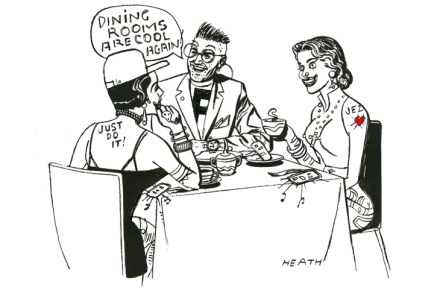
Dining rooms have been in the doldrums for decades. Even Mary Berry has given up on hers. ‘Most of us, I think, live in the kitchen,’ she said recently. She’s right. Plenty of us don’t have a dining room to give up on, me included. Plenty more have knocked down what once divided a dining room from a kitchen to create an airy, open-plan ‘living space’ where we do battle with avocados and everything else. We might be obsessed with what we are and aren’t eating but we don’t stand on ceremony. Nigella Lawson admits she slurps noodles ‘hypnotically’ while watching TV on the sofa. ‘If it can be eaten out of a bowl, I’m very happy to eat while I watch,’ she said.

The queen of hotels

From our UK edition

Jean-Georges at the Connaught — formerly the Prince of Saxe-Coburg Hotel, but it was renamed during the first world war, at about the same time the Duke of Saxe-Coburg and Gotha was deprived of his British peerages, which was one of the funnier events in the war — is the informal restaurant at the Connaught Hotel, and it opened this summer on the curve of Carlos Place, Mayfair. The Connaught is an English hotel with a German heart. It is therefore the hotel equivalent of our Queen, and the best hotel in the world. It is better than its sister Claridge’s, from which Dwight Eisenhower ran away in 1944. He could face the Nazis, but not the ‘whorehouse pink’.

Cabbages and kings

From our UK edition

The first pastry cook Chaïm Soutine painted came out like a collapsed soufflé. The sitter for ‘The Pastry Cook’ (c.1919) was Rémy Zocchetto, a 17-year-old apprentice at the Garetta Hotel in Céret in southern France. He is deflated, lopsided, slouch-shouldered, in a chef’s jacket several sizes too big for him. His hat is askew, his body a scramble of egg-white paint. Soutine painted at least six cooks in their kitchen livery. In their chef’s whites they look like meringues that have not set (‘Pastry Cook of Cagnes’, 1922), îles flottantes that do not float (‘Cook of Cagnes’, c.1924), and, in the case of the ‘Little Pastry Cook’ (c.

Elle Decoration meets pub food

From our UK edition

The Mandrake is a new ‘design hotel’ in London, which means it is for people who treat Elle Decoration magazine as their primary source of op-ed. It lives in a red-brick terrace in Fitzrovia and it feels very odd, like a corpse with the beating heart of a baby, perhaps even a Beckham baby: would it have preferred to demolish the crusty frontage and establish itself inside Heathrow Terminal 5, or a giant fridge? Who can say? And why is it named after a poisonous plant? The entrance is dark, and haunted by black-suited men. I do not know what they do, besides lurk charismatically and pretend they work for Karl Lagerfeld, and he is in danger, perhaps from cheap skirts, or his own plastic surgeon.

Forget the school slop – a true rice pudding is a rare treat

From our UK edition

If I had a pound for every person who’s told me they hate rice pudding, I would be a rich woman. It might be the most hated dessert in Britain, and we have our school system to blame for it. The rice pudding that is ubiquitous (and seemingly generation-crossing) in British schools is offensively bland, inexplicably metallic and unbelievably gelatinous. Made with milk powder and water, never introduced even in passing to actual milk, then poured into a quadrant of a battered plastic tray, it is many people’s first dalliance with rice pudding and, understandably, their last.

In silent misremembrance

From our UK edition

Foxlow is near Golden Square in west Soho, where drunken hacks used to take long drunken lunches before having stupid drunken ideas. My favourite stupid drunken idea was from a Guardian hack and it involved renting an ice-cream van and asking Nick Cohen and A.A. Gill to drive around in it, selling ice creams, bickering and hopefully breaking down, before writing up the experience for a Silly Season special. But drunken hacks no longer take long drunken lunches in Soho. They get drunk at home, if there is one, or drink in the queue at Eat, if they can afford to eat. The piece was not commissioned, the years passed, and I am now a guest at the funeral of my own profession each day. A.A. Gill is dead, Nick Cohen is sober, and even Silly Season has gone.

Our big fat problem

From our UK edition

The good news is that Theresa May has dropped the threat to withdraw universal free school meals. Thank God (and the PM) for that. School lunches are the biggest weapon we have to fight obesity. The UK is sixth in the supersize race of OECD countries, with a quarter of the population obese. The fact that six of the fattest nations (the US, Australia, New Zealand, Canada, Ireland and the UK) are English-speaking should tell us something about our food culture. But sadly even Japan and South Korea, the slimmest nations, are fattening up fast on burgers and chips. What is to be done? No country is going to have the courage to ban junk food, as they have drugs. Maybe we’ll come to that one day.

A perfect feast with Roger Allam

From our UK edition

J Sheekey is one of Richard Caring’s older, and better, restaurants. Since he has dowsed the suburbs of London in multiple outposts of the Ivy (there is one in Wimbledon, another in Richmond and presumably one pending in Penge), J Sheekey increasingly feels like an island in a sea of pointlessly aspirational green. The rise of the Ivy — the original celebrity brasserie, which is code for an indifferent restaurant full of awful people eating shepherd’s pie — is an inevitable consequence of the rise of celebrity culture. This is anti--culture, and the Ivy is, therefore, an anti--restaurant. So many celebrities, and now so many Ivys to put them in. The age of narcissism has many tentacles.

Manning up

From our UK edition

Is this the best book I’ve ever read on the subject of masculinity? Maybe it is, I thought, the first time I read it. And then I thought, Tom Wolfe’s A Man in Full is about masculinity. So is Hemingway’s Death in the Afternoon, David Vann’s Goat Mountain and Bret Easton Ellis’s American Psycho. But this book is different. It is really about ​masculinity. The maleness here feels very raw. I say raw for a particular reason. I’ll get to that in a minute. But first let me introduce you to William Giraldi. He was born into an Italian-American family in blue-collar New Jersey. ‘My hometown’s name, Manville, lets you know precisely what you’re getting: pure Jersey,’ he writes.

Tapas but no phantom

From our UK edition

I am always surprised to remember that Andrew Lloyd Webber has taste; it must be remembrance of Cats. I was surprised, for instance, to learn that he once owned Pablo Picasso’s portrait of d’Angel Fernández de Soto, which I always thought of as my Picasso because it looks like my friend Hadrian Wise, who used to come to Merton College bar in his pyjamas. We once rolled a joint as long as The Spectator because he loved The Spectator. High as I was after the Spectator-length joint in 1994, I never thought I would write for it. Neither did he. Now Lloyd Webber, whose masterpiece is Phantom of the Opera, because it is all about him, has decided to host a tasteful restaurant in Victoria called the Other Naughty Piglet.

Cold foam and spindly legs

From our UK edition

Bibendum is a hushed restaurant on the first floor of the Michelin House on the Fulham Road. (Bibendum is the name of the Michelin Man; as such, he is the only restaurant mascot I can think of who is a morbidly obese drunk, and here of all places. It is a noble gesture in a district full of Prada and control). The building is extraordinary — an art-deco whim standing on a corner like Cinema Paradiso without the dreams. It was once the headquarters of the Michelin tyre company; as such, I admire the ambition of placing a tyre company in what is essentially a Venetian palace, but perhaps tyres were considered special then. In the Congo, for instance, rubber took a lot of people with it.

Books Podcast: Jonathan Meades

From our UK edition

In this week's Books Podcast I'm joined by the great Jonathan Meades. A man of many hats -- food critic, architectural critic, memoirist, polemicist, cultural historian, novelist etc -- and one distinctive pair of sunglasses, Meades is this week talking about stealing food. His The Plagiarist In The Kitchen, new in paperback, is a sort of anti-recipe book; a collection of cookable recipes (well, except the one), an erudite disquisition on the history and theory of cookery, and a slant discussion of the whole idea of plagiarism. Also, it's packed with good jokes.

Patience on a monument

From our UK edition

As a food writer Patience Gray (1917–2005) merits shelf-space with M.F.K. Fisher, Elizabeth David and Jane Grigson. Fleeing from the dreary predictability of her Home Counties upbringing, Gray became, among other things, the first women’s page editor of the Observer; co-author of a bestselling cookery book (the 1957 Plats du Jour with Primrose Boyd); and, nearly 30 years later, sole author of a classic, the 1986 Honey from a Weed. She was also a jewellery maker; textile designer; student at the LSE, where one of her tutors was Hugh Gaitskell; an intrepid traveller; research assistant to H.F.K.