Eu

Spectator podcast special: David Cameron’s EU deal

From our UK edition

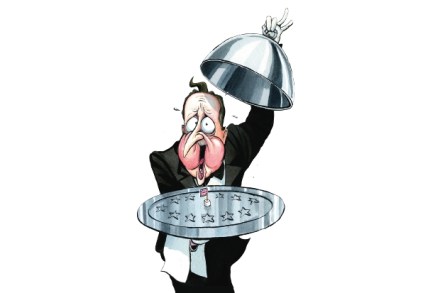
[audioplayer src="http://rss.acast.com/viewfrom22/spectatorpodcastspecial-davidcameronseudeal/media.mp3" title="David Cameron seals the EU deal - but is it any good? Isabel Hardman, James Forsyth and Fraser Nelson discuss" startat=18] Listen [/audioplayer] David Cameron has sealed an EU deal in Brussels - but is it any good? The Prime Minister said the renegotiation gives Britain 'special status' in the EU. Donald Tusk said there was unanimous support for the new settlement. But is the deal really as pivotal as the Prime Minister is suggesting? And what's next for David Cameron as he flies back to London for a special Cabinet meeting in the morning?
The UK’s Global Engagement Begins in Europe

From our UK edition

The advocates of Brexit like to paint an optimistic picture of a post-EU Britain as an active, globally engaged power. 'Who has the parochial mindset here,' asks Dan Hannan, 'those who want a global role of the United Kingdom, or those who think that our role must be mediated by Federica Mogherini, the EU’s Foreign Minister?' Eurosceptics rarely outline the details of the UK that they have in mind. At most, they say that once the UK leaves, the British government could negotiate free-trade agreements with countries overseas – most notably those in the Commonwealth. But there is much more to international engagement than trade.

Watch: David Cameron hails EU deal as giving ‘special status’ to UK

From our UK edition

[audioplayer src="http://rss.acast.com/viewfrom22/spectatorpodcastspecial-davidcameronseudeal/media.mp3" title="Isabel Hardman, James Forsyth and Fraser Nelson discuss the EU deal" startat=18] Listen [/audioplayer] A deal has finally been struck amongst EU leaders in an agreement hailed by David Cameron as giving 'special status' to Britain. Speaking at a press conference in Brussels, the Prime Minister said: 'Within the last hour I have negotiated a deal to give the United Kingdom special status inside the European Union. I will fly back to London tonight and update the cabinet at 10am tomorrow morning. This deal has delivered on the commitments I made at the beginning of this negotiation process. Britain will be permanently out of ever-closer union, never part of a European superstate.

EU summit: Tired European leaders left waiting for their ‘English lunch’

From our UK edition

EU leaders have a funny way of going about their negotiations. The best way, it seems, is to conduct most of the talks in the middle of the night in order to create a sense of urgency and pressure, and then spend the next day sleep-deprived and not eating. The ‘working breakfast’ that was originally supposed to start at 10 then became a late breakfast, before turning into a brunch, ‘English lunch’ (which sounded unhealthy), late lunch, and now it is ‘foreseen’ to be at 4pm. This is surely afternoon tea.

Briefing: What’s holding up EU leaders in Brussels?

From our UK edition

David Cameron is locked in negotiations with the other European leaders at the crunch summit in Brussels. With no sign of a deal, there is a chance the whole thing could drag on until Sunday. But what exactly are the issues that haven't been agreed? Here are the main areas which are proving a sticking point for the PM: Economic Governance: The Prime Minister wants recognition that the EU has more than one currency and that Britain won't be disadvantaged by not being within the Euro. As well as this, David Cameron is seeking assurances that British taxpayers will never be liable for propping up the Eurozone. The emergency brake: Another key factor being discussed is the issue of the emergency brake on in-work benefits for migrants.

EU summit: David Cameron arrives and vows to ‘get back in there’

From our UK edition

It's been a long night in Brussels and it's going to be a hard day ahead for David Cameron as he tries to strike a deal with other European leaders at the EU summit. The Prime Minister has now arrived and said he will 'do everything he can'. He added that 'some progress' had been made but there was still no deal: It looked earlier in the day as though Greece could veto the entire summit over the issue of migration. Polish Minister for European Affairs, Konrad Szymański, said it was a serious issue but maintained that he was confident it would be sorted: French President Francois Hollande said this morning that the proposals had changed overnight: The PM does have some allies around the table, however, including the Dutch PM.

EU summit: Hard day ahead for David Cameron if he wants to seal the deal

From our UK edition

If David Cameron still hopes to wrap up his European negotiations by tea time today, he's got an intense, caffeine-fuelled few hours ahead of him. The Prime Minister left the European Council building just after 5.30am local time after meetings with Donald Tusk and President Hollande. A source said: 'It's hard going. Some signs of progress but nothing yet agreed and still a lot to do.' The talks went on for longer than many expected. Cameron does need to look as though he has fought for these changes, but there are also reports that he is having to demand more from leaders so that his eventual deal isn't totally underwhelming. He is currently pushing for 13 years of benefit restrictions on migrants, rather than the emergency brake lasting 7 years.

Letters | 18 February 2016

From our UK edition

Governmental ignorance Sir: Your leading article (13 February) blames junior doctors for playing with lives in their dispute; but what alternative do they have when confronted with the monumental ignorance of our present government (and the last, and the one before that, for that matter)? The NHS, when it started, was propped up by the amazing dedication of the post-war generation and then the baby-boomers. Even so, by the 1960s it was dependent on cheap foreign labour. If people want a first-class service they have to pay for it. It is about time somebody made our government aware of the facts of life — and the junior doctors seem to have stepped up to the plate.

High life | 18 February 2016

From our UK edition

   Gstaad The locals here in the beautiful Saanen valley are split over the migrant crisis. Switzerland does not belong to the EU, but the fascists in Brussels have pressed good old Helvetia to open its doors to those streaming out of Africa and the Middle East. Switzerland, a tiny country of eight million, has already taken in 40,000, and I have personally seen about 30 Eritreans billeted in our old people’s home nearby. Now it takes a heart of stone to be against poor refugees, especially Syrians, unless they’re North Africans or Somalis who are over here in order to find white women or live off our welfare system.

Emma Thompson’s wrong, and not just about the EU

From our UK edition

At first glance, Emma Thompson’s intervention in the Brexit debate earlier this week didn’t make much sense. Asked at the Berlin Film Festival whether the UK should vote to remain in the EU, she said we’d be ‘mad not to’. She went on to describe Britain as ‘a tiny little cloud-bolted, rainy corner of sort-of Europe, a cake-filled misery-laden grey old island’. She added that she ‘just felt European’ and would ‘of course’ vote to remain in the EU. ‘We should be taking down borders, not putting them up,’ she said. I think I get the bit about Britain being ‘rainy’. That’s true, obviously, and some people dislike our islands for that reason.

Portrait of the week | 18 February 2016

From our UK edition

Home David Cameron, the Prime Minister, spent time in Brussels before a meeting of the European Council to see what it would allow him to bring home for voters in a referendum on Britain’s membership of the European Union. The board of HSBC voted to keep its headquarters in Britain. Sir John Vickers, who headed the Independent Commission on Banking, said that Bank of England proposals for bank capital reserves were ‘less strong than what the ICB recommended’. The annual rate of inflation, measured by the Consumer Prices Index, rose to 0.3 per cent in January, compared with 0.2 per cent in December. Unemployment fell by 60,000 to 1.69 million. A dental nurse from Bradford who gave her friend a facelift was struck off the dental register.

Cameron: Britain’s place in the EU has been ‘allowed to fester for too long’

From our UK edition

This is from tonight's Evening Blend, a free email round-up and analysis of the day's events. Subscribe for free here. Good evening from the Justus Lipsius building in Brussels, where David Cameron is tonight trying to persuade European leaders of the merits of his renegotiation of Britain’s relationship with the EU. For a deal that has underwhelmed almost everybody in Britain, it’s taking a remarkably long time to sign off. A working session, in which the Prime Minister told leaders that this was the ‘opportunity to settle this issue for a generation’, has just broken up, and talks on the migration crisis are starting over dinner. Cameron told leaders that ‘the question of Britain’s place in Europe has been allowed to fester for too long’.

Cameron’s EU summit: Long night ahead in Brussels

From our UK edition

Journalists are waiting in the glass smoking pen at the Justus Lipsius building for the next development in the negotiations over Britain’s EU deal and the migration crisis. There’s a working session focused on the renegotiation followed by a working dinner this evening, where leaders will discuss migration. Nigel Farage is also strolling around the building, though he has yet to start puffing away in the smoking pen. Hacks from all the EU member states are trotting across the press room to take part in huddles - clusters of journalists around a spokesperson who briefs them on or off the record - about how the talks are going and the negotiating position of their country.

Tim Montgomerie has put his country before his party. Will others do the same?

From our UK edition

In the wasteland of principles that is Westminster, Tim Montgomerie has always been an exception.  The area is filled with ambitious, bland careerists whose idea of taking a stand (as with most of the commentariat) consists of trying to locate two ‘extremes’ before comfortably wedging themselves equidistant between them.  But in resigning from a lifetime’s membership of the Conservative party, Tim Montgomerie has demonstrated that there is still room for principles in politics. Because nothing has so highlighted Westminster’s prevalence of careerism over principle than the aftermath of the great EU renegotiation charade.  In private absolutely nobody thinks that David Cameron achieved anything real with his ‘renegotiation’.

Today in audio: The EU summit as it unfolds

From our UK edition

EU leaders have been arriving in Brussels for the crunch summit where Britain's reform demands will be thrashed out. David Cameron arrived earlier today where he did his best to make a bullish entrance, reassuring those back home he was 'battling for Britain': He'll be trying to convince other European leaders that its worth their while signing up to the deal first though.

Will the big political beasts throw their weight behind Cameron?

From our UK edition

David Cameron heads to Brussels today still not knowing which Tory big beasts he will have supporting him in the referendum campaign. The Cameron circle had always been confident that Boris Johnson would ultimately back staying In. But that confidence has been shaken by yesterday’s meeting between Boris and the PM. Part of the problem is that what Boris has always said that he wants on sovereignty is very hard, if not impossible, to actually deliver. If the Cameron circle is worried about Boris, it seems increasingly resigned to losing Michael Gove to the Out side. As I say in the column this week, an immense amount of emotional energy has gone into trying to persuade the Justice Secretary not to back Out.

The Spectator Podcast: Putin’s Endgame in Syria

From our UK edition

In this week’s issue, Owen Matthews discusses Vladimir Putin’s endgame in Syria. He says Russia’s bombing of Aleppo this week was intended to send a clear message: that the Russian President is in charge. But Owen says Putin’s strategy is his riskiest yet. What does it mean for the hopes of peace in war-ravaged Syria? And could it be a good thing after all if Putin’s intervention does bring an end to the conflict? On this week’s podcast, Isabel Hardman is joined by Owen Matthews in Istanbul and Robert Service, Emeritus Professor of Russian history at St Antony’s College, Oxford.

It’s here: David Cameron’s long-awaited EU deal D-day arrives

From our UK edition

David Cameron - and the travelling circus of officials and journalists around him - is in Brussels today for that long-awaited European Council summit at which the Prime Minister hopes he can get his EU deal. Bearing in mind that Cameron never really wanted a referendum, let alone to spend months banging on about Europe when he’s interested in so many other things, he must be rather relieved that the renegotiation may be drawing to a close. But these next few hours are, in the Prime Minister’s mind, a ‘very sensitive point’ in the negotiations. He is likely to encounter attempts from some quarters to water down what is already a rather weak-tasting deal. He is likely to have to deal with drama from others, including the French.