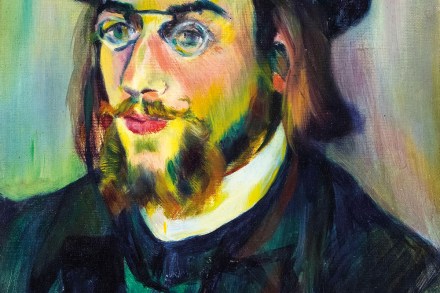
Erik Satie

Picasso’s ravishing work for the ballet

From our UK edition

Visitors to the Victoria and Albert Museum’s new storehouse in Stratford’s Olympic Park are being enthralled by an atmospherically lit chamber devoted to the display of one vast and magnificent work of art: Picasso’s 10 metre-high, 11 metre-wide drop-curtain for Le Train Bleu, a popular hit of Diaghilev’s Ballets Russes, first seen in 1924. The canvas, for many years rolled up in storage, isn’t strictly the work of Picasso himself: Diaghilev’s scene painter Prince Alexander Schervashidze had meticulously expanded it overnight from a small gouache on plywood known as ‘Two Women Running on the Beach’ (1922), but Picasso was so delighted when he saw the result that he decided to endorse it with his signature on the bottom-left-hand corner.

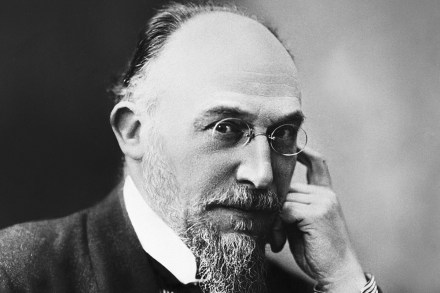
Erik Satie was an inadvertent innovator

The music critic Ian Penman has structured his new book about the great French composer and rascally agent provocateur Erik Satie in three parts, in the manner of classic Satie compositions such as Trois Gymnopédies, Gnossiennes and Trois morceaux en forme de poire. A hundred years after his death, aged 59, in 1925, Satie remains one of the great enigmas of 20th-century composition. A frequent visitor of Parisian cabarets, immersed in the city’s chanson tradition, his work could also be bafflingly conceptual. He was connected to the world of classical composition through his friendships with Claude Debussy and Maurice Ravel, but remained determinately his own person. His music is regularly held up as a precursor to John Cage and to ambient electronica alike.

The unnerving world of Erik Satie’s 20-hour composition 

From our UK edition

Once Igor Levit starts playing Erik Satie at 10 a.m. on 24 April at the Queen Elizabeth Hall, he can expect to be there for a long time. Satie’s Vexations is a piece that looks innocent enough, like butter wouldn’t melt in its composer’s ears. A doleful 18-note theme in the bass is filled in with stately, chorale-like notes in the right hand; the theme repeats, followed by the same chorale except turned upside-down. Nothing too strenuous so far. But Satie’s enigmatic inscription ‘To play this motif 840 times in succession, it would be advisable to prepare oneself beforehand, in the deepest silence, by serious immobilities’ mixes up the variables. Taking him to the letter of his word adds up to a performance duration of anywhere between 14 to 20 hours.