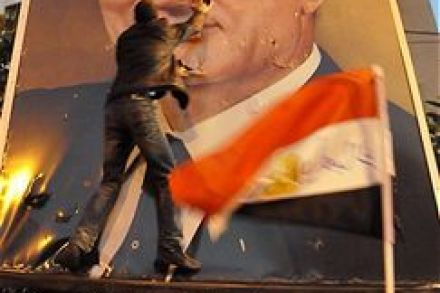
Egypt

Where does it leave Israel?

From our UK edition

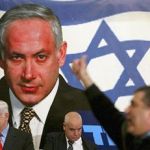
Israel is in a right state over Egypt's incipient revolution. Israeli politicians talk openly about the threat from an Islamist takeover, the greatness of Hosni Mubarak, and have even taken to sneer at the West's hopefulness. Now that President Mubarak has announced he will leave, the Israeli leadership will be looking on in horror. They are right to be concerned. The beleaguered Jewish state has already lost one regional ally in Turkey and does not relish the prospect of losing Egypt too. That would leave only Jordan, a country whose monarchy may be the next casualty of the pro-democracy movement sweeping the region. But it is not just a matter of numbers. The "cold peace" with Egypt was the most important strategic alliance Israel had in the Middle East.

Reports: Mubarak to say he will step down in AugustĀ 

From our UK edition

The wires are buzzing with uncomfirmed report that Mubarak will tonight say on Egyptian TV that he won't run for re-election in August and will stand down then. Update: The New York Times  is now reporting that President Obama has pushed Mubarak to say publicly that he won't run again. The end game appears to be rapidly approaching.

When will mass protest come to Libya?

From our UK edition

As several seemingly permanent Middle Eastern autocracies tremble, Colonel Gadaffi’s Libya rolls on. So far, there have been reports of minor protests in the localities about housing shortages, nothing more. With unemployment standing at 30 percent, the Libyan people are just as impoverished as those in neighbouring Tunisia and Egypt. Gadaffi’s dictatorship is scarcely benevolent, and, as for liberalisation, Libya remains one of the few completely dry countries on Earth. The secret of Gadaffi’s success then would appear to be expressing aggressive anti-American sentiment, whilst suppressing Islamism and democratic opposition at home. And all the while he entices rich Western powers (Britain) with the allure of Libya’s virginal natural resources.

Come on Europe; support the freedom you claim to love

From our UK edition

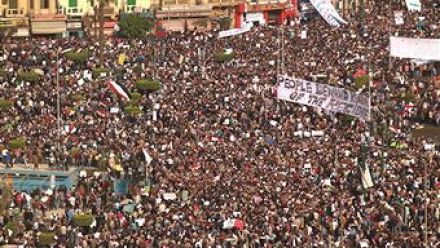
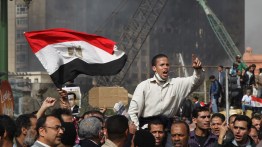
The Middle East is being rocked to its authoritarian core, as pro-democracy protesters defy Hosni Mubarak’s regime for the eighth day in a row. They want an end to his 31-year-rule and, to judge by their continued defiance, are unlikely to accept anything else than his departure. The events, however, have placed European governments in a quandary. Should they back the protests? Support what has been a friendly regime? Or sit uncomfortably on the fence, talking about the need to show restraint and start reforms but standing back from actually supporting regime change, in case the transition becomes violent or the outcome problematic? So far, it looks like the EU prefers sitting on the proverbial fence.

The Failure of Realism: Diagnosis Without Any Prescription

From our UK edition

These two posts by Melanie Phillips on the situation in Egypt are very useful. Clarifying, even. They merit a response not because it's Melanie and she's a neighbour but because she publishes a view that's more widely held than you might think if you only consulted the broadsheets and the BBC. It may, I think, be summarised as: Barack Obama is throwing Mubarak under the bus and we'll soon have Tehran on the Nile. A lot of people believe this or fear it the most probable outcome. They may, alas, be proven right. I'm struck, however, by their certainty that the Muslim Brotherhood will soon be running Egypt and, furthermore, that the Muslim Brotherhood in power will behave and speak in just the way it has in opposition. Perhaps this too will prove the case.

I Love My Country, It’s the Government I Am Afraid Of

From our UK edition

Perhaps Glenn Beck can ask this girl, interviewed in Tahrir Square, if she is just a stooge of the Muslim Brotherhood. Perhaps the "Realists" can ask her that too. Hopey-changey bullshit? Well, maybe. Perhaps the young and the liberal and the educated will receive a desperate, chilling awakening. But this is not set in stone. Plainly this girl does not speak for all Egyptians (and I'd like to know more about what Egyptians living outside the major cities think) but let's not pretend either that this is a bogus or astroturf uprising. It's real and its demands are real too. Fear the worst all you like, but these people deserve whatever support we can offer them.  PS: I kinda want one of those t-shirts. Also, make sure you stick around to see the anti-Mubarak cat at the end.

Glenn Beck: Performance Artist

From our UK edition

Even by our good friend Mr Beck's standards this is an impressive, virtuoso display. Twelve minutes out of your day but worth it, I promise you. Pick your own favourite moment. I'm torn between his wondering if Russia might invade western europe (perhaps Putin could run Belgium?) and his suggestion that protests in the UK (tuition fees) and Ireland (no money) are somehow part of a Muslim Brotherhood plot. Also: he says Italy is "on fire" but I think that's only true of Silvio Berlusconi and even then only in a Humbert Humbert sense...

Fox: Iran could have a nuclear weapon by 2012

From our UK edition

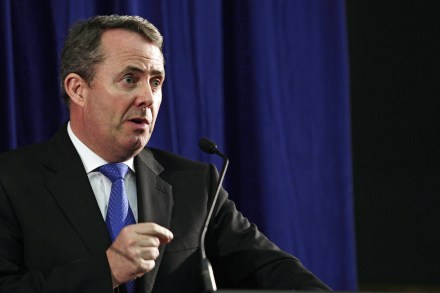
As Cairo smoulders, it's easy to forget about one of the most combustible ingredients in the Middle Eastern cocktail – Iran. Yet the threat still exists, as Tony Blair and Liam Fox have been keen to remind us. James Kirkup reports that the Defence Secretary has warned a Commons committee that Iran could have a nuclear device as soon as next year. Fox isn't the first to make the 2012 claim. The director of the CIA did so last year. And a recent article by the former UN weapons inspector David Albright and Andrea Stricker – which I arrived at via Jeffrey Goldberg – explains just how Iran might pull it off, in spite of recent setbacks: "Technically, Iran could decide to build a nuclear weapon now using the Natanz enrichment plant.

Coffee House interview: Paul Wolfowitz

From our UK edition

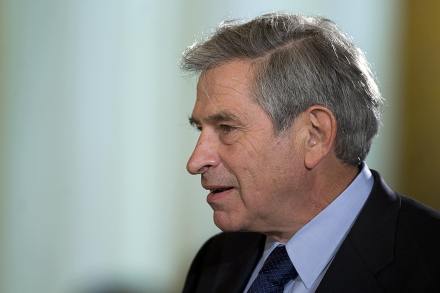
Nobody is as associated with George W Bush's drive to promote freedom and democracy in the Middle East as former US Deputy Defence Secretary Paul Wolfowitz. His role in the Iraq War, and belief that the US should promote democracy in a part of the world better known for authoritarian rulers, remains controversial to this day. But now that the Middle East is being rocked by pro-democracy protests – as people demand freedom, employment, and an end to tyranny – is this advocate of democracy finally being proven right? And what does he think about the dangers of democratic transitions?

Days of Hope, Not Rage, in Egypt.

From our UK edition

Fraser asks where or who is the Egyptian Lech Walesa? Well the answer, somewhat improbably, seems to be Mohamed ElBaradei*. And he's in Tahrir Square. Al Jazeera reports that the former IAEA chief has more backing than anyone might have expected just a week ago. The Muslim Brotherhood, secularists and socialists are all said to favour ElBaradei becoming interim president should Mubarak's regime crumble to dust. I'm less pessimistic than Fraser**. (This may not be a difficult status to acquire.) He writes: I wish I could be more enthusiastic about the events in Egypt and Tunisia – but, as I say in my News of the World column (£) today, the citizens of the Arab world all too often have a choice between a Bad Guy and a Worse Guy.

A Wind of Change down Arab Street?

From our UK edition

I wish I could be more enthusiastic about the events in Egypt and Tunisia – but, as I say in my News of the World column (£) today, the citizens of the Arab world all too often have a choice between a Bad Guy and a Worse Guy. Egypt looks like its choice is between the status quo, the Muslim Brotherhood or a military coup. This is not a 1989-style revolution, there is no Arabic equivalent of Scorpions singing Wind of Change. Successful revolutions normally have a well-organised alternative government, with a clear route towards democracy. Where is the Egyptian Lech Walesa, or the Tunisian Vaclav Havel?

How Do You Say Alea Iacta Est in Arabic?

From our UK edition

Like everyone else of sense, I'm wary of people who are too certain about anything that might happen next in Egypt. That suspicion certainly extends to my own opinions. I'm not sure we even know what the known knowns are, far less anything else. That said, I think one can reasonably suspect that the appointment of Omar Suleiman as Vice-President is neither a sign of Hosni Mubarak's strength nor anything like enough to satisfy the protestors. The regime may yet survive but I wouldn't rush to purchase Hosni Futures. Unlike David Cameron, Nicolas Sarkozy and Angela Merkel, Barack Obama hasn't talked about this year's elections yet but one imagines, reading between the lines of his most recent statement, that will be his next move.

Egypt, moving from revolt to revolution

From our UK edition

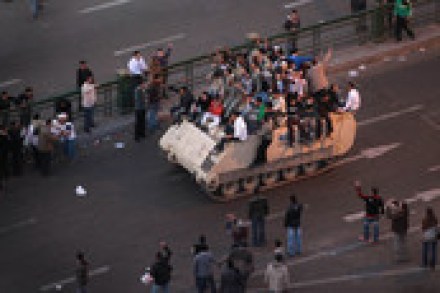
Sitting in London it is hard to know what is going to happen next in Egypt but one particular detail in the New York Times’ latest report makes me think that Mubarak’s fall is fast becoming more likely than not: “In Ramses Square in central Cairo Saturday midday, protesters commandeered a flatbed army truck. One protester was driving the truck around the square while a dozen others on the back were chanting for President Mubarak to leave office. Nearby, soldiers relaxed around their tanks and armored vehicles and chatted with protesters. There were no policemen in sight.

The neoconservatives were right

From our UK edition

The last six years have been fallow ones for the neoconservatives. From around 2005, when Iraq began its descent into chaos, the ideology that did so much to shape US foreign policy became marginalised as, first, George W Bush turned increasingly realist and, then, Barack Obama continued where his predecessor left off. While ideas are not responsible for the people who hold them, it did not help that, after President Bush left office, those who espoused a neoconservative outlook included the likes of Sarah Palin. Funding for democracy-promotion was slashed, and the focus for aid programmes became "accountability" – with the word "democracy" banished from sight.

Life on the Nile?

From our UK edition

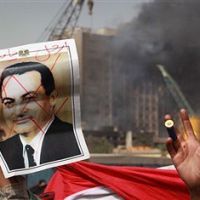
The risks of the status quo are always safer and more appealling than the uncertainties of the new, the unfamiliar and the unpredictable. So it wasn't a great surprise to discover Vice-President Joe Biden saying last night that, all things considered, he wouldn't refer to Hosni Mubarak "as a dictator" or outgoing White House press secretary Robert Gibbs insisting that Washington has no interest in "taking sides" in the struggle between the sclerotic Egyptian regime and the protestors. Depressing, perhaps, but not surprising. Like everyone else, the White House is waiting to see what happens today. Everyone agress that Mubarak's regime is rotten and that the 82-year old dictator (sorry, Mr Biden) cannot endure forever.

Will Mubarak Fall?

From our UK edition

A week ago, that would have seemed a foolish question. But after thousands of Egyptians have taken to the streets for two consecutive days of protest, even Hosni Mubarak is beginning to look vulnerable. It has placed the West in a dilemma, in a way that Ben Ali's fall did not. For years, the fear has been that President Mubarak is the lesser of two evils. Though authoritarian, Mubarak's Egypt is a pro-Western state willing to live with Israel and combat Islamist terrorism. On the hand, the Muslim Brotherhood opposition, which shares an ideological wellspring with Al Qaeda, is a grave threat to Western security.

Death watch

From our UK edition

Although I stopped watching TV some years ago, films are a continuing solace and pleasure. Among the Christmas treats was a previously unseen Jack Nicholson movie, entitled The Bucket List. The plot revolves around two very different Americans, Nicholson and Morgan Freeman, both of whom are suffering from cancer and are given a mere matter of months to live. The Bucket List is their wish list of things to do before they die, some of the more exotic of which the wealthy Nicholson enables them to achieve. The excellent Freeman, a poorer man but the greater philosopher, reminds Nicholson of a more important consideration: the two questions asked of Ancient Egyptians at the gates of Paradise. Have you found joy in your life? And, has your life brought joy to others?

Egyptian Notebook

From our UK edition

The adventures of a wrecked ship can be pieced together from entries in its log book. The last moments of some doomed flight can be reconstructed by consulting its black box. If Dominic and I come a cropper here on the hard shoulder of the Cairo–Alexandria desert road, our iPhones will tell our story in Google searches: 23:30: ‘how do you get out of Cairo airport?’ 00:07: ‘why don’t Egypt drivers use headlights?’ 03:00: ‘Toyota Corolla won’t start’ 03:30: ‘How to deactivate Toyota Corolla immobiliser?’ 04:00: ‘Hertz Cairo number’ 05:00: ‘Hertz worldwide emergency number’ 05:14: ‘What time sun rise in Egypt?