Egypt

No man’s land

From our UK edition

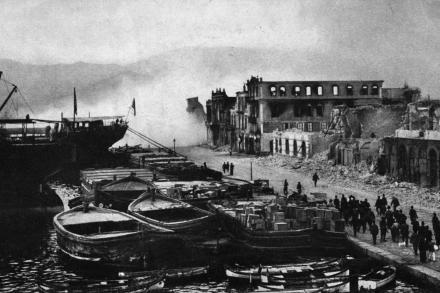
The shores of the eastern Mediterranean, from the eastern Aegean to the delta of the Nile, constitute a region known as the Levant, from the French for the sunrise. The French were first into Smyrna, opposite the island of Chios, which became a boom town in Ottoman times, trading figs and raisins from the hinterland. Far from Constantinople, it was a cheap and relaxed place to do business, encouraged by the Ottoman grants of consular jurisdiction and free trade. European consuls lived like princes in Smyrna, the merchants like lords. Tension between Muslims and Christians, between the many communities of Jews, Greeks, Armenians and Franks who settled there, were generally kept in check, both by the local authorities and by the consuls’ own naval might.

Confounded clever

From our UK edition

‘C’ is for Caul, Chute, Crash and Call, the titles of the four sections of Tom McCarthy’s new novel; for Serge Carrefax, its protagonist; and for, among other things, coordinates, communication technology, crypts, cryptography, Ceres, carbon, cocaine and Cartesian space, motifs that trellis this book. ‘C’ is for Caul, Chute, Crash and Call, the titles of the four sections of Tom McCarthy’s new novel; for Serge Carrefax, its protagonist; and for, among other things, coordinates, communication technology, crypts, cryptography, Ceres, carbon, cocaine and Cartesian space, motifs that trellis this book.

On the brink

From our UK edition

Stephen Potter’s Lifemanship contains a celebrated tip for writers who want to ensure good reviews. Stephen Potter’s Lifemanship contains a celebrated tip for writers who want to ensure good reviews. Simply make the dedication so emotionally blackmailing that no critic will dare attack you — something like, ‘To Phyllis, in the hope that God’s glorious gift of sight will be restored to her.’ It’s a ploy that springs inescapably to mind when reading the introduction to Winter on the Nile. What we’re about to read, Anthony Sattin explains, is the culmination of a dream he’s cherished for decades — a dream whose importance to him will only be truly understood by his beloved wife and children.

Obama in Cairo

From our UK edition

I have no doubt that Barack Obama's speech in Cairo today will not have gone down well amongst American conservatives. In fact many of them will be appalled by it. How long before someone in the right-wing blogosphere writes something about how terrible, if unsurprising, it was to see an American President protstrate himself in such humiliating fashion. All the right's worst fears have com to pass! It's like Jimmy Carter has returned to the White House! And, I guess, you could pull some lines from the speech that made it seem as though Obama was "apologising" for the United States while rarely putting as much emphasis on the sins of the muslim world. But that would be to miss the point: the arab and muslim worlds don't need to be lectured by the United States, they need to be engaged.

Egyptian Reformers Boycott Obama’s Speech

From our UK edition

More on the disappointing lack of emphasis Obama places on human rights and democratic reform. Mike Crowley reports from Cairo that Ayman Nour, the Egyptian dissident, has turned down an invitation to attend Obama's speech tomorrow: The president's reticence to push Mubarak about democracy, Nour says, has been "a huge disappointment, not only from Egypt's perspective but for reformers all over the world. It's not in line with what he promised during the campaign, or with his inaugural speech on January 20." In particular, Nour called the recent 60 percent reduction of U.S. aid for democracy promotion in Egypt a "grave" move, and said that a new approach of channeling that aid through the government, rather than sending it directly to NGO-style groups.

Obama’s Human Rights and Democracy Hypocrisy

From our UK edition

How committed is Obama to human rights? Not very, it seems. Perhaps his speech in Cairo on Thursday will change one's view of this, but the new President must be judged by actions, not merely words and noble intentions. As my friend Mike Crowley points out: But when it comes to Egypt, he has already set a tone. Obama has declined to make America's $1.8 billion in foreign aid to Egypt (our second-largest recipient) conditional on political and human-rights reform, and aid specifically for democratic programs has been slashed by more than half, from $55 million to $20 million. Hillary Clinton has spoken cautiously about Egypt's severe political repression. Cue much muttering about change you can believe in and all the rest of it.