Ed miliband

What will the Labour attack be in a year’s time?

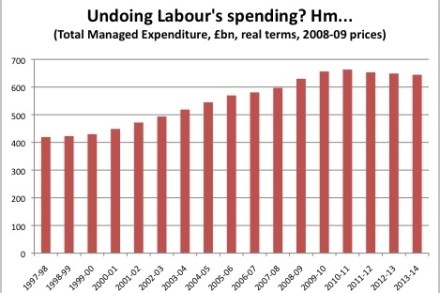
It's days like this when you realise just how stuck Labour are in a Brownite groove.  Everywhere you turn, there's some leadership candidate or other attacking the government for choosing to cut public spending this year.  Ed Miliband claims that the Lib Dems have been "completely macho … completely cavalier" about cuts.  Andy Burnham says that this year could "damage us in the long run".  And even those who aren't chasing the leadership are getting in on the act: Alistair Darling writes that the coalition has "a fiscal policy that undermines fragile growth". So we already know what Labour's broad response to this week's Budget will look like.  But it got me a-wondering: what will their response to next year's Budget be?

Ed Balls and the art of campaigning

I thought that Ed Balls would be a natural for opposition politics. But I’ve been struck by the naivety of some of his recent interventions – notably the Duffy-wooing immigration proposal. As James has argued, Balls’ plan to limit freedom of movement within the EU ia classic opposition politics. They are eye-catching, populist and but completely unworkable in practice. But Balls isn’t really in opposition yet: the Labour party is caught in a kind of limbo whilst it determines its future, a future that Balls wants to control. Advocating the unimplementable looks conniving rather than statesmanlike, naïve rather than astute.

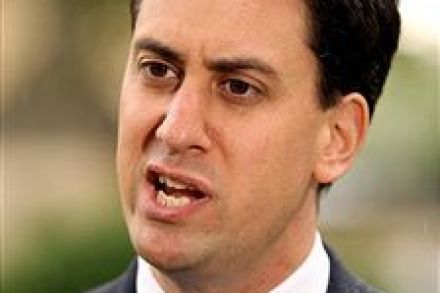
Ed Miliband pitches at change

Obviously, the Labour party must change and make a clean break with the era of Blair and Brown. I have my doubts if any of these candidates, other than incredible Diane Abbott, can escape the politics that moulded them. None have said anything substantively new. They are not wedded to the past; they pine for it. Today, however, Ed Miliband has suggested that he would break from New Labour. He has written an article for the Mirror, arguing that he would keep the 50 percent tax rate. His analysis is: ‘There is something wrong with a society where nurses earn less in a year than bankers - whose botched deals caused the credit crunch - pay themselves every week.

The Prince of Darkness passes into night

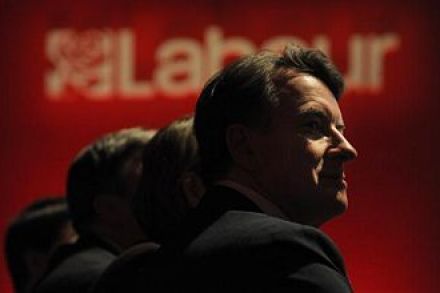
If Ed Miliband wins, it’s curtains for Peter Mandelson. Michael Crick reports this exchange between GMB president Mary Turner and Ed Miliband. ‘"As Labour leader, would you invite Peter Mandelson to join your shadow cabinet?" "All of us believe in dignity in retirement," replied Ed Miliband.’ Is Mordor mobilising? You bet your sweet life it is. No. In reality, I think that Mandelson, the uncompromising diarist, is finished with frontline Labour politics, and it with him.

How the coalition makes room for Labour

Whoever wins Labour's leadership, whether it's a breed of Miliband or Balls, its future will be dominated by its understanding of how it found itself on opposition benches. Philip Gould, Tony Blair, Gordon Brown and the other progenitors of the New Labour project - were wrong. Their fatal assumption was that their core vote, the working classes, had no-where else to go. Labour, therefore, could reach out the middle classes, broadening their support and thus New Labour was born. At first their calculations were correct. Two slogans, "Education, Education, Education" and "Tough on Crime, Tough on the Causes of Crime" brought together the two separate demographics to create a powerful - and seemingly unstoppable - election winning machine.

Labour leadership contenders eyeing the past, not the future

I wonder if the Labour leadership contenders worry that the previous generation’s forthcoming memoirs have created more excitement than them? I would be. The insipid campaign has laid bare the paucity of talent on Labour’s benches, and the party’s ideological exhaustion. No serving Cabinet minister lost their seat at the election; Tony Blair aside, the Milibands and Ed Balls are the best Labour has. That’s a grim prospect if your colour’s red. Ed Balls has the panache of a Vauxhall Zafira; and the two Milibands are trapped in a Beckettian whirl of meaningless jargon, convinced that using abstract nouns is a mark of vital intelligence. It isn’t; it’s irritating, and voters spurn it.

Labour’s gruelling task

There was a great sense of pathos after the election, when Jack Straw was the only Labour politician who could recall the shadow cabinet room’s location. It must have been surreal for those who knew only government. The loneliness of opposition would have struck at last week’s Queen’s Speech. The party must renew whilst avoiding the internecine struggle that condemned the Tories to 13 years in opposition. Fantasy politics won’t be sufficient. Introspection must yield a coherent and credible agenda, free from the undeliverable abstractions and the oscillation between arrogance and desperation that characterised the Brown government.

Ed Balls’ fighting talk is getting him nowhere, yet

The stock response of many Coffee Housers will be ‘Who Cares?’ but surely Ed Balls will be nominated for the Labour leadership? Labour may recognise that a Balls leadership would likely end in Footian catastrophe but he will, in all certainty, proceed to the next round. Surely? Like Pete and Ben Brogan, I reckon Balls and David Miliband allowed their supporters to declare in a steady trickle, hoping to build momentum as the June 8 deadline neared. In which case it is telling that Miliband Major has changed his tactics in response to Miliband Minor’s sudden surge. David Miliband now has the backing of 48 MPs, a very significant advance on yesterday’s figure. By contrast, Ed Balls languishes on 15 nominations.

The curious race for nominations

One of the mildly diverting features of the Labour leadership contest so far is this nominations counter on the party website.  Ed Miliband was the first to pass the crucial 33 nominations barrier yesterday, while David Miliband managed it earlier today.  Ed Balls is still lagging behind on 14, Andy Burnham has 8, and poor John McDonnell and Diane Abbott both have none.  Yep, the excitement is reaching fever pitch. There's one curious feature to it all, though, highlighted by Danny Finkelstein earlier.  Why have some of the candidates – or their nominators – been holding back on their nominations?  David Miliband, for instance, has considerably more than 37 backers, and could surely have crossed the 33 nominations mark days ago.

Is the Labour Party Thinking Seriously About Downing Street or Planning to Become BNP-lite?

I have yet to get really excited about the Labour Party leadership race. I was deeply depressed by the manner of Andy Burnham's entry into the fray. Too many Labour politicians and activists were over-impressed by talk of immigration on the doorstep. They think that because the subject was raised again and again, then it is the key to Labour's failure and therefore its potential future success. The point is that the issue was raised in 2001 and 2005, but Labour knew it would win on both occasions on so chose to ignore what its core voters were saying about foreigners. They believed they had their votes in the bag. That was probably a mistake, although the core vote seemed to hold up rather well even in 2010 considering what a useless campaign Brown ran.

Dodging Iraq

Disowning the Iraq War: that's the task which Ed Balls and Ed Miliband have a set themselves today, as part of their continuing efforts to distinguish themselves from the Blair and Brown years.  In interview with the Telegraph, Balls says that the public were misled by "devices and tactics" over the case for war.  And, in the Guardian, Ed Miliband argues that the weapons inspectors should have been given more time, and that the conflict triggered "a catastrophic loss of trust in Labour".  He has since claimed that he would have voted against the war at the time.

If Ed Miliband is the Answer, What is the Question?

Election post-mortems are always interesting and often fun. Take the speech Ed Miliband made to launch his campaign for the Labour leadership. While paying due attention* to Labour's achievements in government, it still reads as an indictment of the party's record in office. Consider these snippets: We must start by understanding the country we seek to lead again. ...[T]he truth is that as government wore on we lost that sense of progressive mission and of being in touch with people’s concerns. As time wore on we came to seem more caretakers than idealists—more technocratic than transformative. And when political parties lose that sense of idealism and mission they become much more vulnerable to the currents of events.

David Miliband sets out the fraternal dividing lines

David Miliband is one of those politicians who speeches improve when you read them on paper, his delivery still distracts more than it adds. If the Labour party is going to pick the Miliband who is the more natural platform speaker then David hasn’t got much of a chance. But if they want the Miliband who is more prepared to think about why Labour really lost then David might well be their man. On Saturday, Ed Miliband talked about how Iraq, a ‘casualness’ about civil liberties and a failure to regulate the banks properly had cost Labour the election. This might be Ed Miliband’s genuine analysis but it is also what Labour members want to hear: Labour lost because it wasn’t Labour enough.

Why Labour is still within striking distance

Things are looking good for Cameron – his coalition has 60 percent approval rating, he has managed to persuade the Lib Dems to support what always was a liberal Tory agenda. There is plenty for Conservatives to celebrate, especially on welfare reform and education. But, still, things could be a lot worse for the Labour Party than they are now. I say in my News of the World column today that, rather than being “out for a generation” as Tory strategists were hoping only a month ago, Labour remains (amazingly) in striking distance of winning the next election. And there is no telling when that election will be. Clegg and Cameron say their pact will last until 2015 – but only a tenth of voters believe it.

A lesson for all new MPs

Ed Miliband has given a surprisingly good speech this morning: free from all the junk language that his older brother has a weakness for. But he raises an interesting question: Why did Gisela Stuart win in Birmingham Edgbaston? Why did Karen Buck win Westminster North? Why did Andy Slaughter win in Hammersmith? Might it have been because all three of these politicians were, at one point, thorns in the flesh of their government? That they all at times campaigned, on principle, against the Labour government? As I said in The Times yesterday, the German-born Ms Stuart was a committed foe of the EU Constitution - who denounced it, and the Lisbon Treaty, as loudly as she could.

Ed Balls follows Ed Miliband’s lead

So fraternal rivalry it is, then, as Ed Miliband prepares to announce his leadership bid at a Fabian Society conference today. And, reading his interview with the Guardian, it's clear that Ed Balls is soon going to follow suit. Two Eds, two leadership bids, and much shared rhetoric about "listening" to voters. But the similarities don't end there. The passage where Ed Balls argues in favour of "progressive universalism" – a welfare system which stretches to the middle classes – echoes an interview that Ed Miliband gave to the Guardian in March. Both claim that it's important to make sure tax credits and other benefits reach those higher up the income scale. And both claim that Tory plans to trim back the welfare state are damaging to this goal.

Why fraternal rivalry will be good for Labour

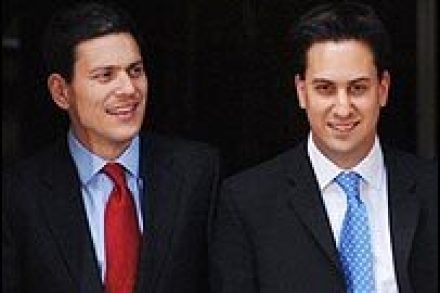
With the Sun reporting that Ed Miliband is going to stand for the Labour leadership, it's probably a good time to dig out Anne McElvoy's profile of the Miliband brothers for the Sunday Times last month. To my mind, its opening neatly encapsulates the choice between the wonkish one and the slighty-less-wonkish one that Labour may have to make: "When David and Ed Miliband were teenagers, their north London household rang to the chatter of some of the most prominent left-wing names of the era: Tony Benn, Tariq Ali, the ANC leader Joe Slovo and the late Michael Foot. David, one regular guest recalls, would sit 'absorbing it all' and asking interested questions of the grandees.

Labour’s Catch 22

The sole current political certainty is that Nick Clegg will not prop-up Gordon Brown. Clegg holds Brown personally responsible for 13 years of failure and not even political marriages can be built on enmity.  Labour’s choice is clear: remove Brown to accommodate Clegg. The Sunday Times reports plots are afoot to kill Gordon ‘with dignity’. But euthanasia is messy. Two options are being discussed. First, Brown would be given a year to make a final indelible mark on Britain before shipping himself off to Westminster’s version of Dignitas. I think we can all see the problem with that cunning scheme, and Nick Clegg certainly will.

Around the Web: Labour’s manifesto

We have some video footage of Brown’s speech at Spectator Live, and you can read Pete’s analysis here. Elsewhere on the Web: Hopi Sen likes the promise on early diagnosis on Cancer care, and the fact that no incredible spending pledges have been included. The Guardian’s Julian Glover attacks a 'meaningless manifesto': 'Ed Miliband, who we are told wrote Labour's manifesto, is fond of saying that the Tories are on the wrong side of the battle of ideas. It's a neat phrase, but an empty one unless you have ideas of your own. On the basis of today's manifesto performance, Labour doesn't.

A burnt out case

Freeing Manchester United from the Glazers is not what I envisaged when Ed Miliband promised ‘a radical manifesto’. But the Guardian reports that a fourth Labour government will legislate so that football fans can buy their beloved clubs. Clearly Brown's granite is plastic to the touch. I’ll reserve judgement until the manifestos are published, but, as Alex notes, the feeling is that New Labour's zeal is exhausted. Budget initiatives on stamp duty and the retirement age originated in Tory press releases and the Queen’s Speech regurgitated policies dating back to the 2007-08 sitting. I suspect the manifesto will offer the same gristle. We should be thankful for small mercies because so few bills have made it onto the statute book.