Ed miliband

PMQs live blog | 23 March 2011

From our UK edition

1232: And that's it. And here's my quick verdict: a solid performance from Cameron is what was, on the whole, a sedate session. The Main Event starts now, follow our live blog here. 1228: More fire from Cameron on the NHS. "Do you want to save ... lives," he quivers," or do you want to stick with the status quo." The PM's rhetorical confidence in this area is striking, particularly given that it is one of his most criticised policy areas. 1226: Matthew Hancock questions why the Labour government used PFI contracts to build hospitals, when there were better value alternatives. The Tories have spent the past few days emphasising Labour waste, as the blame game heats up ahead of the Budget.

Osborne’s white rabbit

From our UK edition

We can expect at least one rabbit out of the hat in George Osborne’s Budget speech. The Chancellor is a canny enough operator to have held at least one big announcement back. Already this morning, we have had news that all councils will freeze or reduce their council tax next year. But I expect there is one more on fuel to come in the speech itself, possibly the suspension of the fuel duty escalator for this parliament. This move would be expensive but it would also say I feel your pain and stop Osborne having to come back to the price of petrol every year. For Ed Miliband, today will be a test of his ability to think on his feet.

The state of public opinion ahead of the Budget

From our UK edition

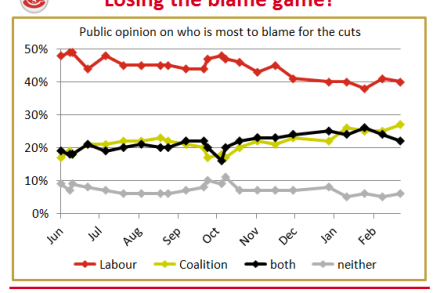
It's a point that I've made before, but here it is again: Budgets don't tend to shift opinion polls, at least not the headline numbers. But opinion polls can give some insight into how Budgetary decisions will go down with the public. So by way of a catch-up with some recent polls, and ahead of tomorrow's Main Event, I thought CoffeeHousers might appreciate a quick overview of public opinion on matters fiscal. Here goes... 1) Who's to blame? When it comes to the overall flow of British politics, the question of who's to blame for the cuts carries clear — and dangerous — implications.

Inflationary troubles ahead of Osborne’s Budget

From our UK edition

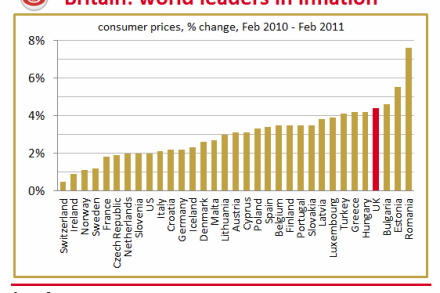
Unwelcome news for George Osborne: he will tomorrow present his Budget against a backdrop of the highest inflation for 20 years. The RPI index — what the nation called “inflation” until Brown changed the definition — is 5.5 per cent. It hasn't been this bad since the aftermath of the ERM crisis, an unhappy comparison for the Tories. The CPI index is up to 4.4 per. And those who deploy the usual arguments about global food prices are spiking might wonder: why is Britain now even worse off than Greece?     Even the Zimbabwean media is laughing at us (their inflation is now considerably lower than ours). It's shocking, but not surprising.

Actually, there’s some solace for Miliband in today’s poll

From our UK edition

Much excitement, today, about the fact that Ed Miliband is just as unpopular as Nick Clegg. A pre-Budget package by Ispos-MORI contains the finding that both party leaders are actively disliked by 51 per cent of the public. It's a striking result, particularly after the tuition fee furore — yet, sadly, it isn't new. It actually comes from the political monitor that Ipsos MORI released in January. They didn't ask the question for their March political monitor. So far as the Clegg-Miliband divide goes, the latest Ipsos MORI figures actually have this to offer us: net satisfaction with Miliband's performance as party leader is at -5 per cent, whereas it's at -22 per cent for Nick Clegg. So, not great for either leader, but considerably better for MiliE.

An alternative PMQs

From our UK edition

With Libya in metaphorical meltdown and with Japan close to the real thing, it was remarkable how little foreign affairs impinged on PMQs today. Ed Miliband led on the NHS and facetiously asked if Cameron planned any amendments to his health bill following the LibDem spring conference. Cameron replied by accusing Labour of wasting £250m on phantom operations. Would he apologise for this scandalous blunder? Miliband, unsurprisingly, declined even to acknowledge the invitation. The session developed on these familiar, solipsistic lines. Keen to harry the PM on bureaucracy Miliband stumbled on a Cameron quote decrying ‘pointless topdown re-organisations’ of the NHS. He pulled it up by the roots, shook off the mud and flourished it in Cameron’s face.

Rattled Cameron battles through PMQs

From our UK edition

A testy PMQs today with Miliband trying to pin Cameron down on the specific question of whether the NHS is now subject to EU competition law, and Cameron responding by dubbing Miliband ‘son of roadblock'. The exchange revealed that although Cameron is not a details man, something that will cause him problems in time, he still has enough presence in the chamber to withstand tricky moments. But I suspect that Labour will be happy if Miliband’s parting shot of ‘you can’t trust the Tories on the NHS’ makes it into the news bulletins this evening.

PMQs live blog | 16 March 2011

From our UK edition

VERDICT: A more evenly-matched PMQs that we have been used to, with both leaders parrying and thrusting to some effect. Miliband's chosen topic — the NHS — was a surprise, particularly given today's unemployment figures and the persistent flurry of bad news from abroad. Yet it did open up a clear divide between him and Cameron. On one side, the Labour leader claiming that the the coalition is taking undue risks with a beloved health system. On the other, the PM painting Miliband as Brown Mark II, a roadblock to reform and change. Neither side really won, or lost, the argument today, but you can expect them to return to it in future.

Labour divided on electoral reform

From our UK edition

John Healey has become the most senior shadow cabinet minister to declare that he will be voting no to AV. In a pugnacious article for the Independent, the Shadow Health Secretary describes the proposed system as a ‘perverse’ leg-up to extremists and one that will make Nick Clegg a permanent kingmaker. He added that he had not been ‘persuaded that AV is an upgrade to the voting system’. This is a small but important intervention. Until now, Labour’s contribution to the no campaign had been a procession of ghosts from former regimes: messrs Reid, Blunkett and Prescott being the most prominent of these heavyweight has-beens.

Miliband: I won’t share a stage with Clegg

From our UK edition

Ed Miliband has been on Sky, talking about the alternative vote and Nick Clegg. The normally consensual Miliband was in strident mood. He said: ‘I want to win the AV referendum because I think it is important to reform our politics and I think it will make for a more accountable democracy and one where more votes count. The problem is Nick Clegg is the last thing we need to win this referendum.’ Earlier this morning, Miliband also urged Clegg to ‘lie low for a bit', after the latter's office allegedly derailed a joint event on AV between Miliband and Charlie Kennedy. Miliband may be dabbling in the Leader of the Opposition’s stock-in-trade of curt throwaway lines, but this could signify a policy shift.

Are two Eds better than one?

From our UK edition

This was the question raised by today’s joint Balls Miliband press conference. The two Eds are very different in both body language and temperament. Balls is the far more pugilistic politician, always looking to dispute the premises of a question and happy to use aggressive language. While Miliband is far more of a conciliator, looking to find consensus and using only gentle humour. They even stand at the lectern in different ways: Balls hunched over his, leaning into the fight. Miliband hanging back from his, and taking a gentle step towards it when answering a question. The danger for Miliband is that Balls appears to be the alpha male, the one taking the fight to Labour’s enemies.

Balls and Miliband fail the credibility test

From our UK edition

Eds Miliband and Balls gathered the press corps together this morning to broadcast a straightforward message: oh yes, we do have an alternative. And the shape of that alternative? A repeat of the one-off tax on bankers' bonuses that, Balls claimed, raised £3.5 billion last year. The money would be used for an entire buffet of economic delights, from the creation of new houses to the funding of job schemes for the young. The upshot, apparently, would be 110,000 new jobs. Nice work, as they say — if you can get it. But there are a couple of problems with all that, the first of which Labour has pre-empted. It is that last year's bonus tax may not have raised as much as £3.5 billion, after all.

Balls sets Labour against Clegg (again)

From our UK edition

It's not just the protestors who are rallying against Nick Clegg today. Here's what Ed Balls has to say about the Lib Dem leader, in interview with the Guardian: "'Clegg looks an increasingly desperate, shrill and discredited politician, losing both public and party support. People think that if Clegg says something, it cannot be the truth. The Liberal Democrats need to have some real hard thinking about what they stand for' He says it would be impossible for Labour to govern with Clegg after the election, arguing: 'I don't see how Nick Clegg could change direction again with any shred of credibility, or how he could work with Labour now, but that is not true of Liberal Democrats more widely.

Labour’s inflation pitch

From our UK edition

Curiouser and curiouser. We in Coffee House have been saying for some time now that – whatever Mervyn King thinks – Britain has the worst inflation in the Western World apart from Greece. An OECD report out today shows we’ve got it worse than most eastern countries too. Korea, Turkey and Estonia are the only eastern nations with higher inflation: But what strikes me most about today is that food prices are soaring here, to an extent far worse than the rest of the world. This is what voters notice most: putting food on the table is very expensive. As Micawber might put it: annual food price inflation 6.3 per cent, annual wage inflation 2.5 per cent, result: misery. And plenty of it.

Abel fights back

From our UK edition

One of the hardest tasks of any opposition is to gain the trust and credibility to run the economy. After what happened over the last few years, Labour have an enormous credibility gap. Ed Balls’ decision to oppose any measure to deal with the deficit has reduced Labour’s economic credibility still further. So too has the two Eds’ decision to make attacks based on mis-truths, like denying there was a structural deficit before the election; or attacking the coalition for cutting bank taxes, when it is actually putting them up; and like backing another bonus tax, despite opposing it at the election, and despite Alistair Darling’s careful explanation of why it won’t work.

A tasty contest

From our UK edition

Today’s PMQs was full of verve and bite. A welcome change after last week’s washout. It’s all getting a bit tasty between Ed and Dave. The Labour leader opened with Libya and after making ritual noises about wanting to support the government’s foreign policy he admitted he found it hard not to voice his ‘concern about incompetence’. Nice tactics there. Pose as a statesman and stick the blade in under the table. But Cameron wasn’t standing for it. ‘I don’t want to take a lecture from Labour about dealing with Libya and Gadaffi,’ he said furiously. And the cheers from the Tory benches redoubled when he called for Labour to apologise for its part in the release of the still-not-dead Al Megrahi.

PMQs live blog | 9 March 2011

From our UK edition

VERDICT: A turgid sort of PMQs, where most of the quips were clumsy rather than cutting. Cameron probably won it by virtue of one of the few direct hits – his line about Ed Miliband knifing a foreign secretary, aka MiliD – and because Miliband failed, really, to prod and aggravate the coalition's wounds over Libya. The Labour leader's main attack – over the competence of the coalition – was clear enough, though, and could have some purchase depending on, erm, how competent the coalition is. As it is, Cameron's hint that he still has the occasional cigarette will probably capture the spotlight. 1231: And that's it. My quick verdict shortly.

David Miliband hurtles back into orbit

From our UK edition

Ah, there it is, in the final sentence of the fourth paragraph: a flattering reference to Ed Miliband. Phew. Good job David Miliband squeezed his brother's name into his article on Labour's future (£) for the Times today, otherwise it might have been July 2008 all over again. As it is, MiliD's third newspaper article in as many days is enough to suggest that he's keen to remain a prominent figure, if not yet an actual rival for his brother's crown. In some respects, though, the recommendations made by MiliD are a challenge to his brother's Way of Doing Things. His suggestion that the left be "an ally of wealth creation," for instance, reads something like: "enough with the banker bashing, already.

Pickles on the offensive against ‘propaganda sheets’

From our UK edition

Eric Pickles is no longer a genial giant. His speech to the Conservative Spring Forum was the rallying cry that many Conservatives in local government, some of whom will be scrapping for survival in May’s elections, have waited to hear.   ‘Ed Miliband,’ Pickles said, ‘is weaker than Neil Kinnock.’ The Labour leader could not take on his unions and militant councils, the Communities Secretaries said before turning an example: ‘Take Labour-run Camden. Ed Miliband’s local council. His councillors are cutting the Surma Community Centre, coincidentally visited by Samantha Cameron. Yet the council has spent twice as much on its town hall newspaper.

Khan comes to Ken Clarke’s support (kinda)

From our UK edition

When it comes to the overall sway of British politics, Sadiq Khan's article for the Guardian is probably the most important of the day. We've heard Ed Miliband say before that, "when Ken Clarke says we need to look at short sentences in prison because of high re-offending rates, I'm not going to say he's soft on crime." But Khan's article, a summary of a speech he is giving later today, actually puts that sentiment into practice – and then some. His central argument is straight from the Hush Puppied One's playbook, particularly in its emphasis on the limitations of New Labour's policy: "Some claim crime fell because of the rise in the numbers imprisoned. But the relationship between crime rates and prison population is more complex than that.