David cameron

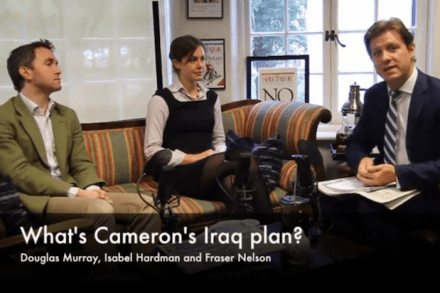
Video: Does Cameron have an Iraq policy? Or is he just making it up?

From our UK edition

The Prime Minister has returned from his holidays, and yesterday wrote an intriguing piece in the Sunday Telegraph about the ongoing struggles in Iraq and Syria. ‘True security will only be achieved if we use all our resources – aid, diplomacy, our military prowess – to help bring about a more stable world’ he wrote, and this morning Defence Secretary Michael Fallon sounded distinctly hawkish about British involvement in Iraq. But what does any of this actually mean? Fraser Nelson tries to get to the bottom of things in our look at the week ahead, while Isabel Hardman wonders whether anyone – including Cameron – knows what our policy is anymore.
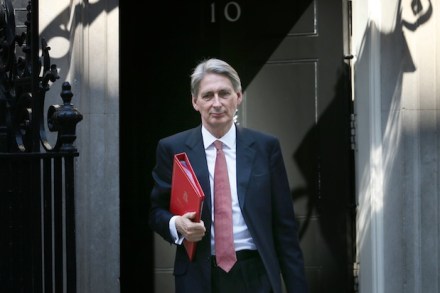
Philip Hammond: No plans to engage in airstrikes

From our UK edition

So Britain's long-term fight against Isis isn't, at the moment, going to involve this country doing any fighting. The Prime Minister this morning insisted that there would be no 'boots on the ground' and Philip Hammond has just told journalists that there are 'no plans at the moment to engage in air strikes'. That latter assertion does of course mean that air strikes aren't being ruled out, while boots on the ground are ruled out daily. Hammond said: 'The priority is the humanitarian situation, there are huge numbers of displaced persons, there are persistent stories of atrocities being committed against people who are fleeing from the violence going on, so that has to be our number 1 priority.

Islamic extremism and the hypocrisy of the Church of England

From our UK edition

The Church of England has written to David Cameron accusing him of lacking ‘a coherent or comprehensive approach to Islamic extremism as it is developing across the globe’. The letter, signed by the the Bishop of Leeds, Nick Baines, and approved by the Archbishop of Canterbury, Justin Welby, also reportedly accuses the PM of turning his back on Christians slaughtered or made homeless in northern Iraq – and wonders why Cameron has chosen to concentrate on the plight of the Yazidis instead. These criticisms are spot on. But I’m surprised that the C of E has had the brass neck to make them. For decades, the Anglican and Catholic Churches have ignored the growth of the domestic Islamic extremism that has seen British Muslims travel to Syria and Iraq to fight for Isis.

What are David Cameron’s plans for the fight against Isis?

From our UK edition

David Cameron warns today that Britain must act against Isis in order to prevent terrorist attacks on this country. But what does he actually intend to do? In his article in the Sunday Telegraph, the Prime Minister argues that a 'broader political, diplomatic and security response' is needed, but also says that 'we should avoid sending armies to fight or occupy'. He writes: 'Britain – our economy, our security, our future – must come first. After a deep and damaging recession, and our involvement in long and difficult conflicts in Iraq and Afghanistan, it is hardly surprising that so many people say to me when seeing the tragedies unfolding on their television screens: “Yes, let’s help with aid, but let’s not get any more involved.

Portrait of the week | 14 August 2014

From our UK edition

Home David Cameron, the Prime Minister, resisted calls for Parliament to be recalled to debate the crisis in Iraq. Philip Hammond, the Foreign Secretary, said that the government was not considering military intervention ‘at the present time’. Mark Simmonds resigned as a Foreign Office minister, but Downing Street hastened to say that his resignation, unlike Lady Warsi’s a week earlier, had nothing to do with government policy on Gaza, since he was complaining he could not afford to rent a flat in London for his family with the £27,000 allowance. A man sought by police investigating the theft of a fish tank from a furniture shop in Leeds hid in a bush and was attacked by a swarm of wasps. Unemployment fell 132,000 to 2.

Violence, fear, confusion: this is what comes into a leadership vacuum

From our UK edition

The old cliché that ‘nothing happens in August’ has again been brutally disproved. From the centenary of the outbreak of the first world war to the Russian invasion of Georgia six years ago, August is a month often packed with violence — but rarely more so than this year. In Syria, Christians are being crucified for refusing to convert to Islam. In northern Iraq, there are reports of mothers throwing their children from mountains rather than leaving them to the jihadis who are parading the severed heads of their victims. Russian convoys are rolling towards the Ukrainian border as Vladimir Putin tests the resolve of the West. Barack Obama has watched this unfold from his holiday spot in Martha’s Vineyard; David Cameron from the Portuguese coast.

David Cameron could have been an anti-slavery hero

From our UK edition

When I helped bring the Modern Slavery Bill to parliament I thought here, surely, was a piece of legislation that the PM would want to own. Three women — Theresa May, the Home Secretary; her then special adviser Fiona Cunningham; and Philippa Stroud, Iain Duncan Smith’s special adviser — had all worked for a Bill that would give the government a chance to seize the moral high ground, restoring Britain to its historic role as leader in the abolitionist movement. David Cameron was within touching distance of greatness. But almost at the last moment, he stumbled. Wary of alienating the business community, he balked at the idea of stipulating that quoted companies must report on how they were checking their supply chains against their use of slave labour.

Westminster plays recall tennis

From our UK edition

Now that David Cameron has returned from his Portuguese fish-shopping exploits, the game of recall tennis that Westminster has been playing for the past few days has stepped up a few notches. Now it's not just Philip Hammond, Michael Fallon and other Cabinet members leaving COBR meetings who can be asked whether or not they think Parliament should return from recess to debate the situation in Iraq, but the Prime Minister himself. It's running like this: another Tory MP writes to the Prime Minister to say there should be a recall, or a senior party figure from the Lib Dems or Labour says there should be one.

‘These people want a holocaust’: pressure grows on PM for recall over Iraq

From our UK edition

Downing Street remains resolute that there will not be a recall of Parliament over the situation in Iraq. But Conor Burns, a Tory backbencher who resigned as a ministerial aide over Lords reform, has just joined calls for a recall by writing to David Cameron warning that helping to evacuate the religious minorities at risk is not enough. His letter, seen first by Coffee House, is pretty strong stuff. Burns tells Cameron that 'these people want a holocaust of everyone who does not share their brutal ideology. It simply cannot be enough to try and evacuate those [ISIS] want to kill and then leave them, as the Pentagon admitted last night, undiminished to continue their terror' and that 'there is more that we could be exploring to deal with the problem's source'.

The three golden rules of intervention

From our UK edition

Barack Obama has authorised the use of targeted airstrikes in Iraq against forces of the Islamic State, which are hell-bent on massacring Yazidi and Christian minorities, and threatening American assets and citizens. David Cameron has welcomed Barack Obama’s decision. There are already voices calling for wider deeper intervention; special forces and conventional ground troops have been mentioned by former US generals and diplomats. Interventions have a habit of escalating, a point that Douglas Murray made in The Spectator this time last year when Barack Obama and David Cameron were preparing to intervene in Syria.

Podcast: Boris is back, Baroness Warsi’s resignation and the demise of the ‘nice girl’

From our UK edition

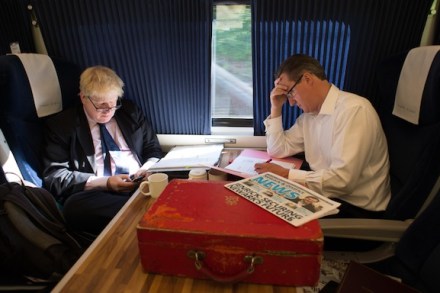
Here comes Boris! After he announced yesterday that he will stand as an MP in 2015, the next Tory leadership fight has just begun. Now that Boris is back in the fray, and making Eurosceptic noises, he has an excellent chance of making it to No. 10 – to assume what he believes is his rightful destiny — the position of Prime Minister of the United Kingdom. Freddy Gray presents this week's podcast, and talks to Harry Mount about how Boris's parliamentary campaign might play out. Isabel Hardman also examines the possible constituencies he might pick. The other major political story this week was Baroness Warsi’s shock resignation. But was it political or poisonous? Douglas Murray believes Warsi was over-promoted and incompetent, and is glad to see the back of her.

Who are you calling a blob, Owen Paterson?

From our UK edition

Why did David Cameron send Owen Paterson to Environment if he meant to sack him? Paterson knew and cared about his subject. He wore green wellies with panache, loathed Europe and wind turbines, and argued with everyone. He was a sop to the shires and a bulwark against Ukip. Yet like his colleague Michael Gove, he was found to be ‘toxic’. He has told the Sunday Telegraph that he blames his downfall on the ‘green blob’, on ‘highly paid, globe-trotting, anti-capitalist agitprop’. Paterson had discovered that the toughest job in government nowadays is no longer foreign affairs or defence, awash in grand crises, whirling dervishes and expensive kit.

Boris Johnson lays down the gauntlet to David Cameron

From our UK edition

Much has been made of the news that Boris Johnson intends to return to parliament at next year’s general election. The announcement, made in the Q&A session after his speech about London, Britain and the European Union, has got Westminster all hot and bothered. But another of Boris’s answers in that session also deserves to be highlighted. Gerard Lyons’s report for the mayor sets out 8 key points of European reform, ranging from changing the relationship between the Eurozone and non-eurozone countries, to the completion of the single market, to halting unnecessary regulations. But Boris went much further than this when responding to a question from Peter Wilding, director of the in-at-all-costs campaign British Influence.

Baroness Warsi – commendable but stunningly wrong

From our UK edition

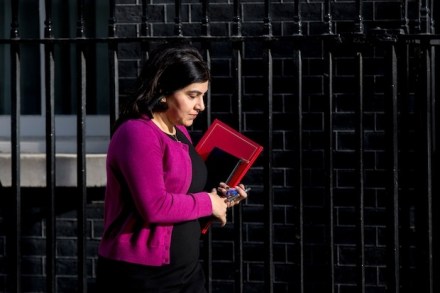
I was a little saddened by Baroness Warsi’s resignation. I like the woman; it is an odd and disturbing thing to say, but I felt I had more in common with her – a Muslim, Asian, woman – than almost any other prominent Tory. I’m not sure why this is. Perhaps class has something to do with it. I’m no Conservative but I think Cameron could have made more of her: he’s short of people who a). possess a vagina b). were state school educated c). come from ethnic minorities and d). talk as if they are members of the human race. She resigned on a point of principle, which is a good thing. They don’t often do that, the politicians. So we should commend her for her single-mindedness.

Warsi resignation: David Cameron replies

From our UK edition

[audioplayer src="http://traffic.libsyn.com/spectator/TheViewFrom22_07_August_2014_v4.mp3" title="Douglas Murray and Tim Stanley discuss Baroness Warsi's resignation" startat=462] Listen [/audioplayer]Dear Sayeeda, Thank you for your letter today, in which you set out your reasons for resigning from the Government. I was sorry to receive this. I realise that this must not have been an easy decision for you to make and very much regret that we were not able to speak about your decision beforehand. I understand your strength of feeling on the current crisis in the Middle East – the situation in Gaza is intolerable.

Baroness Warsi was over-promoted, incapable and incompetent

From our UK edition

Farewell then Sayeeda, Baroness Warsi. The most over-promoted, incapable and incompetent minister of recent times has finally done the nation one service and resigned. This morning she announced on Twitter that she can ‘no longer support government policy on Gaza.’ That would be government policy that now includes reviewing all arms export licenses to Israel? Not strong enough for Sayeeda, it would seem. It was not hard to see this coming. Not just because Warsi’s Twitter activity in recent weeks has mainly consisted of pumping out support for Hamas-run Gaza and berating supporters of Israel for saying things she disagrees with, but also because she has shown a career-long sympathy for Hamas and other Islamic radicals.

Is David Cameron still afraid of Brexit?

From our UK edition

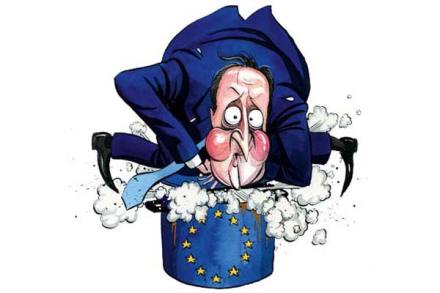
Boris Johnson's speech this week is one of the few domestic issues really animating Westminster. He will argue that the UK should not be 'frightened' of leaving the EU, supposedly in contrast to David Cameron, who has always made clear that he wants to remain in the bloc. But it's worth remembering that Cameron himself has started to shift recently on how he'd vote in the 2017 referendum. When he returned to the Commons after losing his fight against Jean-Claude Juncker's bid to become President of the European Commission, Cameron changed his language on that vote.

If Miliband really cared about defending British Jews, here’s what he would say

From our UK edition

In this week’s Spectator, Melanie Phillips argued that supposedly anti-Israel protests over the Gaza war have convulsed Europe in the worst scenes of open Jew-hatred since the 1930s. The most appalling aspect is the silence in the face of all this of the political class. Here’s her suggestion for what Ed Miliband should say if he really cared about the rise of anti-semitism in Britain: ‘I am horrified, not just because of the resurgence of the madness from which my own family so grievously suffered in the Holocaust, but also because we on the left bear no small responsibility for this current obscenity. ‘Hamas has placed its rocket arsenals below hospitals, schools and mosques. It is using 12-year-old kids as human bombs against Israeli soldiers.

Here’s what Cameron should say if he really cares about defending Britain’s Jews

From our UK edition

In this week's Spectator, Melanie Phillips argued that supposedly anti-Israel protests over the Gaza war have convulsed Europe in the worst scenes of open Jew-hatred since the 1930s. Even more appalling is the silence in the face of all this of the political class. Here's her suggestion for what David Cameron should say if he really cared about the rise of anti-semitism in Britain: ‘I am utterly appalled by the attacks on the Jewish people on the streets of Britain and in our public discourse. This hatred and bigotry is being fuelled by warped and distorted reporting about the Gaza war. ‘Newspapers and broadcasters are uncritically treating Hamas propaganda as fact.

David Cameron’s voteless recovery

From our UK edition

The economy has recovered, and is steadily growing. That much is now clear. It has long been assumed that this will help the Conservative Party’s electoral fortunes. The logic goes that, having steered the country through difficult economic times, a grateful public will come out in their droves to thank them for it. But politics is never that simple, and the public are rarely so willing to give credit to politicians. While it may seem perverse to suggest that economic growth is harming the Tories’ electoral chances, continuing good news about the economy is making it less of an electoral issue. Voters are beginning to ask: ‘what next?’ David Cameron and the Conservatives are experiencing a voteless recovery.