David cameron

The Spectator summer party, in pictures

From our UK edition

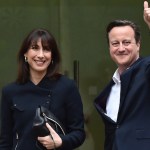
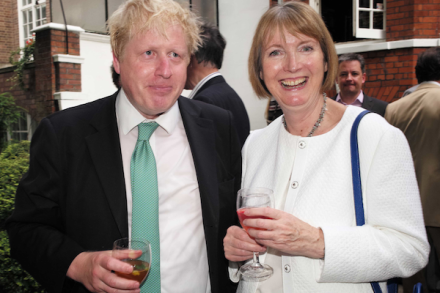
With a Tory majority to celebrate, the Cabinet turned out in full force for this year's Spectator summer party. As David Cameron and George Osborne caught up with their old head of strategy Steve Hilton, Sajid Javid and Michael Fallon enjoyed the British heatwave. Harriet Harman was there on behalf of Labour, with the departing deputy leader sharing a tender moment with Boris Johnson in the garden. Johnson meanwhile was on fighting form over the Heathrow expansion recommendations. However, he also found time to say some kind words about his brother Jo Johnson's plan to change the current university grade system to put a stop to students who 'coast within the 2:1 band'. As the proud owner of a 2:1 degree from Oxford, did Boris think it was a fair comment from Jo?
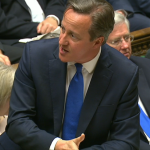
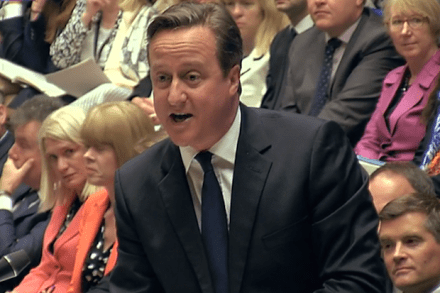
PMQs: David Cameron gives the impression he isn’t sold on a third runway at Heathrow

From our UK edition

Harriet Harman began at PMQs by asking about the situation in Tunisia. The mood of the House was appropriately sombre as this issue was discussed and there was much agreement between her and Cameron. But then she turned to the Davies’s report and its recommendation that a third runway should be built at Heathrow, and party politics was resumed. Harman announced that Labour was now backing a third runway, and challenged Cameron to do the same. He dodged, hiding behind the threat of judicial review. Harman then cracked a series of good jokes at his expense, chastising him for ‘being bullied by Boris’ out of doing the right thing for the country.

Tory summer party auctions a photo of the Cabinet – for £200,000

From our UK edition

Despite the government planning £12bn worth of welfare cuts, it's still a case of no expense spared when it comes to Tory parties. Last night the Conservative Party Summer Party was held at the Hurlingham. The lavish bash saw the Tories celebrate their return to government with their rich donors, who in turn volunteered hundreds of thousands of pounds for a number of lots, including a copy of the EdStone: Although the event was supposed to be private, Mr S's colleague Fraser Nelson was on hand to report back on the lavish bash. He writes about the do in his diary in the forthcoming issue of The Spectator: 'Mind you, nothing much embarrasses the Conservatives nowadays.

We haven’t had a pan-European war for 70 years. Why is that?

From our UK edition

The EU referendum makes me suspect that the grownups don't know what they're doing. I can see how we got to this point but it seems absurd that something so fundamental should be up - not just  for debate but possibly even - for reversal. It is doubly absurd because David Cameron has said that he will be campaigning - as you would expect of a conservative - for the status quo. So why are you doing this? I mouth at the television, wishing heartily that he would fight his internal party battles on his own time. Bewilderment is, it seems to me, one of the main forces behind this referendum. Some - many - people are bewildered by the EU. Getting your head around it is hard because the organisation is unique: there are no good metaphors for it.

Charlotte Church to be reunited with David Cameron at this year’s Tory conference

From our UK edition

In 2012 Charlotte Church met with David Cameron at the Conservative Party Conference as part of a Hacked Off fringe event. Although the meeting appeared to be civil at the time, the classical singer turned anti-austerity activist later said he came across as 'gross and really misogynistic': 'He was so dismissive to what I had to say. It just really irked me that whole situation.' Now three years on, Steerpike understands that the pair will have the chance for a reunion at this year's Tory conference, which is to be held in Manchester in October.

Aid is no substitute for defence, and Michael Fallon knows it

From our UK edition

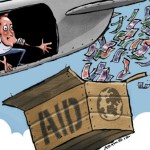
It’s been obvious for a while that the Prime Minister is exasperated by the way American and other allied officials – including President Obama himself – keep expressing concern about Britain’s rapidly shrinking defence capabilities and the prospect of yet more defence cuts. David Cameron also dislikes being reminded that he lectured other Nato leaders about meeting the alliance’s minimum of spending 2 per cent GDP on defence, when by any honest calculation the UK is not going to meet that target. He hasn’t responded directly to the multiple warnings from Washington.

Cameron wants the UK to be more ‘intolerant of intolerance’

From our UK edition

The minute’s silence before David Cameron’s statement to the House gave proceedings in the Commons this afternoon a particularly sombre air. When Cameron spoke at the despatch box, he announced a national minute’s silence at noon on Friday to remember those killed in Tunisia. He also said that there was, as yet, no evidence that Friday’s attacks in Tunisia, France and Kuwait were coordinated. He did, however, confirm that an emergency exercise drill on how to deal with a terrorist attack will take place in London in the next few days.

We assume British Muslims support British values. Do they?

From our UK edition

Let’s put the question very bluntly: do British Muslims affirm British values, or are they outsiders to our way of life? Or, even more bluntly: can we trust them? It is important that we learn to answer this question with nuance, and not in a self-righteous and simplistic way. A week before the Tunisian carnage, David Cameron implicitly raised the question, when he said that too many mainstream Muslims were equivocating, seeming to condone Islamic State and to disparage the West –this 'paves the way for young people to turn simmering prejudice into murderous intent', he said. His comments, and his planned counter-extremism bill, were strongly condemned by commentators, and also by his former party chairperson Sayeeda Warsi.

David Cameron takes centre stage at Glastonbury

From our UK edition

David Cameron's former director of strategy Steve Hilton recently wrote in The Spectator that Glastonbury is not merely a 'left-wing utopia', arguing that it operates in accordance with conservative principles. Mr S, who attended the festival this weekend, suspects Hilton may need to rethink this theory. As Natalie Bennett, Ken Livingstone and Charlotte Church took to the stage to preach their anti-austerity message, David Cameron made his own appearance in Shangri Hell, the festival's main after-hours party area. The Prime Minister had the dubious honour of having his voice played on speakers in the party section, which was covered in political posters about the dangers of cuts.

If Greece leaves the Euro, Cameron should start the British renegotiation all over again

From our UK edition

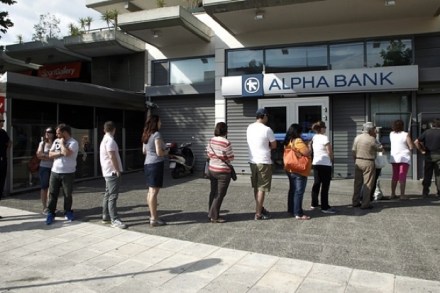
Tonight, it is still not clear how the Greek situation will be resolved. The European Central Bank--which is desperate to avoid being dragged into the politics of this situation--has chosen a middle way on its emergency assistance to Greek banks. It has neither ended it—which would have crashed the whole Greek banking system—nor extended it, which would have enabled the banks to stay open and eased the pressure on the Syriza-led government. Greek banks will definitely be closed tomorrow and probably until the referendum on Sunday. The next big question is what happens on Tuesday when the bailout programme ends and a payment comes due to the IMF which Athens will not be able to make.

‘Religion of peace’ is not a harmless platitude | 27 June 2015

From our UK edition

The West’s movement towards the truth is remarkably slow. We drag ourselves towards it painfully, inch by inch, after each bloody Islamist assault. In France, Britain, Germany, America and nearly every other country in the world it remains government policy to say that any and all attacks carried out in the name of Mohammed have ‘nothing to do with Islam’. It was said by George W. Bush after 9/11, Tony Blair after 7/7 and Tony Abbott after the Sydney attack.

Portrait of the week | 25 June 2015

From our UK edition

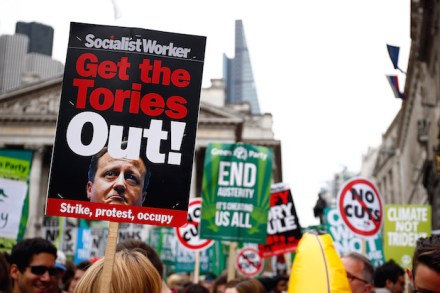
Home Tens of thousands took part in a demonstration in London against austerity, and thousands more in other cities. Russell Brand was heckled for being too right-wing: ‘Fuck off back to Miliband,’ protestors in Parliament Square cried. David Cameron, the Prime Minister, explaining his thinking on further benefit cuts: ‘There is what I would call a merry-go-round: people working on the minimum wage having that money taxed by the government and then the government giving them that money back — and more — in welfare.’ The government sold more shares in the Lloyds Banking Group, bringing its ownership to less than 17 per cent.

There’s no need for Cameron to rush the renegotiation process

From our UK edition

This EU Council has long been marked in Downing Street’s diary as the moment when David Cameron would tell other EU leaders what his renegotiation demands are. But tonight Cameron’s remarks will be a relatively minor part of proceeding as Greece and the situation in the Mediterranean dominate discussion. I understand that the Council President Donald Tusk is not even expected to go round the table asking other EU leaders what they thought after Cameron’s contribution. In some quarters, the fact that the British renegotiation is being treated as a third order issue at this summit is being seen as a snub to Cameron. But those involved in the renegotiation are actually quietly pleased that it won’t be the centre of attention at this summit.

Official: income inequality has fallen under David Cameron.  

From our UK edition

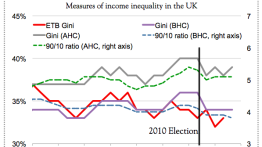
“Inequality has gotten much worse in the United Kingdom,” declared the Nobel laureate Joe Stiglitz when he was on Andrew Marr’s Start the Week last month (clip below). It’s one of those things that ‘everyone knows’ which is (to put it politely) not supported by the data. The latest inequality data came out today, taking us up to 2013/14. There are various measurements, but you get the overall picture (above). As David Cameron said in Prime Minister’s Questions yesterday, inequality is lower than the levels inherited under Labour. There has been a lot of talk about surging economic inequality recently, and lot of books about the problem. But not much evidence.

Europe’s great game

From our UK edition

[audioplayer src="http://rss.acast.com/viewfrom22/angelamerkel-sburden/media.mp3" title="Fredrik Erixon and James Forsyth discuss the challenges facing Angela Merkel" startat=36] Listen [/audioplayer]For generations, ambitious politicians have dreamed about having the power to run Europe — but as Angela Merkel can attest, it’s a horrible job. She didn’t want to end up with the continent’s problems on her shoulders, but things have ended up that way. The Greek economic implosion, the seemingly unstoppable wave of immigrants from north Africa, the menace of Russian aggression, the euro crisis — all the multiple, interconnected, crises battering Europe have ended up as Merkel’s problem.

PMQs: some revealing exchanges from Cameron on tax credits, broadband and ‘the vow’

From our UK edition

In PMQs today, there was no sense of the drama going on outside in Central Lobby as disability campaigners attempted to enter the Chamber. But the exchanges were far more revealing than usual. Harriet Harman asked Cameron about his plans to cut tax credits. Revealingly, Cameron didn’t deny that tax credits were going to be cut or tell Harman to wait until the Budget on July the 8. I think we can take that as something close to confirmation that tax credits will be cut as part of the government’s effort to make £12 billion of savings from the welfare Budget. Indeed, Cameron even endorsed the idea that tax credits have actually kept wages down when he said that he wanted a ‘high pay, low tax, and lower welfare’.

Will the Calais crisis create another EU headache for David Cameron?

From our UK edition

The crisis at Calais has once again raised the issue of UK border security. Some of the 3,000-odd illegal migrants residing at the port took advantage of yesterday’s ferry workers strike by attempting to board the delayed vehicles. The immigration minister James Brokenshire told the BBC this morning the situation is ‘hugely regrettable’ and the government will be taking steps to ensure Britain's border security is beefed up: ‘It is hugely regrettable that we've seen these incidents occurring as a result of industrial action in France. ‘We are putting additional resourcing into the port of Dover to enhance screenings and detections there so that we're looking at this on both sides of the Channel.

‘No’ campaign coordinator pushes idea of two referendums

From our UK edition

Dominic Cummings is the man drafted in to put together the putative No campaign for the EU referendum. Cummings has a tendency to surprise and he has done that today with a piece that pushes the idea that the No campaign should say that there would be a second referendum if Britain votes Out. This second vote would be on the terms of Britain’s exit from the EU. Cummings’ thinking is that this would de-risk voting No. People would be simply rejecting the deal that David Cameron had negotiated rather than voting to leave outright. Cummings sums up the advantages of a second referendum for No thus: This approach might allow NO to dodge its biggest problem – the idea that a NO vote is a vote to leave in one jump and is therefore a leap in the dark.

David Cameron makes the case for the Tories’ moral mission

From our UK edition

David Cameron has never particularly warmed to the language of compassionate conservatism. In the past, that side of the conservatism has generally been represented by Iain Duncan Smith — with help from the Centre for Social Justice, the think tank he founded. But in light of the rapidly approaching £12 billion of cuts in welfare spending, the Prime Minister will give a speech today outlining why it is important to end the ‘merry-go-round’ of benefits: ‘When it comes to extending opportunity – there is a right track and a wrong track. The right track is to recognise the causes of stalled social mobility and a lack of economic opportunity. Family breakdown. Debt. Addiction. Poor schools. Lack of skills. Unemployment.

Greece may soon face a humanitarian crisis of its own

From our UK edition

Normally, the phrase ‘continent in crisis’ is hyperbole. But it seems appropriate today as we contemplate the situation Europe, and more specifically the EU, finds itself in. In the next few days, Greece could default, triggering its exit from the single currency and financial disruption across the Eurozone. Meanwhile, Rome is on the verge of unilaterally issuing Mediterranean migrants travel documents enabling them to travel anywhere in the Schengen area because—as Nicholas Farrell reports in the magazine this week—Italy simply cannot cope with many more arrivals. Those involved in the British government’s preparations for a Greek exit put the chances of it at 50:50.