David cameron

Alan Duncan demoted from shadow cabinet

From our UK edition

So was the "rations" video a gaffe too far?  The news has just come in that Alan Duncan has been demoted from the shadow cabinet, going from shadow leader of the Commons to shadow prisons minister.  Having spoken to various Tory sources, I understand that the decision was made in an "amicable" meeting between Duncan and Cameron – where the former acknowledged he has become a "lightning conductor" for public anger over expenses – and that, apparently, Duncan is "relaxed and relieved" to be working under Dominic Grieve. Some people might be surprised at the timing: many expected Cameron to hold off until next year, so as not to rile any backbenchers who broadly agreed with Duncan on expenses.
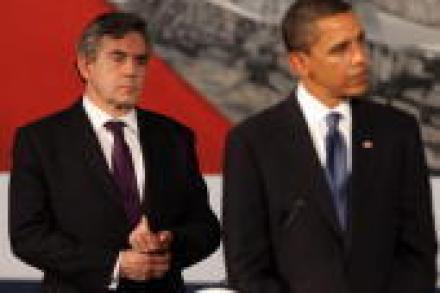
Obama and Cameron: who thought what about whom?<br />

From our UK edition

Remember that New Statesman article about Obama calling Cameron a "lightweight"?  Well, the Journalist Closest to Obama, Richard Wolffe, has a different take.  Here's what he told the Today programme this morning, courtesy of the ever-alert Andrew Sparrow: "He had a strong impression, a strong reaction, to both Cameron and Brown. It was right at the end of his foreign trip. And he was really taken with Cameron. He and his aides thought that he had energy and verve, a dynamism that suggested he was a good candidate – remember this was a candidate at the time, not a president. And there was bonding that took place which you might not expect of two people at the opposite ends of the political spectrum.

If Britain hasn’t returned to growth by the end of the year, will it still be ‘no time for a novice’?

From our UK edition

Looking at the OECD’s latest economic forecast it seems that the UK—unlike the US and the Euro-Zone--will not return to growth by the end of this year. (Although, one can’t help but wonder if Brown will start heralding zero percent growth in the fourth growth). Indeed, the OECD projects that the UK economy will shrink by 4.7 percent over this year as a whole—although the worst appears to be behind us with the rate of shrinkage slowing since the last quarter of 2008 and the first quarter of this year.   As Kevin Maguire suggests today, Labour’s election strategy is likely to be that Britain is not out of the woods yet and so it is still no time for a novice.

Can Cameron learn from Wilson?

From our UK edition

Few Tories will enjoy looking back on 1974, but they may find it useful to study the second Wilson government and its successor, the Callaghan government, when it comes to the question of Europe.  Back then, we had a government coming to power in the midst of a severe economic climate, and which sought to change the pro-European course that its predecessor had set, including by re-negotiating Britain’s relationship with the EU and by appealing to fraternal parties in France and Britain. However, it ultimately ran into blades of domestic discontent and international indifference. The question is: could this end up being the story of a Conservative government from the middle of next year? Sure, there are key differences between then and now.

The Sky debate could be a lifeline for Brown

From our UK edition

As the Megrahi case grows more serious by the day, one thing should be cheering up those in the Brown bunker: Sky’s plan to host a debate among the party leaders. Now, Brown might be the only party leader yet to have agreed to the debate but he is the one with the most to gain from it. If Brown is to have any hope of stopping David Cameron from winning the next election outright, he needs a game changing moment—and a debate might just produce one. The first televised leaders’ debate will be a hugely hyped event. One has to imagine that it would draw a huge TV audience and a ton of media coverage. It would provide the clunking fist with the perfect platform to land a blow on David Cameron.

Cameron should be wary of taking the moral high ground in opposition

From our UK edition

I’ve just re-read Cameron’s article in the Times and it contains one section that might come back to haunt him, should he become Prime Minister. He writes: ‘Many will be disgusted by the suggestion that ministers in Whitehall encouraged al-Megrahi’s release — and did so for commercial reasons. Diplomacy often involves hard-nosed backroom deals. It would be naive to think otherwise. But there need to be lines you are not prepared to cross; values you will not compromise, whatever deal you broker. I believe even to hint that a convicted terrorist could be used as makeweight for trade is a betrayal of everything that Britain stands for.’  I agree with Cameron.

Cameron is the winner of the al-Megrahi scandal 

From our UK edition

It is clear that the al-Megrahi release has damaged Labour, not least because their collective refusal to condemn, or at least have an opinion on, the release of the Lockerbie bomber has confirmed that the government is totally out of touch with public opinion. On the other hand, David Cameron has played a blinder. In stark contrast to the Prime Minister’s Trappist monk act, Cameron has led this issue, voicing considered condemnations of Kenny MacAskill’s decision, the government’s reticence and the its supposedly ethical foreign policy. Cameron writes a piece in today’s Times branding the entire affair a ‘fiasco’ and a ‘failure of judgement by the Scottish government...the British government...and the Prime Minister’.

The Tories’ tax question

From our UK edition

So should the Tories announce tax rises ahead of the next election?  According to Andrew Grice in today's Independent, they're certainly thinking about it: "There is a growing recognition among shadow Cabinet ministers that, if they win power, spending cuts could only be half the picture, as they would also need significant tax rises to fill the black hole in the public finances. That is why Mr Cameron and George Osborne won't rule out tax increases. The big debate among the Tory high command now is whether to announce some tax increases before the general election. Mr Cameron is reluctant to unveil a detailed 'shadow Budget'.

Would Cameron govern differently?

From our UK edition

In an episode of Yes Prime Minister, a tobacco mogul asks Sir Humphrey: “Does he carry any clout in Whitehall?” The Mandarin replies: “None at all, he’s only a minister.” The context has changed but the essential truth remains – most Cabinet ministers have no clout in government whatsoever. That at least is the view of four former Sir Humphreys. Lords Turnbull, Wilson, Butler, and Armstrong are quoted in the Guardian saying that New Labour has centralised government around a clique of special advisers. The result? The marginalisation of the cabinet and the breakdown of what they term ‘the efficient and proper conduct of government’.

Cameron must set out health plans

From our UK edition

For some time now at Coffee House, we’ve questioned the sense of Cameron’s pledge to increase NHS spending in real terms. And in today’s Independent, a ComRes poll suggests that 62 percent of Tory MPs do not think the NHS should receive guaranteed spending increases. Indeed, their opposition to Mr Cameron’s plans runs deeper: only 33 percent believe the current model of care free at the point of delivery is sustainable. Additionally, the Independent quotes an anonymous Tory MP saying:  "The hope is that we would be more radical on health in office than we say now, that he [Mr Cameron] is anxious not to frighten the horses. But there are concerns about cutting other areas and allowing the health budget to carry on rising regardless.

The biggest failure of the Tory opposition years

From our UK edition

Fantastic, thought-provoking stuff by Matthew Parris in the Times today, as he looks back on the past 12 years of Tory opposition and asks: "Just what did they achieve?"  His response is generally unfavourable: that, until more recently, the wilderness years have largely been wasted years.  And he highlights the Tories' inability to take on Labour over their wasteful spending and burgeoning deficit: "But it was on the central domestic question of the era that the Tories’ nerve failed almost fatally. At first new Labour held to the tight spending plans that it inherited from John Major’s outgoing administration. Then the Government let go. The letting go was, in retrospect, fairly spectacular.

The Tories have been put on the back foot, but don’t expect permanent damage

From our UK edition

There's plenty to be sceptical about with this #welovetheNHS Twitter campaign - not least the manner in which it's falsely polarising the debate into "lovers" or "haters", given that 140-character "tweets" hardly allow for nuanced arguments.  But, as Fraser pointed out last night, there's little doubting that it's a spot of good luck for Gordon Brown: a campaign by the left, for the left, which he managed to seize on with uncharacteristic speed.   Indeed, Brown beat David Cameron to the punch for perhaps the first time in months, and has put the Tory leader on the defensive.  Hence Cameron's blog post last night, which set out his own #reasonsforlovingtheNHSbutstillwantingittoimprove, so to speak.

Let the Alan Duncan Incident Be a Warning to You, Mr Cameron

From our UK edition

The last time I was invited to Alan Duncan's office in the House of Commons I took a film camera with me. I didn't hide it and took a film crew along with me. Duncan was charming, if a little cheesy, and talked eloquently about why Ken Livingstone's oil deal with Hugo Chavez was bad news for London and Venezuela. But during the interview there was something that gave me a glimpse into Alan Duncan's soul. Not an off-the-cuff comment about MPs having to live on rations. But a framed photograph proudly displayed on a bookshelf. It was a screenshot from Prime Minister's questions of Alan Duncan alongside George Osborne and they were -- there is no other word for it -- braying. It was posh Tories in their full pomp and it sent a shiver up the spine.

The Tory grassroots deliver their verdict on Alan Duncan

From our UK edition

The Tory grassroots have spoken, and they want Alan Duncan out.  Here are the main results from a poll which has just been published over at ConservativeHome: "A ConservativeHome.com poll of 1,622 Tory members carried out today finds 65% want Alan Duncan to resign and 55% think he should be sacked. A massive 91% think he should be moved from his current job where he has a role in deciding Conservative policy on MPs’ expenses and allowances. 61% are dissatisfied with Alan Duncan's performance. 31% are satisfied.  This makes him the least popular member of the shadow cabinet. 38% agreed that 'Alan Duncan was telling the truth - the antagonism toward MPs has gone too far.'  52% disagreed.

Mandy: Brown would “relish” televised debates with Cameron

From our UK edition

So Mandy's brought up the idea of a public debate between Brown and Cameron again, claiming – in interview with Sky (see footage above) – that the PM would "relish" the opportunity to "take the fight to the Conservatives".  If you remember, the last time Mandy mentioned it, Downing St quickly moved to dampen all the speculation - the rumour was that Brown was going to challenge* Cameron to a series of debates in his conference speech, and was irritated at the PoD for giving the game away so early.  But now that Mandy has made the same point again – indeed, even more forcefully this time – I reckon it near confirms that Brown's challenge will come soon enough. * The word "challenge" is used in the loosest possible sense here.

Alan Duncan is a very lucky man

From our UK edition

Guido has just blogged that he was offered the video of Alan Duncan complaining that MPs live on rations and are treated like sh-ts back in June. If Guido had run it then, Duncan would have been in far bigger trouble and might well have ended up being sacked. The expenses story was still much rawer then, the whole press corps would have been in full pursuit and Cameron would have had to answer questions about whether Duncan could stay or not in every interview he did. Duncan’s comments, though, again call into question his judgement.

Something the Tories could do without…

From our UK edition

...Alan Duncan saying on video that MPs are treated "like sh*t", and that they're forced to live on "rations".  He's just apologised, saying that the remarks were meant in jest.  And I'm inclined to believe him: he was, after all, in conversation with the political pranksters over at Don't Panic (although he didn't know he was being filmed).  But, either way, it's easy work for his opponents to take these things out of context.  And many will argue that the expenses fiasco isn't a laughing matter in the first place.

Supplementary notes on Osborne’s progressive speech

From our UK edition

Earlier, I wrote that Osborne's speech today seemed to be a significant moment for Project Cameron.  Having attended the Demos event a few hours ago, I still think that's the case.  Sure, there wasn't anything particularly new in it - and the delivery didn't quite zing - but its central point that Brown's approach to the public finances is regressive, while spending cuts and the right reforms could deliver better services for all, is a necessary refinement of the Tory message.  Come election time, Brown is going to deploy all kinds of attacks on the "nasty Tories" and their "cuts in frontline services", so it's important for Cameron & Co. that they counter this in advance.

The press’ obsession with the Tories, Rachel Whetstone and Google is immature 

From our UK edition

Nearly all the papers have run articles on Rachel Whetstone today. These pieces concentrate on the fact that she’s the partner of Steve Hilton, Cameron’s chief strategist, and that the Tories mention Google quite often. Frankly, this strikes me as a nothing story. The Tories are mentioning Google so much because it is the kind of modern, successful brand that they want to be associated with, not because Whetsone, who was Michael Howard’s political secretary and who used to be close for Cameron, works there. Also, considering how Google has become shorthand for so much of the technological change going on around us, it would be rather hard for a politician to talk about how the internet can change the way public services are delivered without ever mentioning the company.

Osborne makes progress

From our UK edition

It's a big day for George Osborne.  The Shadow Chancellor is using his new platform at Demos — the think-tank which is credited with much of the brainwork behind the initial New Labour project, but which is now turning to the Tories as well as to the Purnellite wing of the Labour party — to deliver a speech on progressive politics.  I haven't read the whole thing yet, but the snippets which have been published in the papers make it seem like a significant moment in Project Cameron: when the Tories extrapolate their attacks on Brown's fiscal legacy further, and perhaps more resonantly, than they have done before.  Here's a key passage, to give you the idea:   “...