David cameron

What do the Legg letters mean for the Kelly Review?

From our UK edition

As the Legg controversy continues along its unedifying course, I can't help but wonder what it all means for Sir Christopher Kelly's review of the expenses system, due for publication in a few weeks' time.  The plan is that the government will go through its recommendations, adopt any it likes, and then put them to a vote in the Commons.  But will Brown now back away from the more radical proposals, from fear of aggravating the Parliamentary Labour Party even further?  Will MPs now be more tempted to dismiss Kelly's ideas out of hand?  This is, after all, yet another independent review, commissioned by Brown, which will contain suggestions you imagine will be less-then-popular with our political class.
A goatherd by necessity

From our UK edition

In his recent interview with Fraser, David Cameron said that he's keen on bringing in outside talent to the government – the so-called "Goat" strategy, which has been a feature of Brown's premiership.  In her ever-excellent column, Rachel Sylvester makes the point that this may be as much from necessity as by design: "According to Anthony Wells, of UKPollingReport, at least a third of the House of Commons are likely to be novices after the next general election — the highest proportion since 1945. A perceived house of whores, whose members would sell their souls for a bathplug, will soon be replaced by a virgin Parliament, untouched by the John Lewis list. The implications are huge.

Legg Commission: full Shadow Cabinet details

From our UK edition

The damage to the Shadow Cabinet caused by Sir Thomas Legg has been published. All in all it’s not too bad for the Tories. Ken Clarke tops the list with £4,733 on gardening and cleaning expenses. In terms of comparing figures between the parties, an arresting and emotive issue to the public, the Tories are once again ahead, a point that reinforced by the fact that far from all of Labour's and the Lib Dem's frontliners have declared their exposure. However, there might be problems for the Tories in the future. David Cameron and George Osborne both need to produce more information about their mortgage claims. Overall though, the Shadow Cabinet has escaped embarrassment and the public’s ire. Whether Cameron will convince his backbenchers to follow suit remains to be seen.

Widdecombe defies Cameron over the Legg letters

From our UK edition

The Tory leadership’s line on Sir Thomas Legg’s expense repayment demands is clear. Mr Cameron told GMTV: “Repay or you cannot stand as Conservative MP”.   The public’s justified outrage at expenses is such that party leaders must take a stand and discipline MPs, deemed to have transgressed rules or to have exploited the second home allowance. But, as I wrote yesterday, the Legg Commission exceeded its remit, acting as judge rather than auditor. As such, MPs are right to resist Sir Thomas’ demands: Parliament urgently needs reform, but there is a clear problem that reform will be inaugurated by a commission that ignored its terms of reference. This is an unpopular viewpoint, deeply unpopular.

Brown told to repay £12,415.10 of expenses

From our UK edition

Here's the statement from the office of the PM, courtesy of Sky's Cheryl Smith: Mr Brown received a letter from Sir Thomas Legg this afternoon. Sir Thomas Legg has issued his provisional conclusions to MPs, asking for further information where necessary before concluding in December. Mr Brown has always supported this process and will cooperate fully and make the necessary repayment. Mr Brown's expenses have always been cleared by the House Authorities as entirely consistent with the rules. He has not claimed the maximum level of expenses. The Review says its findings "carry no implication about the conduct or motives of the MPs concerned".

The politics of growth

From our UK edition

One strange side-effect of the car crash that was the Liberal Democrat conference is that no one dares say the word “cuts” anymore. Since Nick Clegg promised “savage cuts” – alarming his base in the process – we’re back to the normal euphemism of “efficiencies”. This, like so much in life, will have Gordon Brown hopping mad. He didn’t want to say “cuts” in the first place, and the whole farrago will prove (in his head) that he should stop taking advice from people outside his coterie.   The next stage in the debate is to focus on growth. As James revealed in his political column for the current edition of the magazine, the Tory plan to do this is an aggressive cut in corporation tax.

Michal Kaminski: An Astonishing New Twist

From our UK edition

David Miliband has really gone for it in the Observer. Far from apologising for his Labour conference attacks on David Cameron's right-wing alliance in the European parliament, he has suggested that Churchill would have been ashamed of the modern Tories for getting into bed with Poland's Michal Kaminski and Latvia's Roberts Zile.  I interviewed Mr Kaminski last week, and I found his responses to my questions on the wartime massacre of Jews by Poles at Jedwabne in north east Poland unconvincing. His comments to me have been picked up by The Observer today. Most worrying is the idea that he believes this massacre to be of a different order to Nazi war crimes. He told me: "I think it's unfair comparing it with a Nazi crime and putting it on the same level as the Nazi policy.

John Rentoul Calls it Right on Brown and Cameron

From our UK edition

As he says himself in this week's column in the Independent on Sunday, John Rentoul showed "slavish admiration for a former Prime Minister". Such is his grief for Tony Blair that he can't bear to utter his name.  I did wonder whether John would seamlessly shift his admiration from Blair to Cameron, but he has remained loyal to his former idol's New Labour project. Even when I disagree with him (and possibly especially when I disagree with him) John Rentoul remains one of the most incisive political columnists writing today, even though he has lost his access to the highest levels of power.  At risk of falling into slavish admiration myself, I have to say John's column today is spot on about the post-conference political scene.

A shaming episode

From our UK edition

The Culture Secretary would be advised to keep his fingers to himself. Following Wednesday’s Twitter gaffe, he let fly on Twitter once again. His target was David Cameron’s demolition of the state. All Bradshaw hit was Cameron’s dead son Ivan. He tweeted: ‘the camerons got good nhs care thanks to Labour’s investment and reform. Is this the ‘big government’ the derides.’ (sic) Bradshaw then issued a clarification, not an apology, on Twitter: ‘it wasn’t meant to be offensive. Point is they will the ends but not the means. Need positive government to deliver these things.

What would the Tories take back from Europe?

From our UK edition

Assuming that the Lisbon Treaty is ratified, that the Conservative Party wins the next election and that Angela Merkel and Nicola Sarkozy want Britain to remain in the European Union, what “sovereignty package” will EU leaders come up with for Prime Minister Cameron, so that the Tory leadership can placate its eurosceptic base? The deal cannot be cosmetic, but make it too tough and other EU leaders will not want to compromise.

That Wellington became Prime Minister is irrelevant to the Dannatt case

From our UK edition

General Dannatt denies that he’s been in cahoots with the Tories. He gave a lecture last night and said: “[David Cameron] put it to me that he was concerned that his defence team - at a time when defence was really important, and Afghanistan was really critical - lacked expert understanding. "And would I be prepared to advise his team, and, if the Conservatives win the election, would I be prepared to take a peerage and maybe join his ministerial team… it was a recent decision and indicates that there was no long-term plot." Only a bolus of ministers, who believed they could smear a General who was renowned for his frugality over expenses, could be preposterous enough to suggest that Dannatt was a Tory mole all along.

Should Cameron have told us how he will do it?

From our UK edition

The left’s criticism of Cameron’s speech is that it contained no new policies and that begs the question: how will Cameron set the people free? Steve Richards has an essential article on the subject in today’s Independent. Here are the key paragraphs: ‘Against quite a few paragraphs in Cameron's speech I wrote a single word: "How?" I used to do the same with Blair's early speeches only to discover in 1997 that he had no answers to the question in several key policy areas. Most fundamentally it is still not at all clear how Cameron plans to reduce what he calls Labour's debt crisis.

Michal Kaminski: Cameron’s Ultra-Right Europhile

From our UK edition

The Jewish Chronicle this week landed an exclusive interview with Michal Kaminski, the Tory Party's controversial new Polish friend in the European parliament. He answered some pretty tough questions on his past pronouncements and offered a rebuttal of claims that he is an antisemite. I wasn't entirely convinced by some of his answers but I suggest any Tories who still haven't made up their minds about this curious alliance read the whole interview before they decide definitively on the matter. They may be baffled to read that in his eagerness to appease the Eurosceptics David Cameron has cosied up to a man who argued strongly for the Lisbon Treaty within his own party: "I was on the side of those who were in favour of the Lisbon Treaty. It is well known in Poland.

Conservative Party Conference Impressions

From our UK edition

I have to say that I found this year's Conservative Party conference a little lacklustre. I realise this was sort of the whole point -- the "no triumphalism" ordinance and the champagne ban were part of a conscious effort to keep the conference low key, But I do wonder whether the Tory high command overdid it. I came away from Manchester with the distinct impression that we were about to get a Tory government by default. To be fair I left before David Cameron's set-piece speech, but the real temperature of a party conference is always taken away from the conference platform: at the fringes, in the bars and in the snatched conversations in between. The Tories are beginning to get a policy agenda together, but it is still fragmented and lacking in a binding vision.

Modernisation for a purpose

From our UK edition

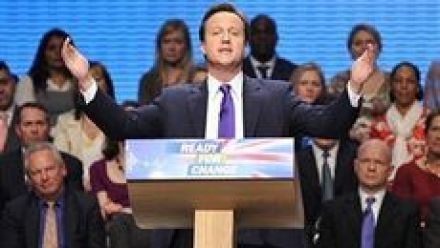
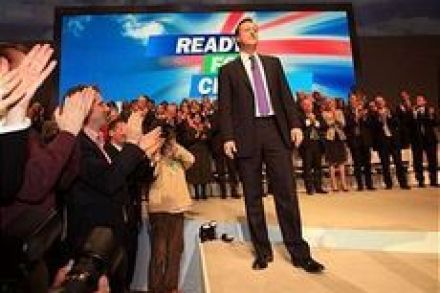
Just before David Cameron came on stage they played a video looking back at his four years in charge of the party. It concentrated on the modernising moments — the huskie hugging, the efforts to get more women into Parliament and the rest. When Cameron did these things, some critics mocked them, claimed that they showed he was all style and no substance. But today we saw what those moments have made possible. Cameron devoted his pre-election conference speech to a classic conservative message, that the big state is the problem. Crucially, this message is getting a hearing. It is not being dismissed as those ideological Tories banging on again. Modernisation has achieved one of its principal purposes.

Cameron’s revolutionary speech

From our UK edition

This was one of the best speeches I have heard David Cameron give. It may not have been a masterpiece of oratory, he may have read from notes, left too make lulls lulls inspiring only a few standing ovations.  But it was packed with mission, seriousness, vision, principles – and, most of all, a real agenda.   Just as last year’s conference speech laid out a Conservative defence of the free market, this year’s laid out a vision of the conservative society. That is to say: one which hands back power to communities, which trusts people and places huge emphasis on social mobility.   First, he positioned the Conservatives squarely in the fight against poverty – on the explicit grounds that Labour has lost that fight.

Dave will slay the Goliath-esque government

From our UK edition

Clever in its lack of cleverness. Cameron’s performance today was shrewd and unexciting, a speech of nursery-school simplicity. Large bland ideas, plain language. No detail. This was certainly no masterpiece. It didn’t have to be. Cameron’s in a holding pattern. Keep circling and he’ll land safely. Before he arrived, William Hague frustrated the eager delegates with two corporate videos of more than ordinary dullness. The BBC, flouting its own policy of censoring political broadcasts, aired both of them on BBC Parliament (albeit with the sound turned down.) First, a surpise. No less a figure than Bono, the UN's top Guilt Ambassador, spoke to the Tories about debt relief.

The Cameron transcript: Part II

From our UK edition

George Osborne has embraced the 50p tax as a central tenet of the “We’re all in this together” theme. CoffeeHousers will be aware of my deep scepticism about this. It is justified on presentational grounds: if you squeeze the rich, and their pips squeak, it will create ‘permission’(to use that Blairite phrase) to do the horrible things like deny pay rises to nurses and social workers. Ergo, presentation and economics are fused together on this issue, he says. Without popular support for the cuts agenda, it cant happen and the deficit won’t be tackled. So the 50p tax should be judged not on its own merits, but on the grounds of its ability to unlock the ability for deeper cuts to be made.