Crime

Huhne resigns

From our UK edition

We've just had a short statement from Chris Huhne — and, unsurprisingly, he's resigning as Energy Secretary. His words and demeanour, though, were strikingly defiant. He described the CPS's decision as ‘deeply regrettable,’ adding that, ‘I'm innocent of these charges, and I intend to fight this in the courts, and I'm confident that a jury will agree.’ In terms of a reshuffle, the likeliest outcome is that Ed Davey will glide into Huhne's former job, and Norman Lamb will in turn take Davey's place as a junior business minister. But there may be a pause before that's confirmed, as Nick Clegg is currently travelling back to London from the Lib Dem jolly in Eastbourne. Easy on the accelerator, Mr Deputy Prime Minister.
Keir Starmer’s statement on Huhne

From our UK edition

And here's the full text: ‘This statement is made by the Crown Prosecution Service in the interests of transparency and accountability to explain the decisions reached in the cases of Mr Christopher Huhne and Ms Vasiliki Pryce and to explain the time taken in arriving at these decisions. A criminal complaint was made to Essex Police in May 2011, alleging that Ms Pryce had accepted responsibility for a speeding offence committed by Mr Huhne in 2003. That complaint was investigated by Essex Police and a file was passed to the CPS in late July 2011. The CPS advised that further investigations should be made, including obtaining certain material from a national newspaper.

My week in Westminster

From our UK edition

I'm presenting Radio Four's Week in Westminster this morning, on deficit wars, London wars, welfare wars, and another set of wars which no one has really discussed yet: the directly-elected police commissioners. There will be about 40 of them elected in November, and candidates are already emerging: Nick Ross (ex-Crimewatch), Colonel Tim Collins and London mayoral hopeful Brian Paddick. I interview two names that have been thrown into the frame, both former ministers and both women: Jane Kennedy (Labour) and Ann Widdecombe (Tory). I wanted to find out just how excited we should be about these elected police commissioners.

12 January 1985: ‘Aren’t you scared?’

From our UK edition

A sad foray into the Spectator archives today, as we mark the death of Christopher Hitchens. He was, of course, linked with many publications: The New Statesman, The Nation, Vanity Fair — and with The Spectator too. We we all pleased to discover that he wrote so warmly of us in his recent memoirs: ‘...Alexander Chancellor, editor of The Spectator, gave me a call. His correspondent in Washington, and otherwise lovely man, was also having trouble taking the thing seriously and was filing copy that was “frankly a bit ‘flip’”. Would I mind surging down to the capital and seeing if I could hold the fort for a while? I didn't hesitate.

The Only Thing You Actually Need to Read About the Riots

From our UK edition

Three cheers for Bagehot for this superb post on the Guardian/LSE's abject justification for inquiry into this summer's riots. Mr Rennie puts it exceedingly well: Now, put me in many contexts, and I am quite the hand-wringing bourgeois liberal. Watching Newsnight yesterday evening, I fear I came over all Judge Dredd. The researcher’s contention, in a nutshell, is that the rioters were not criminals who ran amok for a few days in August, losing their moral compass when they realised their actions would probably be without legal consequences. Instead, we are asked to believe, they are angry young people who hate the police and believe that they were taking revenge on a heartless world.

Recent crime novels | 3 December 2011

From our UK edition

The crop of recent crime fiction is generously sprinkled with well-known names; as far as its publishers are concerned, Christmas is not a time of year for risk-taking. The Impossible Dead (Orion, £18.99) is the second novel in Ian Rankin’s post-Rebus series featuring Inspector Malcolm Fox of ‘The Complaints’, the team that investigates allegations of misconduct among the police themselves. Fox and his colleagues arrive in Kirkcaldy, where a detective constable stands accused of corruption — by his own uncle, who is in the same force. But the case mushrooms into something far more momentous that leads to some dark corners of the Scottish nationalist movement in the 1980s.

Sifting through the rubble from the riots

From our UK edition

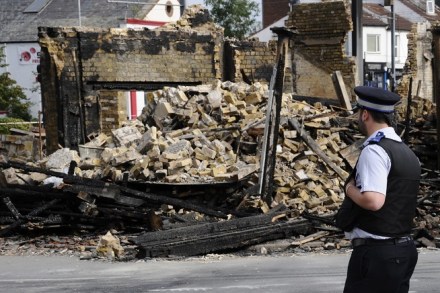
Not many folk are aware of it, but there is an official riots inquiry and it has delivered its interim report today. Its conclusions are pretty clichéd and not really worth studying; David Lammy’s book is infinitely more instructive and readable. But it does produce a few figures about the rioters — or, I should say, those arrested mainly because they didn’t think to cover their face. I looked at this for my Telegraph column last week. Here’s my summary of today's report:   1. Broken Britain. Some 46 per cent of those arrested live in the lowest ‘decile’. These guys are not working class, but welfare class.

Bookends: Not filthy enough

From our UK edition

The Pursued (Penguin, £12.99) is a lost crime thriller by C. S. Forester, the author of the Hornblower novels. It was written in 1935, rediscovered in 2003 and is now published for the first time. Marjorie, a suburban wife and mother, comes home after a ‘jaunt’ in ‘town’ to find her sister dead in the kitchen on page four It is said to be suicide, but we have doubts. Towards the end of the book, Forester summarises the action: ‘It was a filthy business, a tale of lust and murder and revenge, unredeemed by any of the nobler qualities of mankind.’ Not a bad précis, though anyone who reads The Pursued hoping to have their jaded 21st-century palate tickled is likely to be disappointed.

From the archives: A nation ablaze

From our UK edition

A more recent gem from the archives than we would normally mine, but with the forthcoming government report into the riots — and with Fraser's and David's recent posts — we reckoned you might care to (re-)read Harriet Sergeant's piece from this summer. It formed the centrepiece of an issue largely dedicated to those fiery disturbances, and which also included thought-provoking articles by Theodore Dalrymple and Ravi Somaiya. Here it is: These rioters are Tony Blair's children, Harriet Sergeant, The Spectator, 13 August 2011 On the third day of the London riots I received a telephone call from Mash, a member of a Brixton gang who I befriended three years ago. He was standing outside an electronics shop in Clapham, watching the looting.

We cannot forget the riots, nor ignore their causes

From our UK edition

If I’d said that an MP had accused the Church of England of being too obsessed with gay marriage and women priests — and not worried enough about how God can keep young boys out of harm’s way — you’d probably imagine that a Tory had gone nuts. But this is the David Lammy, Labour MP for Tottenham, who has gave an interview to our Books Blog. In it, he elaborates on the theme of his new book: that his colleagues are so keen to help single mothers that they’ve lost sight of what really helps working class boys. Amongst the contributing factors, he mentions two things that may cast him out as a heretic in Labour’s secular religion: fathers, and God.   Lammy’s book, Out of the Ashes, was released yesterday. On Monday.

Were the police hacking phones too?

From our UK edition

"As an American who spent many years in this underground industry, I can tell you that the British phone hacking scandal has exposed only a tiny part of a vast criminal network." So Frank Ahearn wrote in The Spectator a few weeks ago: he spent his life as a "skip-tracer" (as they're called in America), dealing in the black market for information. There are many clients, he says, and journalists are just one part of it. The people he worked for included husbands investigating wives, insurance companies trying to expose dodgy claims and – yes – even the police, using "skip-tracers" to solve cases. Finally, this aspect of the British hacking industry is beginning to be made public.

The post-riots landscape

From our UK edition

Back in August, the riots were being talked about as an event that would redefine our politics. But the economic news has been so relentless that the post-riots issues have received minimal coverage. This, though, doesn’t make them any less important. This week, we’re seeing two strands of the government’s response. First, Louise Casey starts work at the DCLG on dealing with the 100,000 problem families that the government has identified. Second, the May and IDS report on gangs comes out. So far what’s been trailed from the report is the proposal to create a new offence of intent to supply fire-arms.

A crucial week for the cause of free expression

From our UK edition

For those who care about free expression in the UK, and particularly the reform of our invidious libel laws, this is a crucial week. Today and tomorrow, the UK Supreme Court hears the Times’s attempt to overturn an appeal court ruling in a libel case brought against it by Metropolitan Police officer Gary Flood.   On Wednesday the Joint Committee on the Draft Defamation Bill produce its first report. There are grounds for hope that it will suggest strengthening some key areas, paving the way for full legislation early in 2012 — if the government can be persuaded to find parliamentary time.

What the riots mean for Ken Clarke

From our UK edition

The more we learn about the riots, the more it is becoming clear that experienced criminals were responsible for a lot of the looting. The Standard reports today that in London a quarter of those charged in relation to the riots had already been convicted of ten or more offences. What remains to be seen is if these hardened criminals instigated the riots, or simply took advantage of them. The involvement of these veterans of crime demonstrates the need both for better work on rehabilitating prisoners and for longer sentences to keep habitual criminals off the streets. The problem with Ken Clarke is that he, admittedly partly for budget reasons, only wants to see one side of this equation. The riots have been overshadowed by the brewing financial crisis.

Clarke is right to focus on reoffenders

From our UK edition

The Justice Secretary Ken Clarke – who was away during the disturbances last month – has signalled his return with an uncharacteristically tough piece in today’s Guardian. The reference to the rioters as a “feral underclass” is not language that the penal reform lobby will welcome from their favourite Minister, but it does signal a firmer line from the Justice Secretary: “In my view, the riots can be seen in part as an outburst of outrageous behaviour by the criminal classes – individuals and families familiar with the justice system, who haven't been changed by their past punishments.

Bookends | 3 September 2011

From our UK edition

Dr Temperance Brenner, like her creator, Kathy Reichs, is a forensic anthropologist. She works in North Carolina, specialising in ‘decomps and floaters’. This ensures that in Flesh and Bones (Heinemann, £18.99) you get plenty of authentic sounding detail with your gore. So when a human hand is found sticking out of a drum full of asphalt at the local speedway track, Reichs carefully includes plenty of stuff about how to extract the body — start with a power saw, then move on to an air hammer — and about the drum itself: ‘the size of the drum suggested a 35-gallon capacity.’ But there’s plenty more to Reichs than just insider info.

Art for ransom

From our UK edition

These two books make mutually illuminating and surprisingly contrasting companions, given the similarity of their subjects. Both are written by those with hands-on experience in the field of art preservation and security. Sandy Nairne was Director of Programmes at the Tate Gallery in 1994 when two important paintings by J.M.W. Turner were stolen while on loan to an exhibition in Frankfurt, and was a key player in their eventual recovery. When Anthony Amore became Security Director at the Isabella Stewart Gardner Museum in Boston in 2005, he immediately picked up the threads of the investigation into the theft of three Rembrandts and other works which had been stolen from the museum 15 years previously.

The danger of disproportionate sentences

From our UK edition

It’s great that hundreds of looters are being punished properly, and the police are to be congratulated for working hard to find the thugs responsible for damage during the riots. But whilst it’s important to be tough, let’s also beware of completely  ludicrous, perhaps counterproductive sentencing. Today it was reported that a young man called Anderson Fernandes has been jailed for 16 months for stealing an ice cream. He walked into an open ice cream store, prepared two scoops on a cone, took one lick, then passed it on to a nearby woman because, he said, he didn’t like the coffee flavour. Is this really a crime that deserves a 16-month sentence?

The riots, Whitehall and universality

From our UK edition

Away from the excitement of Libya and Colonel Gaddafi’s singular definition of ‘tactical retreat’, the post-riots debate continues. The government has announced that unemployed offenders will have to work a minimum 28 hours in their communities for four days per week and spend a fifth day looking for a job. This is part of the plan to bolster the Community Payback Scheme, signalled by Nick Clegg last week. Crispin Blunt, the prisons minister, has described the riots as a “one-off” and said it was vital that community sentences were sufficiently firm and constructive to “break the cycle of crime and encourage a law-abiding life.

Cameron’s Cognitive Dissonance

From our UK edition

The best parts of David Cameron's speech this morning were those passages spent defending the government's plans for police reform and secondary education in England. This should not be a surprise: whether you agree with them or not, these are relatively coherent policies that have enjoyed the benefit of long gestation. The rest of the speech, alas, was a humdrum tour of long-familiar bromides (families are good!), items pulled from discount bins ('elf and safety!) and impossible promises just vague enough to escape obvious ridicule ("a clear ambition that within the lifetime of this Parliament we will turn around the lives of the 120,000 most troubled families in the country"). Perhaps it has to be this way.