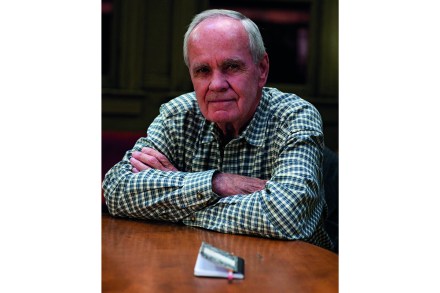
Cormac McCarthy

The Last Westerner captures the American Southwest

 The epigraph to this novel is from Chretien de Troyes’s Lancelot, one of the French author’s Arthurian romances. It is fitting because The Last Westerner is a medieval romance, as well as an epic set in the American Southwest in the closing years of the 20th century. The dedication is to the author’s wife and to the late Edward Abbey, a personal friend. It is equally fitting because The Last Westerner is a western novel in setting and theme and will bring to mind other western novels such as Abbey’s The Brave Cowboy (1956) and Cormac McCarthy’s All the Pretty Horses (1992). Abbey’s book is subtitled, An Old Tale in a New Time. That could be the subtitle for The Last Westerner too, and as for pretty horses, Chilton Williamson, Jr.’s novel is full of them.

horseback last westerner

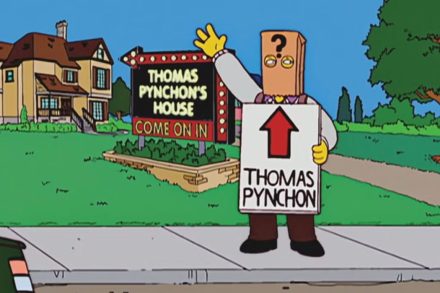
The final act of Thomas Pynchon

Whisper it, very quietly, but the now 87-year-old author Thomas Pynchon is having something of a moment in 2025. Not only has his 1990 novel Vineland supposedly served as the loose inspiration for the eagerly awaited new Paul Thomas Anderson-Leonardo DiCaprio collaboration One Battle After Another, but the near-impossible has been announced: Pynchon will publish a new novel, entitled Shadow Ticket, around the time of the movie’s release. It will be his first book in more than a decade, his ninth novel and his third consecutive noir-influenced story.

thomas pynchon

Is Cormac McCarthy finished?

During his lifetime, author Cormac McCarthy was renowned for being one of literature’s most retiring, even reclusive figures. Although his books and original screenplays were adapted into high-profile films by the likes of the Coen brothers and Ridley Scott, he barely gave interviews and preferred to lead a quiet and low-key existence in his own home own Santa Fe. Most believed that his solitude simply came about because of his desire to be left alone, but now an explosive new Vanity Fair feature has put a metaphorical rocket under McCarthy’s posthumous reputation. The article, written by Vincenzo Barney, reveals that, when McCarthy was forty-two years old, he fell in love with a sixteen-year-old girl, Augusta Britt, who he met by a motel pool.

cormac McCarthy

Oppenheimer’s passenger

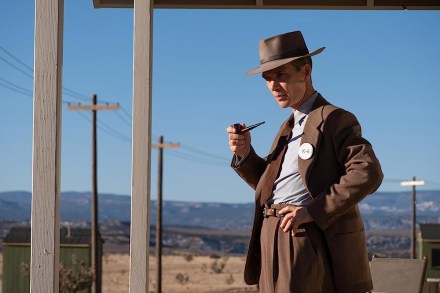
Ripples appear in courtyard puddle outside the Cavendish Laboratory at the University of Cambridge; a tornadic funnel erupts from the black atmosphere toward Earth. Between these images — the small one of intimate life and the colossal one of planetary death — a haunted young man looks on in curiosity and horror.  The man is Robert Oppenheimer, played to perfection by Cillian Murphy, a theoretical physicist “troubled by visions of a hidden universe.” This visionary, capable of conjuring apocalypse from the particles stowed inside atoms, spends the first fifteen minutes of the film looking bewildered — a gaunt, gray sliver of a man wandering through his life like a ghost.

oppenheimer

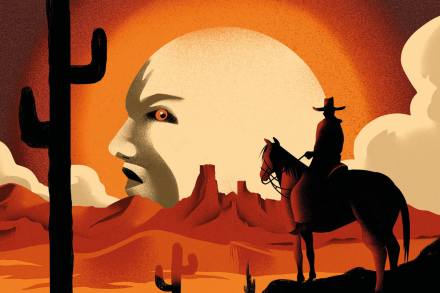
Blood Meridian is Cormac McCarthy’s masterpiece

In June, Cormac McCarthy — our greatest living writer — slipped from this world to the next and joined his forebears Melville, Twain, Faulkner and Flannery O’Connor in the American literary pantheon. By noon the following day, Blood Meridian, or The Evening Redness in the West, his magnum opus, had reached number eight on Amazon’s Top 100 Books, assuring that, for the first time, it would hit the New York Times Paperback Bestseller List; a curious development for a novel that, when it was first published in 1985, failed to sell its initial print run of 1,500 and was quickly remaindered.

blood meridian

To honor Cormac McCarthy, release the Thornton Cut

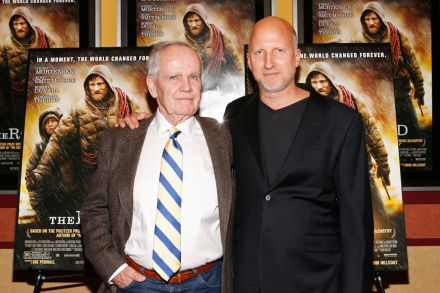
The success of the late Cormac McCarthy reached new heights in the spring of 2007, when mainstream audiences became familiar with his work through the Coen Brothers' film adaptation of No Country for Old Men, which would go on to win Best Picture, followed by the surprising choice of McCarthy's post-apocalyptic book The Road as the next selection in Oprah Winfrey's vaunted Book Club. The reclusive McCarthy did his first television interview ever with her that summer, to the shock of long-standing fans of his work.

The return of Cormac McCarthy

After sixteen years of silence, Cormac McCarthy has literally written a novel and a half. That’s the good news. Perhaps less-good news is that about half the longer novel depicts conversations between a mad person and an imaginary deformed imp called The Thalidomide Kid, while all of the half-novel is a dialogue between the same mad person and her psychiatrist. The unequivocal bad news is that quite a lot of both is about quantum physics, by way of ruminations on the Manhattan Project and a JFK conspiracy theory: an unholy trinity of literary red flags. I do not mean to dissuade anyone from reading a rare new work by one of America’s finest living writers. Parts of The Passenger and its “coda,” Stella Maris, are very funny. Parts are even brilliant.

cormac McCarthy

Cormac McCarthy, brutal but brilliant

Cormac McCarthy of all living American novelists has realized most fully the potential grandeur of his métier by revealing the spiritual condition of our time in the old epic language. In this sense, he is the most serious American novelist of the post-war era. McCarthy’s work is magnificently oblivious to modern industrial and technological society and to the post-urban and suburban culture of consumerism, triviality and superficiality that are its fruits: the penalty a decadent civilization pays for its self-alienation from nature, humanity and metaphysical reality, and its embrace of an artificial world in which what is real and human withers and dries up, and art becomes well-nigh impossible.

cormac mccarthy