Copernicus

Heavenly beauty: Doppelmayr’s Atlas Coelestis

From our UK edition

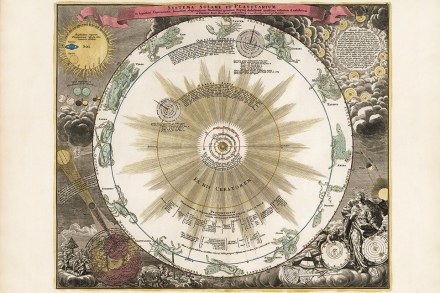
It seems something of a disservice to a work of this seriousness to say how beautiful it is, but that is what will first strike the reader. Open this book and if you can prise yourself away from its wonderful marbled end papers, with their swirls and drifts of deepest blue, brilliant flashes of rusty orange, rivulets of ochre, inky spheres and floating masses of fiery red, you will find yourself taken back to the Enlightenment world of Johann Gabriel Doppelmayr’s Celestial Atlas and an age in which Europe’s polymaths were as interested in the discoveries of science as they were in the literary and artistic culture of the day. The Atlas Coelestis, published in 1742, is an extraordinary work consisting of 30 plates illustrating everything that was known of the cosmos at the time.

Are cancel-culture activists aware of their sinister bedfellows?

From our UK edition

Is there a woke case to be made for freedom of expression? Jacob Mchangama certainly seems to think so. This 500-page door-stopper, which combines a history of free speech with a persuasive case for its defence, is aimed squarely at snowflakes and social justice warriors. Mchangama deals patiently and methodically with all the objections they might make to ‘the first freedom’ and then tries to convince them it’s in their interests to defend it. Take the assumption that untrammelled free speech perpetuates current inequalities, favouring the privileged and penalising the disadvantaged.

Plato, Socrates and Glaucon’s Fate

The astronomer Nicolaus Copernicus studied Plato’s writings in the original Greek, and found in him a kindred spirit. In his main work, On the Revolutions of the Heavenly Spheres, Copernicus draws on what the philologist František Novotný describes as Plato’s ‘metaphysical heliocentric argument from the Republic’ — his characterization of the sun as the god and ruler of the visible sphere and image of the Good, the unifying source and highest principle of reality.

plato glaucon