Conservative party

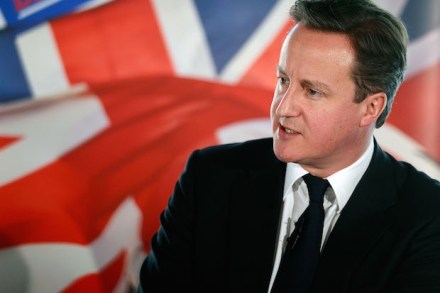
Cameron declares that the Tories are the ‘party of working people’ as he pledges to extend right to buy

From our UK edition

Tomorrow’s Tory manifesto will contain the boldest policy proposal of this campaign so far. The party will promise to extend the right to buy to 1.3 million families living in housing association properties. This policy has the potential to create a new group of homeowners and to start the reversal of the decline in home ownership; even critics of the plan think that more than 150,000 families might take advantage of it. It helps to keep alive the idea of a property owning democracy which has been so crucial to the success of the centre-right in this country.

Nick Clegg sets out red lines for coalition negotiations with Labour and the Tories

From our UK edition

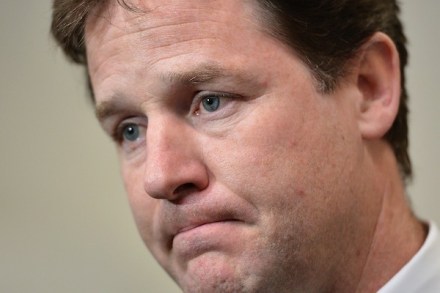
Nick Clegg produced Lib Dem red lines for any coalition with either Labour or the Tories in an interview with Evan Davis this evening. Clegg said that he wouldn’t go into Coalition with the Tories if they insisted on making £12 billion of cuts to welfare in the next two years. But he said that he also couldn’t recommend going into coalition with Labour until they were clearer about how they planned to deal with the deficit, making clear that what Labour said today was not sufficient. As Fraser says, this was an assured performance from Clegg who offered a robust defence of the government’s record. The Liberal Democrats would be in a better position to claim credit for the recovery if they had always been this unequivocal.

The truth behind David Cameron’s new inheritance tax policy

From our UK edition

David Cameron's new Inheritance tax policy is clearly an important political message of aspiration and family values rather than a policy that will either help many or actually have much fiscal impact. The OBR has numbers on death rates and estates subject to the tax: just under 600,000 people died in 2013/14 and only 5 per cent of those had estates that were liable to inheritance tax. So that is just over 26,000 deaths in one year whose estates paid inheritance tax. According to the Telegraph, Cameron's policy would only begin in 2017, two years into the next parliament. So three years of this policy and on 2013/14 rates this will only effect about 80,000 estates. On the face of it not a huge vote winner then.

This week, the Tories must seize the initiative

From our UK edition

Even Tory insiders admit that while they broadly had the better of the first week of the campaign, Labour had the better of the week just gone.  This makes it imperative for their hopes of re-election that the Tories wrest back the initiative this week. As I say in the Mail on Sunday, if they don’t, Tory discipline—which is already beginning to fray a bit—will crack, and Ed Miliband will have the keys to Number 10 within his grasp. The Tories have made a decent start to this task. Labour has been unsure of how to respond to the Tories’ commitment to give £8 billion more to the NHS.

Tories try to use their lead on the economy to bolster their position on the NHS

From our UK edition

The Tories believe that their record in government and their lead on economic competence means that they can set out spending commitments without having to set out precisely how they would pay for them. George Osborne’s interview on Marr this morning was a demonstration of this strategy. Challenged repeatedly over where the £8 billion for the NHS that he and Cameron pledged yesterday would come from, Osborne simply pointed out that they have managed to increase the amount of money going into the health service every year over the last five years despite having to make significant spending cuts. However much it infuriates their opponents, I suspect that this Tory tactic is quite effective.

Have the Tories made an ‘electoral pact’ with Ukip?

From our UK edition

This week David Cameron invited Ukip voters to 'come home' to the Conservative party. 'Come with us, come back home to us rather than risk all of this good work being undone by Labour,' he pleaded at a campaign event. However for all of Cameron's talk, Labour sources claim that the Tories would be quite happy to form a coalition with Ukip after the election. Now, Jonathan Reynolds, the Labour MP for Stalybridge and Hyde, says that a pact has been made in Tameside, the Greater Manchester borough, between Ukip and the Tories. It's claimed that the parties have agreed not to stand against each other in a number of wards for the local election in order to increase their chances of beating Labour.

Miliband vs Millwall

From our UK edition

I’ve been trying to think of a good football analogy to describe the battle between the two main parties as the general election approaches. One suggestion is the second leg of a Champions League game, with the Conservatives having won the first leg by one goal to nil. If we assume that the Tories are playing at home, that means Labour have to score two goals to win, whereas all the Tories have to do is not concede. Last week’s debate certainly felt like that, with Cameron playing a tight, defensive game and Miliband trying to score at every opportunity. The Conservative leader ended up winning on aggregate because the Labour leader failed to find the back of the net. But a Champions League match suggests two teams of real quality, which is where the analogy breaks down.

Swing time

From our UK edition

The age of two-party politics is over: we know that because everyone keeps saying so. We are entering an era of coalitions, apparently, where compromise is king and a wider variety of views will be represented in parliament. These barely comprehensible seven-way television debates are the future, we are assured, and decisive general election results a thing of the past. Look deeper and this analysis falls apart. Even now, Labour and the Conservatives between them have about two thirds of the vote, just as they did at the last general election. What we are witnessing is the collapse of the Liberal Democrats, who have been reduced — on a bad day — to being the UK’s sixth most popular party.

Louise Mensch’s love for David Cameron reaches new lows

From our UK edition

Louise Mensch has never been one to hide her love for her former boss David Cameron. However, their relationship took a hit earlier this year when the Prime Minister's decision to pay tribute to the late King Abdullah resulted in Mensch blasting Cameron on Twitter. Happily, the pair have since made up and Mensch is supporting Cameron in the election. In fact her support is so strong that as well as donating thousands of pounds to Tory candidates to help them campaign, Mensch is also trying to collect some David Cameron stash. Mr S sees that Mensch - who was once heralded as a  'Cameron Cutie' - has entered a competition on Twitter in a bid to win a set of David Cameron car stickers.

Ashcroft marginal polls show Tory-Labour races remain tight — and Ukip is falling behind

From our UK edition

The Tory-Labour battleground remains very close. Lord Ashcroft has returned to ten competitive marginal seats in his latest round of polling and has found swings to Labour, ranging from 0.5 per cent to four per cent. According to his latest polls, the Conservatives are set to hold onto five of these marginals: Blackpool North & Cleveleys, Gloucester, Kingswood, Pendle and Loughborough — the last represented by Education Secretary Nicky Morgan. Use the interactive chart above to see the latest polls. In the other five marginals, Pudsey is a tie between the two parties — as it was in November last year — while Labour is set to take Harrow East, Hove, Morecambe & Lunesdale and Stockton South.

The Tory ‘rally’ that wasn’t: these photos reveal how modern campaigning works

From our UK edition

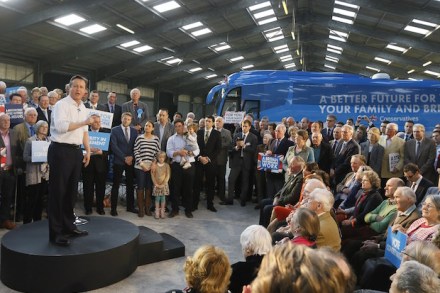
David Cameron took the stage at an election rally in Wadebridge, Cornwall this evening. He was surrounded by supporters waving placards. From the pictures, it seems there was a real sense of excitement about the Conservative party. But here are a couple of photos taken from a perspective that's a bit, er, different. The PM is currently holding a rally in Cornwall, in what appears to be a massive cow shed pic.twitter.com/eJh6RrnsQ6 — Niall Paterson (@skynewsniall) April 7, 2015 To give you a better idea of the size of this barn, and the size of the rally, the event is entirely behind this bus pic.twitter.

Ed Miliband’s popularity is improving – and the Tories should worry

From our UK edition

Ed Miliband has long been considered the Conservatives' main electoral asset. Certainly, Simon Danczuk touched a nerve when he described his party leader as a liability only a fortnight ago. But as the election nears, is the Labour leader beginning to turn his personal fortunes around? Polling from YouGov shows a fascinating trend. Voter approval of Miliband’s performance as Labour leader has improved from a dire state in late-November last year, at net -56%, to the most recent level of -26% last week. With the election campaign underway, a significant chunk of the electorate appear to have given the Labour leader a second look. Indeed, his net approval rating improved by 10 points after the "hell, yes!

Why all this talk of a hung parliament could be a self-fulfilling prophecy

From our UK edition

In a close campaign, you would normally expect the smaller parties to get squeezed as voters decided that is really a choice between Labour and the Tories. But this time, thing might be different. Why, because the general expectation is that there will be another hung parliament and the coverage of the campaign is being reflected through that prism. This emphasis on the likelihood of a hung parliament could change how people actually vote. As I write in the current issue of the magazine, the British Election Study shows that among voters who expect another hung parliament support for both Labour and the Tories is radically lower with the minor parties doing that much better. Among those who expect one party to win outright, Labour and the Tories poll at 39 and 38 percent respectively.

Another Tory ‘defection’ to Ukip – in a safe Labour seat

From our UK edition

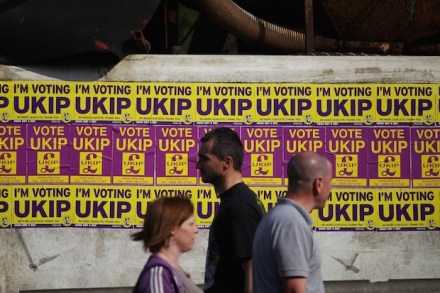
Nigel Farage has had a torrid few days - exactly as he'd planned. He had all six of his fellow contestants in the TV debate ganging up on him over immigration, just as he'd hoped. He's provoked the Liberal Metropolitan Elite into attacking him over his comments about health tourism and HIV, just as he'd hoped. And today, to cap it all, he's claiming a Tory defection. Mike Whitehead had been the Conservative candidate in Hull West and Hessle, standing against Alan Johnson in the Labour safe seat. The Tories came third here in 2010. Farage said this morning: 'I am delighted to be welcoming Mike to the party at this exciting time. His move to UKIP just underlines that today, the real party of opposition to Labour in the North is UKIP.

Parties launch tax attacks as Britain heads to the beach

From our UK edition

The three main parties are having a fight about tax today. It’s the day the rise in the personal allowance comes into effect, and David Cameron will give a speech describing what is to most people the Easter Bank Holiday as ‘Money-Back Monday’ (which sounds a bit like a gameshow in a pound shop) and claiming tat up to 94 per cent of households are better off under the tax and benefit changes that come into effect this year. Ed Balls is also working today while the rest of Britain heads to the beach and scratches its head about how to sort out the garden: the Shadow Chancellor is also giving a speech in which he will say that the Tory record on tax is ‘millions pay more, millionaires pay less’.

Tories convinced ‘moment of maximum danger’ has passed

From our UK edition

On Thursday night, David Cameron didn’t eviscerate the competition. But nor did he suffer any damage and that, to Tory high command, meant that it was job done. The Tory leadership didn’t want any debates at all, they’d rather not have taken the risk. So, to get through this one debate with the dynamics of the campaign unchanged was, to their mind, a result. As Cameron enjoyed a late night drink with Samantha Cameron, George Osborne and his key aides on Thursday, he reflected on how much better he felt than he did after the first debate five years ago when he knew that he had not only underperformed but that he had two more to get through. This time round he’d done fine and was done with debates.

Coffee Shots: Election fatigue sets in

From our UK edition

With just five weeks to go till polling day, one happy voter in Bedford has had enough. Mr S suspects that it's for the best if Patrick Hall, the Labour candidate for Bedford and Kempston, doesn't pay a personal visit to this address.

Why aren’t the Tories winning?

From our UK edition

When launching the Conservatives’ campaign this week, David Cameron told party activists that the general election was ‘on a knife edge’. He is right. His chances are little better than 50/50, which is terrifying given the calibre of his opponent. The Prime Minister is entering this election with a list of achievements matched by almost no other leader in Europe. Yet he’s struggling to beat one of the least popular opposition leaders in modern times. What has gone wrong? It’s not the economy. Employment stands at a record high, and most voters will never have lived through such low inflation as we have today. The price of food is actually falling, as is the price of petrol; it costs £18 less to fill up an average car than it did 18 months ago.

Cameron needs to be the reasonable statesman on tonight’s debate

From our UK edition

Which David Cameron will take the stage for tonight’s seven-way showdown? Will it be the competent, likeable and reasonable statesman who has steered the economy onto safer ground? Or the tetchy one who calls Ed Miliband a ‘waste of space’ at Prime Minister’s Questions? On Monday, speaking at a lectern outside the door of Number 10, the Prime Minister decided to launch a personal attack on his opposite number rather than make a statesman-like pitch to the electorate. To have mentioned Ed Miliband by name once would have been historic – doing so three times smacked of desperation.

The media and political elite need to stop treating the electorate like dogs

From our UK edition

There are many grating phrases in modern British politics. ‘Best practice.’ ‘Fit for purpose.’ ‘Let me explain’ (just bloody well explain!). And that tendency of Labour politicians to preface pretty much everything they say with a schoolmarmish ‘Look’, as in ‘Look here’. As in: ‘You donuts know nothing, so I am going to put you straight.’ But even more grating than those, sat at the top of the pile of temperature-raising sayings, is ‘dog-whistle’. Everyone’s talking about ‘dog-whistle politics’.