Conservative party

What Cameron should push for in Brussels

From our UK edition

As David Cameron stays in Brussels for his third European summit as PM, it’s becoming increasingly clear that the EU's approach to the eurozone crisis – put up short-term cash and pray – isn’t convincing anyone.   On Wednesday, Moody’s threatened to downgrade Spanish government bonds another notch, citing the fact that, between them, the country’s government and banks have to raise €290bn next year to keep the party going. And, across the eurozone, banks and governments face daunting refinancing targets in 2011, which begs the questions: at what cost? And what happens if they fail to meet them?

MPs’ February fear

From our UK edition

When you talk to MPs about the new expenses’ regime there are a whole variety of grumbles you’ll hear, many of them reasonable. For example, it does seem silly that all MPs buy their own printer ink cartridges rather than the Commons buying a job lot and using bulk ordering to obtain a discount. But one of the things that really bothers them is that IPSA will publish all the refused expenses’ requests in February. Now, I expect that most of you think this is reasonable. But MPs do have a point that the way IPSA logs these things means that any enquiry about what you are or are not allowed to claim comes across as an attempt to claim.  David Cameron is being pulled two ways on expenses. His MPs wanted the system changed—and fast.

Cameron tries to reassure colleagues on expenses

From our UK edition

David Cameron has this evening told the 1922 Committee that IPSA will have to change by April 1st next year or be changed. He told the ’22 that he understood the ‘pain and difficulty’ caused to colleagues by the new system and denounced the new system as ‘anti-family.’ He said that IPSA would be given until April next year and if it failed to do so it would be reformed. Tonight’s address was an attempt to defuse an issue that has really rankled with Tory MPs, and has for some become a proxy for the leadership’s perceived lack of regard for them. It is, perhaps, a sign of how strained relations are that Tory MPs are tonight complaining about a Conservative party spokesmen briefing out details of the meeting.

A “two stone” solution to the Euro crisis will unbalance the coalition

From our UK edition

Whatever the British government wants, moves are now afoot on the Continent to address some of the structural problem with the Euro. They may in the end lead to some form of fiscal federalism. So far they are not supported by Angela Merkel, the key decision-maker, who worries constantly about the court in Karlsruhe, which has set clear limits on further European integration. But they are said to be supported, at least in part, by Finance Minister Wolfgang Shauble. Writing in the Financial Times, Frank-Walter Steinmeier and Peer Steinbrück argue that the EU needs "a more radical, targeted effort to end the current uncertainty, and provide stronger support for the future of Europe’s common institutions.

The Spectator’s Christmas interview with George Osborne

From our UK edition

The Christmas Special of The Spectator is out today, and George Osborne kindly agreed to an interview. We have printed 1,500 words in the magazine, but James and I thought CoffeeHousers may like a fuller version, where he has more space to speak for himself.  We have gone into way more detail on tax policy here than in the magazine, for example, as Osborne is seldom pressed on this point and his thoughts are very interesting. We have divided it up by subject headings, so CoffeeHousers can skip the chunks they’re not interested in.   Liberty, paternity and Treasury It is an exciting day for Liberty Osborne, the Chancellor’s daughter, to join him at work.

The anti-Clarke campaign is gaining momentum

From our UK edition

After months of whispered asides, Theresa May cut loose yesterday and expressed what may on the Tory right (not to mention Labour’s authoritarian elements) feel: Ken Clarke’s prison proposals are potentially disastrous. Prison works. Tension has built to its combustion point, but there is no apparent reason why May chose this moment. Perhaps she was inspired by the persistent rumours of Cameron’s displeasure with Clarke? Or maybe the cause was Michael Howard’s smirking syntax as he denounced Clarke’s ‘flawed ideology’ in yesterday’s Times? Either way, the campaign to move Clarke sideways in a Christmas reshuffle is gaining momentum.

Keeping the troops happy

From our UK edition

A media narrative is rapidly emerging that the Tories are taking advantage of the Liberal Democrats, using them to defend the coalition’s most unpopular polices. On the Today Programme this morning, Justin Webb pressed Paul Burtstow, the Lib Dem health minister, on whose idea it was that he, the Lib Dem, come on the programme to defend the government against the Health Select Committee’s critical report. The implication was clear, that Burstow had been sent on because it was bad news. I think this narrative is a bit shonky. Yes, the Liberal Democrats took the brunt of the criticism over the fees hike but that was because they were breaking an election pledge and because they chose to be out there defending it.

Expect the unexpected

From our UK edition

Peter Kellner has an interesting comment piece up on the YouGov site about how we are in the unusual position of having three relatively unpopular party leaders. Nick Clegg’s approval rating is down at minus 29 but that hasn’t helped Ed Miliband who is at minus 15. David Cameron does have a positive rating, but only just. His approval rating is plus one. As Kellner points out, normally when one political leader is unpopular another benefits. But that hasn’t happened this time: a sign of how strong a hold anti-politics has on the public consciousness. This discontent is mirrored by how all three parties are having quite serious debates about what they should be.

Who are the government’s regulation busters?

From our UK edition

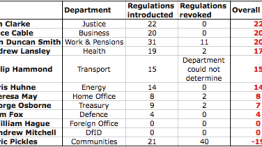
Each time politicians fight regulation, regulation normally wins. So far it seems like this coalition government is no different. John Redwood has been busy tabling parliamentary questions asking each department how many regulations have been introduced, and how many repealed. Rather than “one in, one out” in turns out that two regulations have been introduced for every one revoked. Eric Pickles emerges as the star, having revoked twice as many as he introduced. But the rest? Here’s the league table: I don’t think that the “guilty” ministers have been lax. It’s just that the system is out of control.

Eric Pickles kickstarts the local blame game

From our UK edition

We've got lots of power – please take some. That's the central message of today's localism bill, and of Eric Pickles' article in the Telegraph to accompany it. Indeed, the government's 15-page document to explain the bill features the word "power" (in the context of shifting power away from the centre) over 50 times. Eight of those come in Nick Clegg's short, Lib Dem-friendly foreword. The specifics of the bill are, on the whole, already familiar. It's all about elected mayors, local referendums and greater budgetary control for councils. But just because we've heard this drumbeat before, it doesn't make it any less radical. As the BBC's Mark Easton notes, some of the measures are utterly totemic.

Another item for the coalition’s to-do list: intergenerational unfairnessĀ 

From our UK edition

With an uncanny sense of timing, the latest annual British Social Attitudes Survey suggests that the "conflicts of the future may be between today's young and their parents' generation." And the thinking behind this conclusion? Simple: that, in so many ways, young people have never had it so good as the babyboomers did. From tuition fees to house prices, those born after 1975-80 have always tended to fall on the less favourable side of the divide – and that has, in turn, fuelled the sense of injustice that we saw erupt onto the streets last week.

Simmering below the surface…

From our UK edition

By way of an addendum to Fraser's post, it's worth reading Melissa Kite's account of internal Tory strife for the Sunday Telegraph (it doesn't seem to be in the paper, but is available online here). The piece records what sounds like a tumultuous week for the Tory whips, as they struggled to keep a group of disgruntled MPs on side. There are plenty of little insights, of which this is just a selection: 1) The 1922 Committee gets angry. "The ceding of a series of major powers to Europe, the increasing of international aid, the decision to have a referendum on voting reform, the redrawing of constituency boundaries – all had been eating away at Tory backbenchers for months. Worse than that, their concerns had been repeatedly brushed aside by Mr Cameron.

Cameron must head for the common ground

From our UK edition

All the attention last week was on the Lib Dem split – but what about the division within the Conservatives? This is the greater threat to the coalition, and while there is not likely to be an earthquake soon, one can discern the outlines of the tectonic plates. Ladbrokes has odds of 5-2 of an election next year, and these don't seem so short when one considers the short life of coalitions in British peacetime history. So where might the tension lie? A while ago, I referred to the bulk of the party as "mainstream Conservatism," as a more useful phrase than the tautological "Tory right". Tim Montgomerie last week drew a distinction between this and what Ken Clarke calls "liberal Conservatism".

Conservatism is a broad church

From our UK edition

A long time ago, I worked for CCHQ, David Cameron’s leadership campaign and them back in CCHQ again. We spent months trying to define what Conservatism really is. I don’t think we ever really got a pithy soundbite, because the root of its success is that it evolves to suit the times. Perhaps the best description is that it is a pragmatic creed, wary of dogma, going with the grain of human nature, and focusing on effective policy that leads to real improvements.

The coming battle over Mainstream Conservatism

From our UK edition

It's not just the students who are waging a political struggle. In yesterday's Times (£), Tim Montgomerie fired up a debate over the future of the Conservative Party that will no doubt simmer through the rest of this Parliament. For those who can't delve behind the paywall, the argument was broadly this: that a tension is emerging between liberal Conservatism and a more traditional Conservatism. On the side of the Liberal Conservatives are those who want to extend the union with Nick Clegg and his party; a group which may well include the Tory leadership. On the other side are those who want the Tories to go it alone after the next election, with a more traditionally Tory policy platform.

The divisions laid bare

From our UK edition

When The Speaker called a division, the Labour side roared a passionate No while the coalition benches delivered a rather muted Aye. I did not see a single Lib Dem open their mouth at this point. Instead, they sat on their benches looking emotionally exhausted. Even those Lib Dems who have been proved right in their warning about the party’s position on fees—notably, David Laws and Jeremy Browne—appeared downcast.   In the end, the government won but with a much reduced majority. 21 Lib Dems voted against the coalition, as did six Tories. Simon Hughes abstained despite Ed Miliband’s entreaties to come with him into the no lobby.   This meant that the Lib Dem’s three senior figures split three ways.

The Tories keep plugging away at the Big Society

From our UK edition

The Big Society never really went away as a theme, but it certainly became a less insistent catchphrase after the general election. The Tories were no doubt stung by the ambiguous response their invitation to government, and felt that the early days of coalition government were not an opportune moment to reheat their central election message. Months went by where the words "big" and "society" barely made any contact at all. That changed with David Cameron's conference speech, of course. And, since then, the Big Society has been back, loud and proud. Only this week, Philip Hammond was talking about a "Big Society approach" to dealing with the snow. Nick Clegg has taken to opening "big society classrooms".

Miliband rises from his deathbed

From our UK edition

At last Wednesday’s PMQs Cameron kicked Ed Miliband into touch with a debonair swagger. Today anger replaced disdain. The PM’s eye-popping rage is so palpable that some commentators take it for vulnerability or even a hint of self-doubt. Milband has Cameron rattled? Nothing of the sort. Cameron just can’t control himself.   Asked about the Coalition’s higher education policy, he heaped rancid abuse on the opposition leader from a lofty perch. He called him "an opportunist,"  who "posed about social mobility" and was guilty of "rank hypocrisy." "He saw a big crowd in the Mall," fumed Cameron, referring to the student protests, "and said, 'I am their leader I must follow them'.

Miliband’s jibes throw Cameron off course

From our UK edition

After last week’s PMQs, Ed Miliband needed a clear win today—and he got one. Cameron, who had admittedly just flown back from Afghanistan, didn’t seem on top of the whole tuition fees debate and kept using lines that invited Labour to ridicule the Lib Dems. When Cameron tried to put Miliband down with the line, ‘he sounds like a student politician—and that’s all he’ll ever be’, Miliband shot back that “I was a student politician but I wasn't hanging around with people who were throwing bread rolls and wrecking restaurants." It was a good line and threw Cameron off for the final exchange.   The rest of the session was not a cracker.