Conservative party

Cameron encourages his party to bang on about Europe

From our UK edition

Something quite curious is going to happen in the Commons this afternoon. David Cameron is encouraging his party to bang on about Europe. He has called a general debate, with the motion 'that this House has considered the matter of Europe', and it promises to be rather strange. The strangest thing is that a month ago, David Cameron would never have dreamed of tabling this sort of debate: his camp were busy in October trying to quell an uprising of backbenchers over the EU Budget. But after the speech that delighted even Mrs Bone last week, Cameron finally doesn't have to wait for a backbencher to pounce on him with entreaties on referenda and renegotiations: he's got nothing to hide now.

The government’s attitude to Romania and Bulgaria is contemptible – Spectator Blogs

From our UK edition

Pity the staff at the British embassy in Bucharest. Only last month they were cheerfully banging the drum for Great Britain, telling Romanians what a swell country this rain-soaked archipelago is. You see: The GREAT campaign invites the world to take a fresh look at the UK, and is designed to promote Britain as one of the very best places to visit, live, work, study, invest and do business. Oh dear. Time to reverse ferret. Brother Forsyth reports that the government is so spooked by the appalling thought that plucky Romanians and enterprising Bulgars might think the United Kingdom a land of opportunity that they are considering a new advertising campaign targeting the EU's newest members: Britain is crap. Don't come here.

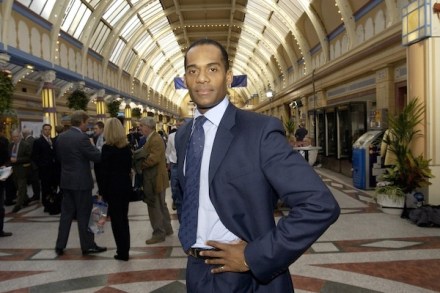
Why is Adam Afriyie being touted for leader? Expenses.

From our UK edition

The Adam Afriyie leadership stories this Sunday confirmed several things. First, there’ll be no shortage of candidates when David Cameron goes. A large tranche of backbenchers have become increasingly irritated at what they view as a magic circle of ministers, special advisers and journalists who, they claim, are deciding who is and isn’t considered a serious player in Westminster. A result of this will be a determined effort to bust this alleged cartel come the next leadership contest. The second, and more important, thing is that the whole issue of pay and rations for MPs is still shaping our politics. Many of those most hostile to Cameron are those who feel that he hung them — or their colleagues — out to dry during the expenses scandal.

Adam Afriyie ‘coup’: a false start for the stalking horse

From our UK edition

The camp supporting backbench Tory MP Adam Afriyie in a possible leadership bid have been busy, managing to get whispers of their planned coup into three Sunday newspapers (the Sun on Sunday, The Sunday Times, and the Mail on Sunday). Whether or not Afriyie is a popular backbencher who managed to soothe colleagues over toasted teacakes in the Pugin room, and whether or not he's the ideal person to lead the Tory party after Cameron, the timing for the Windsor MP of the plot appearing in print couldn't be worse. This time last week, it wasn't difficult to find a clutch of MPs who would gloomily mourn the direction their party was going in.

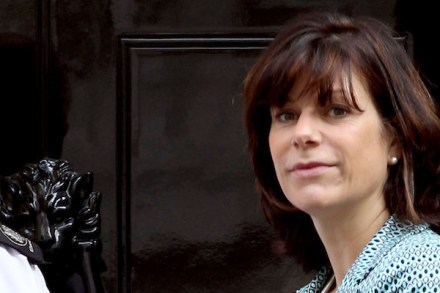
Claire Perry interview: Leaving internet on at night is as reckless as leaving the front door unlocked

From our UK edition

Claire Perry, the determined MP for Devizes, is very, very determined not to be set up as a 21st century Mary Whitehouse. Her job title, as the Prime Minister's adviser on preventing the sexualisation and commercialisation of childhood, might suggest the Tory MP is yearning for a more innocent bygone era. But she's insistent that she isn't anti-porn, or even a mother who snoops on her children: 'I'm in no way the Mary Whitehouse of this,' she tells me as she sits under a washing line in her office decorated with children's artwork. 'I am in no way old-fashioned, this is not some kind of anti-porn crusade. Amongst consenting adults, it's fine, it's just that it's not porn as we know it.

Worthwhile Canadian Immigration Initiative – Spectator Blogs

From our UK edition

Reihan Salam highlights the latest pro-immigration move by Stephen Harper's Canadian government: Canada is looking to poach Silicon Valley’s intrepid foreign up-and-comers as it launches a “first of its kind in the world” program that will grant immediate permanent residency to qualifying entrepreneurs starting April 1. Immigration Minister Jason Kenney said Thursday he will head down to America’s technology heartland once the program is in place to begin recruiting the “thousands of super bright young foreign nationals,” often from Asia, who are working at technology start-ups on temporary visas and may have to go home before they’ve been able to obtain their coveted U.S. Green Card.

David Cameron marries a Rothschild

From our UK edition

In the Jewish joke a matchmaker calls on a poor tailor living in a Tsarist shtetl in the middle of nowhere. He tells the old guy that he wants to arrange the marriage of his middle daughter to the heir to the Rothschild fortune, no less. The tailor isn't impressed. He cannot marry off his middle daughter until he has married off her older sister, he says. He does not want his beloved girl to move far from him, and everyone knows the Rothschilds live in Paris and London. In any case, he is not sure about this Rothschild fellow: he has heard he is irreligious and a drunk. The matchmaker answers all the objections with great patience until, eventually, the tailor relents. 'Excellent,' says the matchmaker, 'now all I have to do is talk to the Rothschilds.

Will Cameron’s EU speech help his drive for gay marriage?

From our UK edition

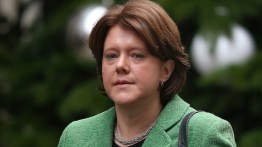
The government's gay marriage bill is published later today, after receiving its first reading in the Commons yesterday. How it's received by the Tory party will be an interesting indication of just how powerful David Cameron's EU speech was this week. When Maria Miller unveiled the 'quadruple lock' to protect the Church of England from being forced to conduct same sex ceremonies, she did so into a febrile Commons. In the tearooms, MPs quarrelled or shook their head at the exodus of stalwart Conservatives from their constituency parties. But the Prime Minister's speech gave the party such a shot in the arm on Wednesday that the atmosphere is currently very different.

The EU renegotiation pantomime

From our UK edition

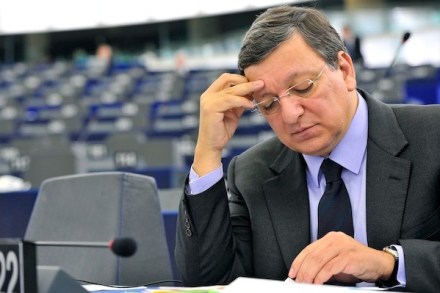
Today’s midday press briefing at the European Commission was of course dominated by questions about the Cameron speech. This was despite efforts by Pia Ahrenkilde Hansen, Barroso’s spokesman-in-chief. First she tried to downplay the implications of the speech by making an anodyne statement welcoming democratic debate in member states. Then she announced that questions on Cameron’s speech would be limited to three. A growl came up from the press corps that indicated she should think again. So she took more questions. She just didn’t much answer them. I asked Pia if she could describe for me any existing mechanism under present treaties by which Britain could claw back powers which have already been surrendered to the EU.

Tory MP: The public will struggle to believe Cameron’s EU pledge

From our UK edition

Six months ago, the word ‘referendum’ had not even passed David Cameron’s lips. The issue was not on the table. I would, therefore, like to thank the 100 Conservative Parliamentary colleagues who co-signed my letter in June, urging the Prime Minister to commit to a referendum. In a small way, I like to think our efforts helped to change his mind. We can now have a vigorous debate. However, whilst not doubting the Prime Minister’s sincerity, I am concerned his pledge will not be believed by the public. Far too many promises have been broken in the past, such as Blair’s promise on the EU Constitution and the Liberal Democrats’ commitment at the last General Election.

The Spectator: One step ahead of David Cameron’s EU manoeuvres

From our UK edition

While David Cameron's EU speech today made all the front pages, it is far from fresh news. Two weeks ago, James Forsyth revealed to Spectator readers what the Prime Minister would say in his speech. But as far back as last May, we revealed that a referendum on EU membership was almost certain: A referendum on Europe is the obvious answer. It is one the leadership seems set to embrace. The popularity of Cameron’s EU veto made his circle realise how much of a political asset Euroscepticism could be, if used in the right way. There is also concern in No. 10 that if the Tories don’t offer the public a vote, Labour will. One source intimately involved in Tory electoral strategy told me recently that a referendum in the next manifesto was ‘basically a certainty’.

Why fall for Cameron’s cast-iron EU pledges?

From our UK edition

Tory MPs have fallen for David Cameron’s cast-iron pledges to hold a referendum before. So are they right in buying into his latest promise? Labour is trying to expose cracks in the pledge to re-negotiate our relationship with the EU, then hold a plebiscite mid-way through the next Parliament, if the Tories win the election. But Ed Miliband rather misses the point when he asks Mr Cameron at PMQs whether he might later change his pledge to campaign for a 'yes' vote. Surely, the problem is not that Cameron could change his mind and campaign for a 'no' vote.

Sketch: Cameron’s EU climax

From our UK edition

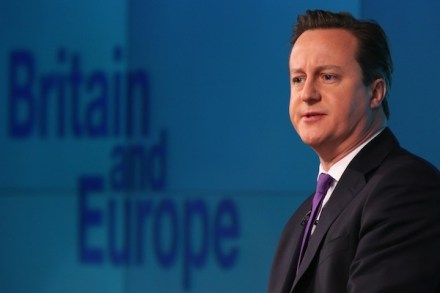
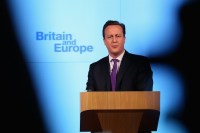
This was no tantric anti-climax. This was a seismic moment in British politics. David Cameron breezed into a London press conference this morning and proceeded to reshape Europe. The wooden lectern he stood at was pale and municipal. He wore a dark suit and a nice purple tie, and his affable pink chops glowed with moderation and good sense. He looked like a council negotiator arriving to settle a hedge dispute between warring neighbours. The Euro-crisis will lead to the restructuring of Europe, he said. He called for a new design that would incorporate more openness, flexibility and competitiveness. And the single market, not the single currency, should lie at its heart.

‘Mrs Bone was singing in the shower’: PM’s EU speech delights Tory MPs

From our UK edition

David Cameron should savour today as the moment he finally satisfied Mrs Bone. I've been calling round Tory MPs, and Peter Bone, often a thorn in the flesh of the Prime Minister with his probing questions that his wife wants clearing up, is happy with the speech. He says: 'I could hear Mrs Bone singing in the shower room and it included the words "for he's a jolly good fellow".' Bone explains why his household is filled with such joy this morning: 'I am in a very good mood. A year ago, if I had said to you the Prime Minister is going to renegotiate the terms of the EU towards a Common Market and then put it to the British people in an In/Out referendum, you would have said I was barking mad.

David Cameron puts Nick Clegg on the spot

From our UK edition

Downing Street always hoped that once David Cameron had given his Europe speech, the pressure would shift on to the other party leaders. They believed that once Cameron had committed himself to a referendum, Ed Miliband and Nick Clegg would be required to say whether or not they’ll match this pledge. But Cameron has put particular pressure on the Deputy Prime Minister by making clear that renegotiation and a referendum will happen if he is Prime Minister after the next election. In other words, this is not up for debate in any 2015 coalition negotiation. Every interviewer can now ask Nick Clegg if he and the Liberal Democrats could be part of a government that was committed to renegotiating Britain’s terms of EU membership and then putting the result to a referendum.

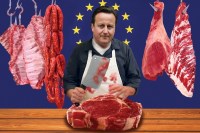
Cameron’s red meat EU speech: five key points

From our UK edition

Cameron has finished delivering his 'red meat' speech on the European Union and answering questions from journalists. You can read the full text here, but here are five key points to take away: 1. The Prime Minister is a pro-European sceptical about the current EU settlement It actually took Cameron a long time to reach his vision of a new Europe because he was so busy praising its history. We had a whistle-stop tour through the EU's creation, dotted with praise for its peacekeeping mission first. He was clearly keen to emphasis his pro-European credentials as much as he was to criticise, saying: 'I am not a British isolationist' and 'I speak as a British Prime Minister with a positive vision for the future of the European Union'.

David Cameron’s EU speech: full text

From our UK edition

This morning I want to talk about the future of Europe. But first, let us remember the past. Seventy years ago, Europe was being torn apart by its second catastrophic conflict in a generation. A war which saw the streets of European cities strewn with rubble. The skies of London lit by flames night after night. And millions dead across the world in the battle for peace and liberty. As we remember their sacrifice, so we should also remember how the shift in Europe from war to sustained peace came about. It did not happen like a change in the weather. It happened because of determined work over generations. A commitment to friendship and a resolve never to re-visit that dark past - a commitment epitomised by the Elysee Treaty signed 50 years ago this week.

David Cameron’s EU speech: the Coffee House guide

From our UK edition

Downing Street has tonight released the following extracts from David Cameron's speech on the European Union, which he will deliver tomorrow at 8am. Here's your guide to what we know so far: 1. An unwilling EU could sleepwalk Britain out of the union 'I speak as British Prime Minister with a positive vision for the future of the European Union. A future in which Britain wants, and should want, to play a committed and active part. 'If we don’t address these challenges, the danger is that Europe will fail and the British people will drift towards the exit. 'I do not want that to happen. I want the European Union to be a success. And I want a relationship between Britain and the EU that keeps us in it. 'That is why I am here today. To acknowledge the nature of the challenges we face.

Tory MPs to press Theresa May on Bulgarian and Romanian migrants

From our UK edition

Tory backbenchers will raise concerns about the government's preparations for the lifting of controls on Bulgarian and Romanian migrants at a meeting with the Home Secretary in the next few weeks, I understand. Conservative MPs are becoming increasingly nervous about the situation, fearing that if handled poorly, it could have a particularly bad impact on the party's performance in the 2014 European elections, as the transitional controls end on 31 December 2013. One of those worried backbenchers is former ministerial aide Stewart Jackson, who tells me he is considering introducing a modified version of the 10-Minute Rule Bill that he brought before the House in October.