Conservative party

The Tories have failed to agree a line on UKIP

From our UK edition

David Cameron's refusal to say 'UKIP' on the radio today was rather entertaining, but it does highlight a strange problem that the Conservative party has brought upon itself for these local elections. Here's his exchange with Martha Kearney, which you can listen to below, from 8m 49s in: Cameron: 'My role is to get around the country and I've enjoyed doing it in the last couple of weeks, to get around the country and to talk about the government's policies, local policies, what the Conservatives are doing. I think there is a real appetite for…' Kearney: Is it a strategy, not to say UKIP? Cameron: No, not at all, it's a - but you know, as I say, you only get a limited bandwidth in this life and I'm determined to use my bandwidth to talk about the positive benefits of my party.
Exclusive: whips ask ministerial aides to snoop on their bosses

From our UK edition

Not wanting to heap worries onto the Prime Minister when he's just about found harmony with his party, but as well as the underused backbenchers I mentioned this morning, he might want to think about his party's PPSs as well. Some of them feel they were offered their jobs with the promise that the role would become 'turbo-charged', but haven't found the reality quite so glamorous. I hear that the last meeting Downing Street held for ministerial aides didn't cheer many of them up.

No 10’s outreach programme mustn’t leave underused MPs scratching their heads

From our UK edition

David Cameron is really trying to reach out to his party at the moment. The announcements of a policy board of MPs and a policy chief who is also an MP were intended to show that it's not just the inner circle that calls the shots. Jo Johnson appears to have received a bigger promotion than initially announced: today's Sun reports he's not just leading on policy, he's also taking over from Oliver Letwin in writing the manifesto. But appointing Chris Lockwood to the policy unit has added to the impression that the PM really trusts his friends and those who hail from the same social circle. He did, after all, name this journalist as one of his friends in evidence to the Leveson Inquiry. It is an unfair impression: a proper look at the policy board reveals MPs from a range of backgrounds.

Chris Lockwood to join new Number 10 policy unit

From our UK edition

[caption id="attachment_8508921" align="alignright" width="140"] Chris Lockwood[/caption] Downing Street has pulled off a coup with the recruitment of Chris Lockwood, the US editor of The Economist, to the new Downing Street policy unit. Lockwood is one of the brightest and most insightful people in journalism and one imagines that he wouldn’t have left a prime perch at The Economist if he did not think that the new Policy Unit will have real heft. Lockwood is close to Cameron: he was one of the six journalists that the Prime Minister listed as a personal friend in his evidence to Leveson. In 1993, as reported in the Elliott and Hanning biography of Cameron, Lockwood was part of a group that went on a villa holiday to Italy with Cameron and Samantha Sheffield, as she then was.

Local elections: Tory leadership prepares MPs for the worst

From our UK edition

The Tory leadership is getting increasingly nervous that the party isn’t sufficiently braced for bad local election results this Thursday. They’re worried that too many MPs assume the party won’t lose much more than 300 seats. The problem is that, for understandable reasons, MPs are treating all of CCHQ’s dire predictions — one source there is talking about 750 loses if the UKIP wave doesn’t break — merely as expectations management. In an attempt to persuade people of how bad the results could be, senior figures have taken to showing people this bar graph and map which illustrate the Tories’ current dominance. Their argument is that there is only way they can go from here, and that’s down.

Dealing with the UKIP threat

From our UK edition

How do the Tories deal with UKIP? The party likes to split on most issues, and it has got a nice little fault line running across it at the moment on whether to squash the party as 'fruitcakes', or, as Conor Burns eloquently argued on Coffee House this morning, engage with the problems and anxieties that are driving Tory voters towards Nigel Farage. If UKIP does have a good showing in the local elections later this week, one side will blame the other for taking the wrong course. MPs like Burns will worry that colleagues such as Ken Clarke will have insulted their own voters, or that the party's obsession with whether all those nice-sounding pledges really add up has missed the point.

Voters hold Ukip to a different standard: there is no point in attacking their people or their policies

From our UK edition

Some of the coverage of the background and views of UKIP local election candidates has been met with a glee born of a belief that it might be the silver bullet to puncture the party's recent rise in support. I have an intrinsic suspicion that this will prove not to be so. Last night I was away from news and twitter. Before reading the papers in any detail I sent a tweet saying: 'Attacking UKIP over policy or people won't work. Genuinely responding to legitimate concerns of people tempted by them may well do.' I later read Lord Ashcroft’s perceptive observations that sum up my own views precisely.

Nick Clegg: No one has proposed to me that the UK should leave the European Court of Human Rights

From our UK edition

In a detailed interview on the Sunday Politics, Nick Clegg claimed that neither the Home Secretary nor Downing Street have ever proposed to him that Britain should temporarily leave the European Court of Human Rights so that it can deport Abu Qatada. Clegg was adamant that ‘no one has put a proposal to me.’ Under questioning from Andrew Neil, Clegg defended his decision to block any communications data legislation in the Queen’s Speech. He maintained that the proposals were ‘neither workable nor proportionate.’ Clegg conceded that the UKIP offer was ‘very seductive’ to voters. But he then attacked them for their flat tax proposal.

David Cameron and the married couple’s tax allowance

From our UK edition

The married couple’s tax allowance is back on the agenda. After Conservative Home’s exclusive yesterday, David Cameron has confirmed that he will introduce one before the end of this parliament. This would allow couples to share a proportion of their personal allowance, lowering the tax bill for those household where one person stays home to look after the children. Cynics will suggest that this is a good time to float a policy particularly popular with the party base given that there are county council elections on Thursday. But Cameron is a bigger enthusiast for recognising marriage in the tax system than most of his Cabinet colleagues. In opposition, George Osborne always worried that it looked like a measure designed to encourage mothers to stay at home.

Margaret Thatcher and the missing votes

From our UK edition

There was a startling late entry for the first volume of my biography of Margaret Thatcher. On the day after she died, I received an email from Haden Blatch. Mr Blatch’s father, Bertie, was the chairman of the Finchley Conservative Association when it selected her in 1958. I had asked Haden for information before, but he had not got round to it. Now he revealed that his father had come home from the Finchley selection meeting and explained that Mrs Thatcher had not really won the vote. Her rival, Thomas Langton, had just pipped her. Blatch senior, however, was very keen on Mrs Thatcher, and thought that Langton, who ‘was born with a silver spoon in his mouth’, would easily get in somewhere else, whereas she, being a woman with young children, would not.

Things are looking up for the Tories

From our UK edition

There’s a distinct sense of optimism in the Tory ranks today. First, there’s relief that a triple dip recession has been avoided. Dire economic news would have ended the rare outbreak of unity in the Tory party. Second, the changes to Number 10 and the newly announced policy board have gone down well with Tory MPs. Even those who have not been offered a role are pleased at this broadening of the Cameron operation; the recall of Peter Lilley to the colours has gone down particularly well. For the first time, there’s a feeling that Cameron is prepared to consult and listen to his party and that is prepared to be led. If this Tory unity can survive next week’s county council elections, then politics could get very interesting.

GDP relief leaves spotlight on a Labour party under pressure

From our UK edition

Westminster has felt rather muted over the past few weeks: it may well continue to do so today, but for good reasons. That the first estimate of Q1 GDP figures recorded growth of 0.3 per cent means Labour spinners have to work much harder on falls in certain sectors in order to get their points across, and that George Osborne and David Cameron can relax, knowing they've just been gifted more good feeling in their party until at least the local elections. After the building tension over today's figures came a really rather good anti-climax. This means that the spotlight remains on Labour, and not the Conservative party. Len McCluskey's intervention yesterday - slapped down by Ed Miliband as 'reprehensible' - is just one of a number of cracks appearing in the party's unity.

The View from 22 — Sex and success, Conservative vs. Labour unity and the two-wheeled tyranny of cyclists

From our UK edition

What do Margaret Thatcher, Sheryl Sandberg and Angela Merkel have in common? They are the ultimate alpha-female icons, according to Alison Wolf. In this week's Spectator cover feature, Alison examines the ultra-competitive female elites who are pulling ahead and leaving the rest of the 'sisterhood' behind. On this week's View from 22 podcast, the Spectator's deputy editor Mary Wakefield discusses with Alison what makes an alpha female, why they are only interested in alpha males and how feminism is response for this new divide. Melissa Kite and Gary Lingard also debate whether the world now revolves around cyclists. In this week's magazine, Melissa argues that beautiful country paths should stop be turned into tarmac cycle routes.

A rare mood of unity descends on the Conservatives

From our UK edition

The idea that ‘loyalty is the Conservative party’s secret weapon’ was always dubious. Benjamin Disraeli, for instance, made his name attacking a sitting Conservative prime minister. This, though, did not stop him becoming arguably the party’s most celebrated leader. But in recent years, the ‘loyalty’ adage has become a joke — one that has taunted leader after leader as they struggled to deal with an increasingly rebellious party. The party changed leaders four times in the eight years between 1997 and 2005. In these opposition ‘wilderness’ years, changing a leader was the closest to power that Conservative MPs came. Leadership plotting gave an odd sense of purpose to their presence at Westminster.

Since I moved to the country, I’m on the side of the squirrel-killers

From our UK edition

What is the correct expression to wear, I wonder, when you’ve just caught a squirrel in your squirrel trap? Guilt? Pain? Sorrow? Fear at the possibility of a 3 a.m. knock at the door from the boot boys of the RSPCA? The expression you definitely shouldn’t wear, apparently, is one suggestive that you might have taken any pleasure in poor, sweet, bushy-tailed Mr Nutkin’s death. This was the mistake made by Defra secretary of state Owen ‘Butcher’ Paterson, who was revealed over the weekend to have upset visiting Tory colleagues by showing pictures of himself cheerfully posing with the decapitated victims of his Kania 2000 squirrel traps.

Cameron keeps his friends close, but now he’s drawing his MPs closer

From our UK edition

David Cameron and the Tory party appear to be emerging from a period of marriage counselling that has gone particularly well. The leader is making more of an effort with his backbenchers generally (James examines this in his column tomorrow), and tomorrow's papers bring yet more news of reconciliation. The Prime Minister is beefing up his political policy operation by appointing a panel of bright and impressive MPs to help him, and promoting Jo Johnson to be his head of policy and a Cabinet Office minister. Those MPs aren't just impressive, though: some of them, including Jesse Norman and George Eustice, are also rebels. This is a big gesture to say that the troubles of the past year and a bit should go behind the party now as it gets in shape for 2015.

How David Cameron is improving his relations with Tory backbenchers

From our UK edition

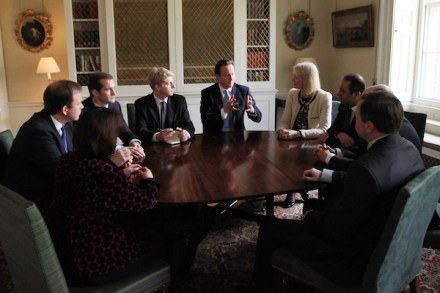
There has been a rare outbreak of unity in the Tory party in recent weeks. It is the product of several factors - the bonding effect of honouring Margaret Thatcher, the influence of Lynton Crosby and a growing sense on the Tory benches that Labour are beatable. Another important element of it is that David Cameron has found a better way to interact with his own MPs. As one senior Number 10 figure told me, ‘Rome wasn’t built in a day. But for the first time, I think, we have a proper systematic way of engaging with the party.’ One element of this is more serious policy discussions with MPs. Indeed, I understand that Number 10 is now trying to systematically involve MPs in policy making.

How the Snooping Bill could end up dead in the water – sooner or later

From our UK edition

When Cabinet met this morning, ministers didn't discuss the Communications Data Bill, which the government hopes to get into the forthcoming Queen's Speech. But there is a growing sense in Westminster that it won't make it out of the Commons alive - if it even manages to make it into the Commons. Here are three different scenarios for what could happen to this controversial piece of legislation: 1. The Bill fails to make it into the Queen's Speech. Discussions about the legislative programme for the next parliamentary year are taking place at the moment.

Anna Soubry: PM thought only a woman could do ‘soft bloody girly’ public health job

From our UK edition

Was Anna Soubry grateful to be promoted to the health department in last September's reshuffle? She doesn't exactly give that impression in her interview with Total Politics magazine this month. 'To be quite frank, when the PM said to me, ‘I want you to do public health’, I thought, ‘Oh boss, I respect you so much, but I’m the only woman here and I get public health – I hope there’s no connection there. 'Maybe I can make people realise that this is not a soft bloody girly option, it is a big serious job. I’m a huge fan of our prime minister… but I did sit there in the cabinet room and think, ‘Boss, you do know what you’ve just done?