Conservative party

Brian Binley tells Coffee House he’s set to stand for Deputy Speaker

From our UK edition

Simon Burns isn't the only Tory MP who fancies a crack at the Deputy Speakership, even if, as James has blogged, he might be the preferred Number 10 candidate. Other names include Nadine Dorries and Eleanor Laing. But I've just spoken to Brian Binley, who says that he has pretty much made up his mind to stand too. Binley said: 'I haven't completely made up my mind but I've had a lot of support. I've pretty much decided but I just want to be in the House when it is sitting to see what the mood is there. All the support I have had so far suggests that it is going to be good.' This is the Brian Binley of chambermaid and janitor fame, a man whose outspoken comments on the leadership will make him very popular indeed with backbenchers.

Bercow baiter Simon Burns to run for deputy speaker

From our UK edition

We’re about to find out what Tory MPs really think of John Bercow. Simon Burns, Bercow’s biggest Tory critic--and that’s says something, has resigned his ministerial post to run for deputy speaker. If he wins, the Speaker will be forced to work day in, day out with someone who, as Tim Shipman who broke the story points out, once called him a ‘stupid, sanctimonious dwarf’. David Cameron’s very warm letter accepting Burns’ resignation suggests that the Prime Minister is rather amused by the prospect. I also suspect that he’s grateful for Burns freeing up a ministerial post ahead of the reshuffle next week. The vote for deputy speaker is a free vote.

Ukip’s supporters are anxious, not awkward

From our UK edition

I guess the ‘unite the Right’ memo has not got through to some Tories, with Michael Heseltine calling Ukip 'a racist party' and James Wharton saying they’re ‘an awkward group of strange people’. That may be unwise — rather like attacking your customer-base — but it’s also untrue. Small Right-wing parties have a huge disadvantage because, although lots of people are socially conservative, soc-cons tend on average to be low in social skills and charisma and so the normals are easily driven away by the weirds, especially when immigration is an issue.

The ravelling and unravelling of the only policy in David Cameron’s speech

From our UK edition

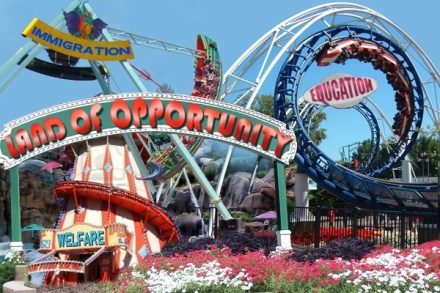
David Cameron's speech to Tory conference yesterday was supposed to be policy-free so that the media would pick up his list of achievements because it had no other choice. The problem with this, though, was that the papers found a policy in the speech anyway, and if they did splash on the speech, they chose this policy, not the 'finish the job' line or any other (although the Mail used the 'Land of Hope is Tory' line). It was on housing benefits for the under-25s, but it wasn't exactly ready to be a set-piece conference announcement, more a fleeting reference to gain more applause in the hall. Because the policy wasn't quite ready, a rushed briefing came out when it was demanded. You can read the note in full at the bottom of this post.

Matthew Parris: The Tories mustn’t cuddle up to Ukip — just imagine if it happened on the left

From our UK edition

Such is my respect for Spectator readers that I offer you a column whose subtext is in Latin. Ours is one of the last mainstream magazines among whose readership the phrase mutatis mutandis will be very widely understood. But the little test you and I are going to try concerns a live issue, not a dead language. For the purposes of this test I am going to paint you a scenario, and you’re going to give me the broad thrust of the advice you’d give in such circumstances. Imagine that the Labour party has been trying for some time to position itself firmly on the centre ground.

Tory conference 2013: five things we learned

From our UK edition

1. Labour set the agenda for this conference. Ed Miliband might be preoccupied by his row with the Daily Mail about his father, but he can take heart that his shift to the left in Brighton last week had a huge influence over this Conservative party conference. This wasn't just the cost of living agenda, which Tory ministers felt the need to rebut and respond to in their own speeches, but, as James explains in his politics column this week (get a sneak preview on Coffee House here), Ed Miliband has energised the Tories into being more determined than ever to beat Labour. David Cameron's own speech contained 25 references to Labour, and he tried to deal with Ed Miliband in a number of ways, which I outlined here.

Tories shift their plans on benefits for under-25s

From our UK edition

Although David Cameron's speech was deliberately light on policy, it did contain one hint about a manifesto commitment for the 2015 general election. The Prime Minister told the conference that 'we should give young people a clear, positive choice: go to school. Go to college. Do an apprenticeship. Get a job. But just choose the dole? We've got to offer them something better than that.' The party is clear this afternoon that this will be a fully fleshed-out pledge in the Conservative manifesto, and that it is linked to Cabinet Secretary Sir Jeremy Heywood's review of training and education for under-25s. The benefits that could be docked for young people who aren't 'earning or learning' include housing benefit and job seekers' allowance.

Labour set the test for this Conservative conference – but Cameron passed

From our UK edition

David Cameron is an essay crisis Prime Minister. He works best when his back is against the wall. And this conference he had a last-minute test set for him which he had to step up to. That test was set by the Labour party last week, with its focus on the cost of living, and Cameron passed it. His speech was written with clever flourishes and turns of phrase - 'the land of despair was Labour, but the land of hope is Tory', 'Abu Qatada had his very own May Day this year' and 'I've got a gesture of my own for Ed Balls' - but it was also dominated by the Labour party. There were 25 references to Labour in the text of the speech.

Tory modernisers can’t rest on their laurels – the job’s never done

From our UK edition

Where next for Tory modernisation? The first point is that it never ends. The Conservative party could not have survived and thrived as the longest standing and most successful political party in history without continually updating ourselves. Modernisation is one of our most important traditions. The second point is that modernising is not ideological. Still less is it about making ourselves less conservative or tacking to the left. Indeed, in the 1970s and ’80s modernisation was about detaching ourselves from an outdated corporatist consensus from which particularly younger people felt increasingly alienated. The third point is that it isn't superficial or about appearances.

Conservative conference: Tuesday fringe guide

From our UK edition

Every morning throughout party conference season, we’ll be providing our pick of the fringe events on Coffee House. It's the third day of the annual Tory conference in Manchester and like yesterday, today is jam packed with tens of  fringes with interesting party members, MPs and the like.

William Hague’s plan to reunite the right

From our UK edition

William Hague is the man with a plan to deal with Ukip at next year's European elections. At a fringe event hosted by the Conservatives in the European Parliament group this evening, Hague urged the assembled MEPs to take a tough message to the country, making sure they know what the Tories have done to reform and enhance our relationship with the EU. As James Forsyth suggested in the Spectator last week, the message the Tories need to adopt is part carrot, part stick, to unite the right. The Foreign Secretary seems to have listened to his advice. On the the electoral carrot, Hague suggested a pact was needed with the voters: 'It's only by David Cameron being Prime Minister, not Ed Miliband, that we get a referendum on Europe in the United Kingdom.

Conservative conference: Monday fringe guide

From our UK edition

Every morning throughout party conference season, we’ll be providing our pick of the fringe events on Coffee House. It's the second day of the Conservative conference today in Manchester and the fringe is in full swing. As Grant Shapps noted when he kicked things off yesterday, the Tories' is the largest party conference in the UK, and you could easily tell that from the fringe listings. So, for a round-up of the events you can't miss look no further than Coffee House's guide to the crème de la crème of the conference fringe below: Title Key speaker(s) Time Location Business is good for Britain: How can we encourage private investment and growth?

Free Enterprise Group MPs say no to Help to Buy

From our UK edition

Will any Tories except Cameron and Osborne applaud the Help to Buy mortgage scheme? At an IEA fringe event this evening, discussing lessons to be learnt from the recession, all the members present of the Free Enterprise Group of Tory MPs all conveyed their concern at the plans the Prime Minister has accelerated this weekend. Former banker Andrea Leadsom said she was 'exceedingly concerned' and suggested the property cap should be lowered from £650,000 to £350,000. Chris Skidmore agreed the cap is too large while Kwasi Kwarteng (leader of the group) said he was 'uneasy about governments propping up credit markets in such a direct way'. The Free Enterprise Group have been heralded as the future of the Conservative party, but the present party is listening to them too.

Conservative conference: Sunday fringe guide

From our UK edition

Every morning throughout party conference season, we’ll be providing our pick of the fringe events on Coffee House. The Tories' annual bash kicks off today in Manchester with plenty of cabinet ministers and interesting figures popping up, mostly later in the day.

We haven’t heard the last of the mansion tax

From our UK edition

In Manchester this week, there’ll be much talk from the Tories about how they are gunning for a majority. But in private, many senior Tories will admit that being the largest party in another hung parliament is a more realistic aim. As Matthew d’Ancona reveals in the Telegraph this morning, there has been talk—albeit brief-- between the principals about a second coalition. Matt also reminds us how, if it had not been for Cameron’s intervention, a mansion tax would have been imposed by the coalition. I suspect that if there is to be another coalition, the Liberal Democrats would insist on some kind of mansion tax. It has come for them a proxy for wider questions about how much influence they would wield inside a second Tory-Lib Dem coalition.

The Boris Johnson guide to making headlines

From our UK edition

Boris Johnson sure knows how to make the front pages. His interview in the latest FT Weekend Magazine — with the cover quote 'for the first time in years, I wished I was in Westminster' — is a prime example of his strategy. He wants to remain in the public consciousness without revealing anything new. He’s done it several times before, often in similar ways: 1. After a period of inactivity, give an interview which appears revelatory Boris flits in and out of the spotlight, particularly when he’s busy trying to run London. Then suddenly, he appears front and centre with 'news'. In the FT's interview, he says ‘during the whole Syria thing, for the first time in years, I wished I was in Parliament. I watched that and I thought ... I wished, I wished’.

Why a Tory/Ukip alliance would benefit Labour

From our UK edition

In YouGov's poll this morning for the Sun the Conservatives had 33 percent support, Labour 40 percent, the Liberal Democrats 9 percent and Ukip 11 percent. While it would be a gross exaggeration to say all of Ukip's support comes from the Conservative party, they do gain a disproportionate amount of support from ex-Tories and it's natural for people to add together that Conservative 33 percent and that Ukip 11 percent and think what might be. The reality though may not be as simple as adding the two together.

‘North-south railway’: the new Tory brand for HS2

From our UK edition

When Lord Howell described parts of the North East of England as 'desolate' (or did he mean the North West?), he was talking about shale gas exploitation, but he could have more accurately applied the term to the map of Tory support in the region. The urban north hasn't supported the party since the late 1980s. Seats like Manchester Withington, Newcastle Central and Nottingham North (that last is not in the North, of course, but another example of the urban problem) were once Conservative, but now it's hard to imagine them ever being safe blue seats again. The Tories can win without the urban North, but as their electoral map continues to shrink, it's a risky strategy to let the rot continue.

Letters: On quitting Facebook, and putting down Nigel

From our UK edition

Why we joined Sir: I was astonished by the assertion made by Wyn Grant (Letters, 21 September) that ‘the postwar surge in Conservative party membership was due to people rebuilding their social lives after the war’. Where did that idea come from? I grew up in south London before and during the war. I recall that social contact increased during the war and friendships made then endured when the war was over. Of course the nature of social activities gradually changed after the war, but the suggestion that most people joined the Conservative party purely for social reasons is wrong.

Why the Tories need to reunite the Right

From our UK edition

One of the most important things about British politics right now is that the left is united and the right is divided. The combination of the Liberal Democrats going into coalition with the Tories and Ed Miliband’s leadership of the Labour party has seen left-wingers who moved from Labour to the Liberal Democrats during the Blair years go back to Labour. At the same time, Ukip has started eating into the Tory core vote. Combine this with constituency boundaries that hugely favour Labour and it becomes evident that Labour can win with nowhere near 40 percent of the vote. If the Tories are to stop this happening, they need to reunite the right: to win back the vast majority of those voters who have moved to Ukip. Doing this is going to take a combination of carrot and stick.