Classical music

Claude Vivier ought to be a modern classic. Why isn’t he?

From our UK edition

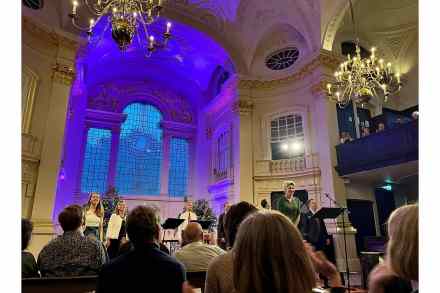
April is the cruellest month, but May is shaping up quite pleasantly and the daylight streamed in through the east window of St Martin-in-the-Fields at the start of I Fagiolini’s latest concept-concert, Re-Wilding The Waste Land. The centenary of Eliot’s poem is the obvious hook. But whether you’re counting from the Rite of Spring riot in 1913, Schoenberg’s Skandalkonzert the same year, or further back to Strauss’s Salome or Debussy’s Faune, music’s modernist moment occurred some time earlier. Which is helpful, in a way, because it freed the group’s director Robert Hollingworth from the limitations of chronological programming and gave him scope to do something a bit more interesting, and possibly a bit more Eliot-esque.
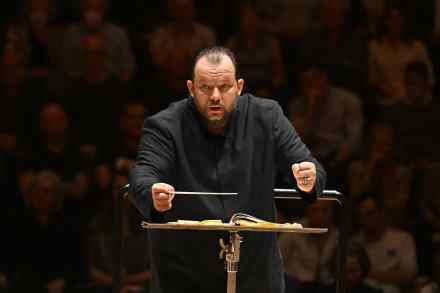
Even Nelsons’s miscalculations are fascinating: Leipzig Gewandhaus/Andris Nelsons, at the Barbican, reviewed

From our UK edition

Imagine growing up with a whole orchestra as your plaything. Richard Strauss’s father was the principal horn of the Munich Opera, and doting relatives funded publication of the teenage Richard’s earliest compositions. At the age of 19 he was assistant conductor of the Court Orchestra in Meiningen, and had rather got used to having world-class musicians at his command.

Too affectionate, not enough cruelty: Don Pasquale, at the Royal Opera House, reviewed

From our UK edition

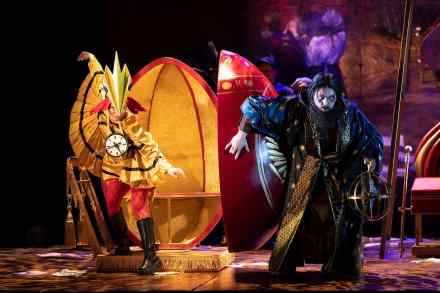
There are many things to enjoy in the Royal Opera’s revival of Donizetti’s Don Pasquale, but perhaps the most surprising is that the director plays it straight. This was my first encounter with Damiano Michieletto’s newish (2019) staging, and the plan was to approach it without preconceptions. (If we’re about to experience, say, a Bold Feminist Re-Imagining, I’d prefer to deduce it from the evidence on stage.) But for an opera premièred in 1843, Don Pasquale is distinctly old-school, with all its commedia dell’arte assumptions intact and whirring away like clockwork. The elderly miser Don Pasquale disinherits his lovelorn nephew and marries a compliant young bride who instantly becomes an abusive shopaholic scold.

Why I booed Birtwistle

From our UK edition

With the passing of Sir Harrison Birtwistle last month we are witness to a changing of the guard in new classical music. For 70-odd years contemporary music in the West was dominated by a highly exclusive atonal mode of thought that produced works that were hostile to the wider music-loving public and written for a small but highly subsidised cultural circle. If it was spontaneous when it began, the atonal idiom – meaning a highly dissonant style – quickly ossified into a kind of luxury backwater of music, so obscure it couldn’t even be questioned, yet endlessly backed by public subsidy which the public could nevertheless never challenge.

Of Mahler and mandates

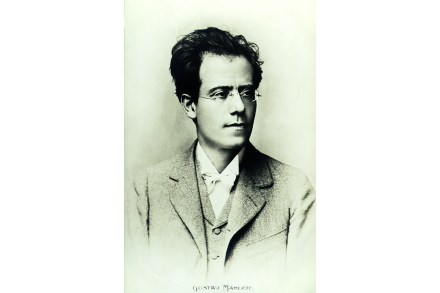
On February 23, 1897 a slight Austrian eccentric walked into the parish church of St. Ansgar and St. Bernhard in Hamburg, affirmed his belief in the Holy Trinity, the one, holy, Catholic, and apostolic church, and received the sacrament of baptism. Some months later, Gustav Mahler was named principal director of the Viennese court opera — a post that would have been denied to him had he not converted from Judaism. One hundred and twenty-five years after his baptism, the Kennedy Center for the Performing Arts honored Mahler by performing his Second Symphony with legendary guest conductor Michael Tilson Thomas.

Mahler

Igor Levit deserved his standing ovation; Shostakovich, even more so

From our UK edition

Music and politics don’t mix, runs the platitude. Looks a bit tattered now, doesn’t it? For Soviet musicians, of course, it wasn’t a question of whether you were interested in politics. Politics was unambiguously interested in you. Shostakovich wrote his 24 Preludes and Fugues for piano between 1950 and 1951, in the teeth of Stalin’s postwar crackdown, and in adopting the model of Bach, he seems to have been looking for a safe path forward: music that was politically neutral. He dedicated the Preludes and Fugues to the pianist Tatyana Nikolayeva, whose surprise victory at the 1950 Bach competition in Leipzig had been exploited by state propagandists. Bach himself was a permanent conundrum to the Soviets – that inconvenient fixation with God!

Pitch-black satire drenched in an atmosphere of compelling unease: ETO’s Golden Cockerel reviewed

From our UK edition

Blame it on Serge Diaghilev. Rimsky-Korsakov died in 1908 and never saw the première of his last opera, The Golden Cockerel. When the great showman finally presented it in Paris in 1914, it was as Le Coq d’Or: a spectacular opera-ballet hybrid, with colourful, folk-inspired designs by Natalia Goncharova that came to define the Ballets Russes in its imperial phase. That was the form in which it came to Britain, where the Evening Standard described it as a ‘farrago of love-making, black magic and ingenuous inconsequence’ before turning to the real news – the costumes.

Astonishing, if unnecessary, grandstanding: Barbara Hannigan’s La voix humaine reviewed

From our UK edition

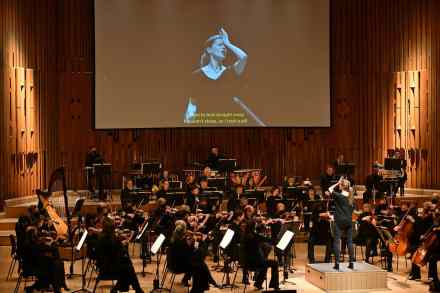
I think it was when she leaned forward and balanced on one leg that Barbara Hannigan jumped the shark. It wasn’t just a question of physical agility, although that was impressive enough. Hannigan performed her on-the-spot acrobatics while singing; the results were projected on to a big screen by three remote-controlled cameras, which zoomed in on her eyes, merged blurry images of her face and occasionally froze, meaningfully, on a particularly arresting posture. She did all this at the same time as conducting the London Symphony Orchestra in Poulenc’s one-woman opera La voix humaine, though that wasn’t really what this was about; at least, not by the time she was on one leg.

The genius of Iannis Xenakis

From our UK edition

This year is the centenary of the birth of Iannis Xenakis, the Greek composer-architect who called himself an ancient Greek stuck in the contemporary world. His instrumental music at times suggests an alien species trying to communicate with us through our musical instruments, his electronic music a distressed animal on the receiving end of amateur dentistry. For his part, Xenakis said that music ‘must aim… towards a total exaltation in which the individual mingles, losing his consciousness in a truth immediate, rare, enormous and perfect’. Of all the post-war European firebrands, Xenakis remains the most influential today.

Deserves to become an ENO staple: The Cunning Little Vixen reviewed

From our UK edition

Spoiler alert. The last words in Janacek’s The Cunning Little Vixen come from a child playing a frog. The story has come full circle — there was a frog near the start of Act One, and naturally you assume it’s the same one. But no: ‘That wasn’t me. That was my grandaddy. He used to tell me about you.’ It’s the final sad-sweet sting; the orchestra swells and the curtain falls. Perfection. Or so Janacek thought, anyway: ‘To end with the frog is impossible,’ insisted his German translator Max Brod — the same well-meaning meddler who either rescued or (according to taste) wrecked Kafka. Brod wanted a final hymn to nature from the central human character, the Forester. You know, a proper peroration.

Sibelius speaks

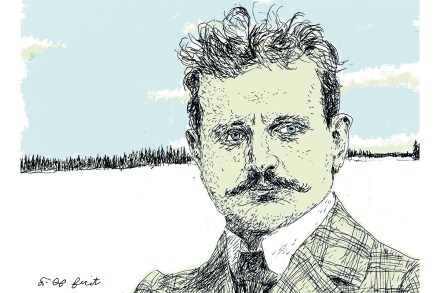
When it comes to music in the classical era, central Europe — or, to put it is where most of the action has taken place. Haydn, Mozart, Beethoven, Schubert and Brahms are, in a sense, the Big Five, commanding the limelight, with the likes of Mendelssohn and Mahler bringing up the rear. But if geography has somehow played a key role in the development of modern classical music, then another region has been gradually nudging its way into view. Names from northern Europe such as Kalevi Aho, Leif Segerstam, Per Nørgård and Vagn Holmboe must figure prominently in any tally of leading composers who have expanded the boundaries of musical expression.Take Holmboe’s brilliantly imaginative Concerto No. 11 for trumpet and orchestra.

Sibelius
Carnegie

Carnegie plus one

"A cable channel... but for classical music! It could be called ‘The Carnegie Hall Channel.’” I was on a beam reach to Eatons Neck about a quarter-century ago when a young man named Lawrence Perelman made this blustery pronouncement. We were Bill Buckley’s guests for an overnight sail across Long Island Sound. My first thought was: good luck with that. My second thought was no one wants to watch classical music on television. PBS’s Great Performances? More like lesser performances. With pixels the size of Cheez-Its and tin-can soundtracks, the experience was nothing like the real thing. But Perelman, an impresario who became an advisor to classical artists and institutions, as well as a friend, kept waving his baton long after we returned to Stamford.

Ralph Vaughan Williams: modernist master

From our UK edition

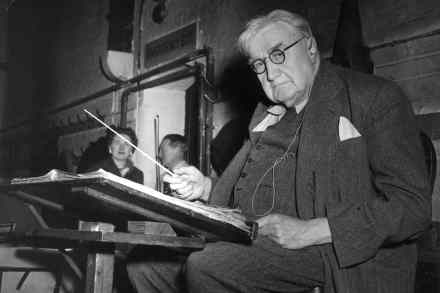
To look at a picture of Ralph Vaughan Williams is like contemplating an image of a mountain. Not the elegant, keen-eyed Edwardian intellectual whom we sometimes glimpse on CD sleeves or in concert programmes; I’m thinking of the portraits from the last decade of his long life. By the 1950s ‘RVW’ had been the father of British music for so long that he already seemed like part of the landscape, and he looked it too. The craggy jowls, the weathered thatch of grey hair; that questioning gaze — and beneath it all, those great, tumbling scree slopes of rumpled tweed. In his 150th anniversary year he’s still there, towering in the middle distance of national memory.

Get with the program

It was Rust Belt versus Sun Belt. Over the holiday season, I visited Pittsburgh’s Heinz Hall, located in the heart of the city, and Miami’s New World Center, a concert hall in South Beach. The former, a one-time movie theater built in 1927, looks like an oversized jewel box stuffed with red velvet chairs and glitzy chandeliers. The latter, a spectacularly intimate venue designed by Frank Gehry, serves as the home of the New World Symphony, a local outfit that operates as a final training ground for musicians who have graduated from conservatories and want to go on to play in major orchestras. In their own way, each of the carefully executed performances underscored that the obituaries repeatedly pronounced for classical music as a preserve of elitist white males are so much bosh.

symphony

Not pleasant, and not in tune, but unarguably compelling: Royal Opera’s Nabucco reviewed

From our UK edition

Nabucco, said Giuseppe Verdi, ‘was born under a lucky star’. It was both his last throw of the dice and his first undisputed hit, composed after the failure of Un giorno di regno and the death of his young wife and two children had driven him to abandon music outright. The story (at least, as Verdi told it) was that the director of La Scala had forced him to accept a libretto on the Biblical story of Nebuchadnezzar, and that when a page fell open on the chorus ‘Va, pensiero’ the muse returned. Citation needed, possibly, but there’s no question that the ‘Chorus of the Hebrew Slaves’ is one of those once-in-a-lifetime melodies; a tune (as Elgar might have put it) to ‘knock ’em flat’.

A booster shot of sunlight: Unsuk Chin’s new violin concerto reviewed

From our UK edition

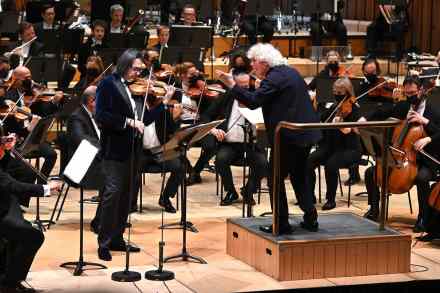
Sir Simon Rattle and the London Symphony Orchestra began the year with a world première. Unsuk Chin’s Second Violin Concerto opened with the soloist, Leonidas Kavakos, completely alone in front of a silent orchestra, playing phrases that rocked back and forth until, suddenly, they were striking sparks. As well they might; Kavakos, after all, is the reason that the concerto exists — the violinist whose ‘burningly intense’ (the composer’s words) artistry has prompted Chin to break her self-imposed rule of writing only one concerto for any given instrument. She explained in the programme notes that ‘the solo violin part forms the foundation of the whole score, the soloist triggering all of the orchestra’s actions and impulses.

Musical conservatives ought to love identity politics

From our UK edition

It’s 2022 and classical music is, again, dead. It’d be surprising if it wasn’t. In 2014 the New Yorker published a timeline by the industry analyst Andy Doe showing the precise chronology of the decline and fall. Ageing audiences in the 21st century, the gramophone in the 20th, the dangerous new technology of the pianoforte in the 1840s: all, in their time, were considered proof that the rot was terminal. Doe traced the root of the problem back to a papal bull in 1324, giving new potency to Charles Rosen’s remark that ‘the death of classical music is perhaps its oldest continuing tradition’. Anyway, the fatal blow this time is the Great Awokening.

The genius of Tchaikovsky’s Nutcracker score

From our UK edition

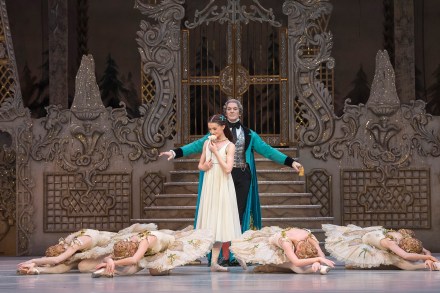
By all accounts, Tchaikovsky struggled to compose The Nutcracker. It wasn’t his idea of an effective ballet scenario, and he was unimpressed with the choreographer Marius Petipa’s prettified storyline. Mid-composition, he learned of the death of his younger sister Alexandra. ‘Even more than yesterday, I feel absolutely incapable of depicting the Kingdom of Sweets in music,’ he wrote. But inspiration can be counterintuitive. On a good day, Tchaikovsky could write as fluently as any Victorian serial novelist, churning out forgettable piano pieces (as he put it) ‘like batches of pancakes’. Projects like The Nutcracker put him through purgatory but the result, with hindsight, was nothing less than the sound of Christmas.

Reprehensible – but fun: Orpheus Chamber Orchestra’s Complete DG Recordings reviewed

From our UK edition

 Grade: B It must have been an interesting day in the Orpheus Chamber Orchestra’s press office when Blair Tindall’s memoir Mozart in the Jungle hit the bookshops in 2005. ‘He sat in the desk chair, pushed aside the first oboe part of Rossini’s Italian Girl in Algiers and tapped a pile of cocaine on the glass’ runs a typical anecdote. Even in 2005, it wasn’t really what anyone expected to hear from a former member of Orpheus — a youthful, conductor-less New York outfit who used to pose for album covers dressed in spotless white.

In defence of the earworm

From our UK edition

That strain again… it’s the morning after the concert and one tune is still there, playing in the head upon waking, running around and around on an unbreakable loop over breakfast. I’ve never liked the term ‘earworm’. It suggests an alien parasite, an aural violation, when in fact some part of the musical brain is clearly in love with this scrap of melody, and getting a microgram of a dopamine hit every time it presses ‘repeat’. It’s consensual, even pleasurable. Why fight it? There’s an Arthur C. Clarke story about a scientist obsessed by the finale of Sibelius’s Second Symphony.