Classical music

Barbara Hannigan needs to stop conducting while singing

From our UK edition

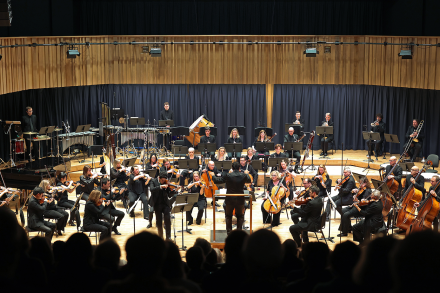
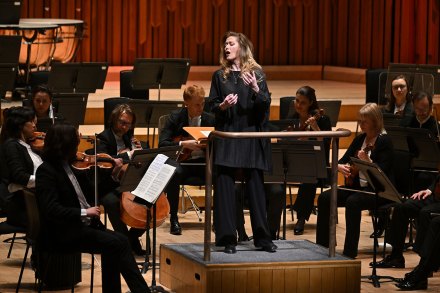
Last week, Barbara Hannigan conducted the London Symphony Orchestra in Haydn, Roussel, Ravel and Britten, though to be honest she had me at Haydn. It’s still relatively unusual to encounter him in a symphonic concert, and more than one promoter has told me that Haydn is ‘box office poison’, which is a shocking description of such life-enhancing music. Perhaps it’s down to sonic overkill. Bingeing on Shostakovich and Mahler has left our emotional reflexes distended and coarsened, and now we feel short-changed if every inch of the concert platform isn’t crammed with extra brass and percussion.

The agony of making music at Auschwitz

From our UK edition

Anita Lasker survived the Holocaust because, as a Berlin teenager, she had enjoyed her cello lessons. The Hungarian Lily Mathé’s violin performances had once impressed the man who became the Auschwitz concentration camp commandant. Alma Rosé, among Europe’s most talented musicians and the niece of Gustav Mahler, became the conductor who kept these young women and more than 40 others alive through ‘ferocious discipline’ and determination. In The Women’s Orchestra of Auschwitz, Anne Sebba recounts these intertwined stories with great sensitivity. She also explores the ethical questions that haunted the survivors who were once forced to play melodies in the darkest moments of the 20th century.

A luminous new recording of The Dream of Gerontius

From our UK edition

Grade: A– There’s a species of music-lover who enjoys pointing out that Elgar isn’t played much on the Continent – the musical equivalent of those social media bores who pop up each April to reveal that Saint George was Turkish, ackshully. It’s all rot, of course. Some of the best Elgar performances of recent years have come from Barenboim and Petrenko in Berlin; and, after all, it was Richard Strauss in Düsseldorf who put The Dream of Gerontius on the map.  And now here’s Gerontius from Helsinki. True, the conductor, Nicholas Collon, is British and I hadn’t previously had him down as an Elgarian. The choirs are a mixture of Finns and Brits (they blend well) and the soloists are about as fresh a crop as you could hope for right now.

The filthy side of Dame Myra Hess

From our UK edition

The photograph on the cover of Jessica Duchen’s magnificent new biography of Dame Myra Hess shows a statuesque lady sitting at the keyboard, hair swept back into the neatest of buns. Add a pair of half-moon spectacles and she could be Dr Evadne Hinge, accompanist to Dame Hilda Bracket. This isn’t to imply that Dame Myra looked like a man in drag, but then neither did the ‘Dear Ladies’ played by George Logan and Patrick Fyffe, some of whose fans thought the singing spinsters actually were women. In their 1980s heyday Hinge and Bracket were national treasures – and so, on a far grander scale, was Dame Myra, who lifted Londoners’ spirits with her National Gallery concerts during the second world war.

A dancing, weightless garland of gems: Stephen Hough’s piano concerto reviewed

From our UK edition

Stephen Hough’s new piano concerto is called The World of Yesterday but its second ever performance offered a dispiriting glimpse into the world of tomorrow. A couple of minutes into the finale Hough stopped playing and the orchestra fell silent. ‘I’m very sorry,’ he explained. ‘My iPad is going crazy.’ A murmur of sympathy, mingled with laughter; then Hough signalled to the conductor Mark Wigglesworth and the Bournemouth Symphony Orchestra and they carried on, this time without mishap. But we’d seen it happen, and until last week I’d have told you it was inconceivable. This wasn’t some rash experiment: professional musicians have been using electronic scores for well over a decade, generally without problems.

How to write a piano concerto

From our UK edition

My Piano Concerto, The World of Yesterday, began with an email during one of the darker days of the pandemic: would I like to write a score for a movie about a concert pianist writing a piano concerto. As I looked at my concert diary, blank but for Zoom calls, it seemed like a wonderful way to keep me busy. I’d never wanted to write a piano concerto (how to begin?

Are these performances of the Bach cantatas the best on record?

From our UK edition

Three projects shedding light on the sacred music of J.S. Bach are nearing completion. The first consists of an epic 25-year project to record all the composer’s vocal works – passions, masses, motets and more than 200-odd cantatas – in electrifying performances supplemented by lectures and workshops. At the helm is a Swiss choral conductor renowned for his improvisatory skills – and surely the only baroque specialist to have played Sidney Bechet on a chamber organ. The second project is a guide to Bach’s church cantatas tailored at ‘cultural Christians’; that is, music lovers intrigued but intimidated by their Lutheran theology, unsure how to approach this treasure trove of, at a conservative estimate, more than 100 masterpieces of western civilisation.

Want to understand a conductor? Listen to their Haydn

From our UK edition

Grade: B When a music-lover is tired of Haydn’s London symphonies, they’re tired of life. It’s not just the sheer creative verve of these 12 symphonies by a composer in his sixties. It’s the generosity of spirit. Beethoven demands a battle of wills; Mozart a near-impossible grace. But a conductor can run straight at a London symphony and Haydn will show us, with a smile, exactly who they are. Beecham is urbane, Bernstein camps it up; Abbado is trim and impeccably turned out. Eugen Jochum (a belated discovery) is just very, very German. Haydn’s still bigger than all of them. Paavo Jarvi has reached the second volume of his London symphonies with the Bremen-based Deutsche Kammerphilharmonie, and he’s surely never been anyone’s idea of a ray of sunshine.

The thankless art of the librettist

From our UK edition

Next week, after the première of Mark-Anthony Turnage’s new opera Festen, the cast and conductor will take their bow. All being well, there’ll be applause; and then a brief lull as the creative team takes the stage. There’s often a ripple of curiosity in the audience at this point, because it’s rare that we get to see just how many people it really takes to make an opera. Standing near the composer will be Lee Hall, the writer of Billy Elliot and The Pitmen Painters, and now part of the most maligned – and indispensable – profession in all of music. He’s the librettist. In short, Hall wrote the words, and in the world of opera there’s no more thankless task. ‘There’s this snobbery about it, an English snobbery, I suppose,’ he says.

Opera North’s Flying Dutchman scores a full house in cliché bingo

From our UK edition

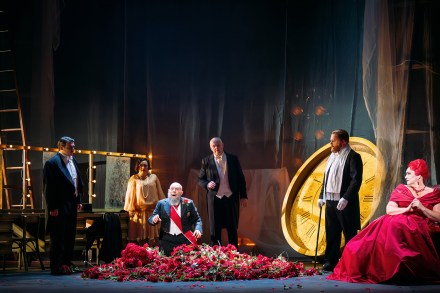
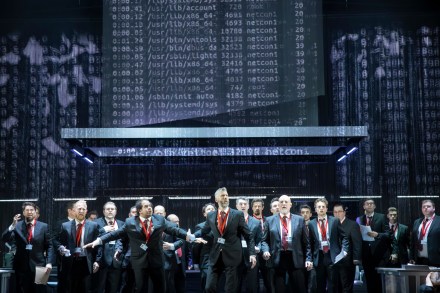
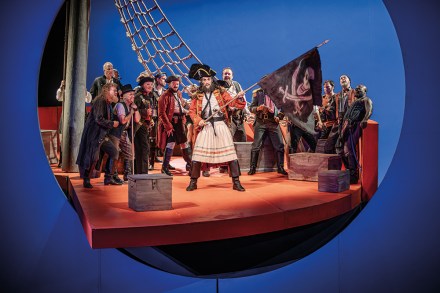
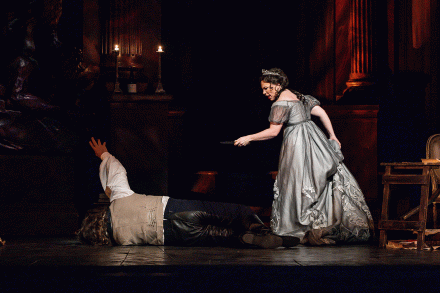
The overture to The Flying Dutchman opens at gale force. There’s nothing like it; Mendelssohn and Berlioz both painted orchestral seascapes but no one before Wagner had flung open the sluices and let the ocean roar into the opera house with quite such elemental power. Garry Walker and the orchestra of Opera North dived into it headfirst, while images of waves were projected on the curtain. If you believe that opera audiences can’t handle an overture without visual distraction (and most opera directors do appear to think this) it’s as good a solution as any. A strong start for a new production. Then the curtain rose and we were in the Home Office.

Classical music has much to learn from Liverpool

From our UK edition

They do things their own way in Liverpool; they always have. In 1997 the Royal Liverpool Philharmonic Orchestra launched a contemporary music group called Ensemble 10:10 (the name came from the post-concert time-slot of their early performances). For a decade now, they’ve also administered the Rushworth Prize, an annual competition for young composers based in the north-west. And while classical fads and crises have come and gone, the RLPO has held its friends close and tended its garden. The result? The kind of artistic self-assurance that lets you put your chief conductor in charge of a première by a novice composer, and then call in a Barenboim to guarantee a full house.

A pleasant respite from the tumult in Cambridge

Cambridge, England Inscribed on the lid of a two-manual harpsichord in Holy Trinity Church at Hildersham in Cambridgeshire is the Latin tag Musica Donum Dei — music is a gift of God. It was a sentiment I could hardly quarrel with as I listened in the little twelfth-century church to a variety of baroque sonatas for violin, recorder, cello and harpsichord. They were expertly performed by the Azur Ensemble, which is comprised of recent graduates of the Royal College of Music. A particular standout was the French harpsichordist Apolline Khou, who has performed widely in Europe and in a solo concert for King Charles III.

Cambridge

The stupidity of the classical piano trio

From our UK edition

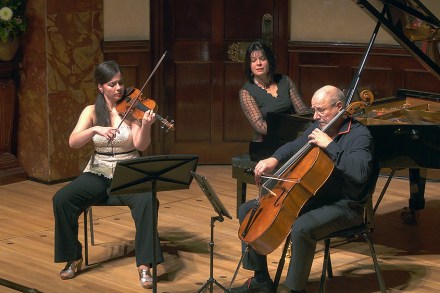
It’s a right mess, the classical piano trio; the unintended consequence of one of musical history’s more frustrating twists. When the trio first evolved, in the age of Haydn, the piano (or at any rate, its frail domestic forebear) was the junior partner, and the two string instruments, violin and cello, were added to make the silly thing audible. Then the piano started to evolve, while its partners – give or take the odd tweak – really didn’t, much. The end result, by the second half of the 19th century, completely reversed the original balance of power, leaving the two string instruments thrashing for dear life against the onslaught of that glossy, black, all-devouring monster, the modern concert grand.

Our verdict on Pappano’s first months at the London Symphony Orchestra

From our UK edition

Sir Antonio Pappano began 2024 as music director of the Royal Opera and ended as chief conductor of the London Symphony Orchestra. Around the middle of the year, there was a sort of retrospective; a stock-taking, if you like, as he made the transition to this third act of his career. Warner Classics released a box set of Pappano’s recordings with the Santa Cecilia Orchestra in Rome, where he held the top job from 2005 to 2023. And Pappano published a memoir, My Life in Music – a masterclass in diplomacy. No beans were spilled, and they were never likely to be. You don’t survive 22 years in an international opera house without learning discretion; not, that is, if you intend to remain sane.

Vivid, noble and bouyant: AAM’s Messiah reviewed

From our UK edition

More than a thousand musicians took part when Handel’s Messiah was performed in Westminster Abbey in May 1791. It wasn’t the only item on the bill, either; it was part of a day-long blow-out that lasted from 11 a.m. to 5 p.m. and also included the whole of Handel’s Israel in Egypt. The crowd came prepared. According to Adalbert Gyrowetz, a Bohemian composer then living in London, the audience munched on ‘hard-boiled eggs, ham and roast meat’ during the intervals. ‘One had almost to wade through a mass of eggshells and other rubbish on the way out of the church,’ he noted.

Radio 3 Unwind is music for the morgue

From our UK edition

Soon after the launch of Classic FM in 1992, the then controller of Radio 3, Nicholas Kenyon, asserted that his high-minded station was not in any competition with its commercial rival and certainly not lurching into ‘some ghastly descent into populism’, even as he hired Classic FM’s presenters and fiddled with the programming to create ‘access points’ for novice listeners. Classical music once had a higher calling than to be this subdued That argument is now over, the pretence dropped. The current controller of Radio 3, Sam Jackson – appointed last year – was previously the actual boss of Classic FM, as well as Smooth and Gold.

Why is Fauré not more celebrated?

From our UK edition

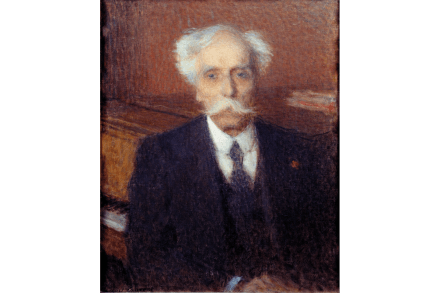
It is 100 years since the death of Gabriel Fauré, a composer whose spellbinding romantic tunes emerge from harmonies and rhythms that nudge us towards the future. No other composer deploys such subversive mastery of the conventions of French music: again and again, if we look underneath the arches of his melodies, we find ambiguous chromatic shifts or disorientating spiralling arpeggios. For some critics, the musical argument of Fauré’s late chamber work is so understated it evaporates And – see above – no other French composer is so hard to describe without falling into a purple puddle.

The striking musical world of Welsh composer Grace Williams

From our UK edition

Grade: A- There are neglected composers, and then there are Welsh composers. It’s just a question of geography. When Grace Williams’s Fairest of Stars was played at the Proms a few years back, it was hailed as a major rediscovery. That raised a few eyebrows in the Principality, where her music has long been standard repertoire. I grew up 20 minutes from the border and I’d played three of her orchestral works before I turned 30. Still, there’s always more to discover, and this new disc breaks over you with the force of a Snowdonia rainstorm. The BBC Philharmonic lives up to its reputation as the most brilliant of the BBC’s English orchestras, and the conductor, John Andrews, is the man behind recent recordings of operas by Ethel Smyth and Malcolm Arnold.

The Book Club: John Suchet

From our UK edition

42 min listen

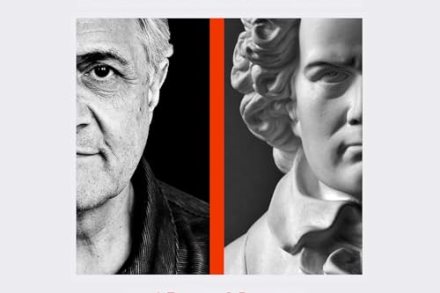
My guest in this week’s Book Club podcast is John Suchet whose new book In Search of Beethoven: A Personal Journey describes his lifelong passion for the composer. He tells me how the ‘Eroica’ was his soundtrack to the Lebanese Civil War, about the mysteries of Beethoven’s love-life and deafness, why he had reluctantly to accept that Beethoven was ‘ugly and half-mad’; and how even in the course of writing the book, new scholarship upended his assumptions about events in the composer’s life (from his meeting with Mozart to the circumstances of his death).

A lively and imaginative interpretation of an indestructible Britten opera

From our UK edition

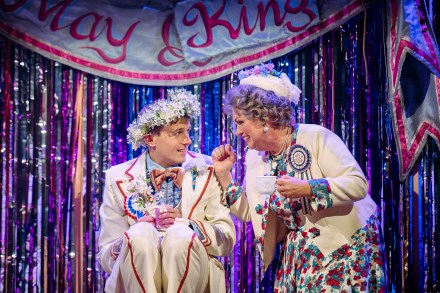
Scottish Opera’s new production of Albert Herring updates the action to 1990, and hey – remember 1990? No, not particularly, and I suspect that’ll be a common reaction if you were actually around back then. The director Daisy Evans was a toddler at the time and she imagines a gaudy, tawdry small-town world of bum-bags, WeightWatchers and decrepit gas heaters. Loxford Village Hall looks like it hasn’t been redecorated since the year the opera was composed, 1947, and that certainly rings true. Blancmange for the May Day feast, though? I’m pretty sure that even under John Major, blancmange was a throwback. But Evans has a show to put on after all, and a pink wobbling gelatine-based dessert is more theatrical than a bowl of Monster Munch.