China

2022 Biden contradicts 2001 Biden over action in Taiwan

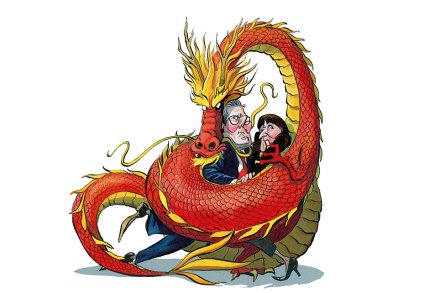
Cockburn is not one to point fingers (as they are often preoccupied with his cigar), but he finds himself making an exception for President Biden over his apparent U-turn on the issue of the United States using military force to help defend Taiwan against China. Tyler Cowen, an economics professor at George Mason University, just unearthed a 2001 Washington Post op-ed then-senator Joe Biden wrote dissenting from President George W. Bush’s stance that the “United States had an obligation to defend Taiwan if it was attacked by China.” Biden wrote that “words matter,” and that Bush’s extreme language had "damaged US credibility with our allies and sown confusion throughout the Pacific Rim.” Speaking of confusion...

fauci

The Harvard connection

On the morning of Sunday February 2, 2020, Anthony Fauci, then in the middle of putting together America’s pandemic response, received an unusual email with a highly unusual request. The email, revealed as part of a tranche of FOIA documents requested by the Intercept, was from George Daley, the dean of Harvard Medical School. “Alan Garber, Harvard’s provost, and I met yesterday with a team led by Jack Xia, the CEO of China’s Evergrande Company, and Dr. Jack Liu, Evergrande’s chief health officer,” Daley wrote. Addressing the director of the National Institute of Allergy and Infectious Diseases as “Tony,” he asked for “whatever information you are willing to share on your current efforts to coordinate a response.

China’s grave insult to the Catholic Church

The outrageous arrest of Cardinal Joseph Zen last week — together with the Vatican’s weak response — presages dark days for Catholics under Beijing’s authority. Nicknamed “the conscience of Hong Kong,” Cardinal Joseph Zen is known and respected throughout the world for his fearless defense of Chinese Catholics and his opposition to communism. As bishop of Hong Kong, he encouraged and celebrated annual masses on June 4 for the victims of the Tiananmen Square massacre (participation in a Tiananmen Square memorial was one of the “offenses” that put Hong Kong media tycoon Jimmy Lai in jail last year). This year, the diocese of Hong Kong has canceled the June 4 Tiananmen Square memorial masses, for the first time in over two decades.

Hong Kong is now a police state

No one now denies that Hong Kong is a fiefdom of Beijing. Its democratic leaders have been packed off to prison on spurious grounds or have left the territory, and its street protests have long been beaten to pieces with batons. The 2020 national security law has made mockery of Hong Kong's last shreds of freedom of expression, rendering all criticism of the Chinese Communist Party akin to terrorism; and its uncensored homegrown newspapers are now closed by the state — their proprietors inexorably marched off to jail. Any pretense of adherence to the treaties signed by Britain and China around the time of the handover in 1997 — treaties that guaranteed Hong Kong autonomy — has long fallen away. Hong Kong is a subject province of the People's Republic now, and nothing more.

Springtime for Cold War nostalgics

My favorite spy movie cliché of all time is the secret agent stuck in the 1980s. The threats have gone asymmetrical, terrorists slip across borders, but our hero longs for the simple days when the world was divided between good Westerners and bad Russians. “You’re a fossil!” sneer his girlboss department administrator, his vegan drone pilot, his tech whiz who has just hunted down a non-state actor by crosschecking the latest SIGINT with a Yelp! review of an Iraqi yoga studio. Cut to him muttering under his breath à la Judi Dench in Casino Royale: “Christ, I miss the Cold War.” Now, suddenly, those who miss the Cold War are having a moment.

Cold War

What Ukraine means for Asia

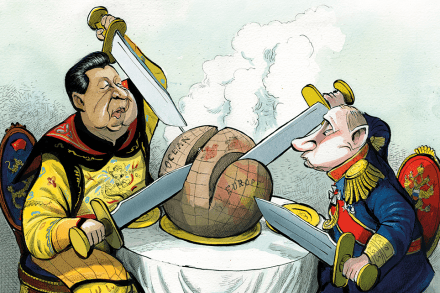
If Asia has entered the debate over the war in Ukraine, it is primarily through questions over the role China is purported to be playing in supporting Russia. Given the now-infamous declaration of a “partnership without limits” by Vladimir Putin and Xi Jinping during the Beijing Olympics just weeks before the invasion, many observers have searched for signs of Chinese aid, military or economic, to Russia in the conflict. The scope of devastation in Ukraine and the probable war crimes being committed by Russian troops understandably mean less attention has been paid to how the conflict might affect geopolitical stability in the Indo-Pacific region. The exception is Taiwan — there has been considerable speculation over the influence of Ukraine on Beijing’s calculations there.

asia

How to avoid World War Three

The Russian assault on Ukraine has awakened the West to the fact that we may be back in a Cold War — or worse. After a few decades’ respite in which the United States did not find itself in conflict with any nuclear powers, presidents must consider a world in which nuclear-armed Russia and China actively oppose US interests and deliberately test American resolve. This reality will become even more complicated if a hostile Iran gets its hands nuclear weapons too. The return of Cold War-style geopolitics means the return of Cold War-style statecraft. Presidents will once again face the difficult task of calibrating their actions to advance US goals while avoiding escalation toward possible nuclear confrontation.

presidents

Why we need robust free speech laws

The biggest tragedy of the Russian invasion of Ukraine is, of course, the loss of thousands of Ukrainians, who have been killed because of Vladimir Putin’s insane and horrific actions. But alongside that horror are many other alarming developments. One of them is the near-total suppression of the free flow of information in both Russia and China. As you have likely read, Putin cast the war with Ukraine not as the unprovoked invasion it is but, laughably, as a “special military operation” for “de-Nazifying” the Ukrainian leadership. Russia swiftly passed a law greatly enabling Putin’s propaganda campaign.

speech

Will America follow China toward ‘Zero Covid’?

The city of Philadelphia appears to be following China, if only in small steps, toward the delusional goal of Zero Covid. A new indoor-mask order, announced last week by Cheryl Bettigole, Philadelphia’s health commissioner, takes effect today, April 18. It’s the first resumption of such a mandate by any large city in the United States. President Xi Jinping, the well-meaning Dr. Bettigole most definitely is not. Yet is Philly, like China, again being seduced by the notion that the virus can be made to go puff? In Shanghai, a brutal push for Zero Covid is imprisoning millions in their homes and tearing infected children from their parents for quarantine.

Hollywood won’t say gay in China

Exactly when and where are our stunning and brave Hollywood stars prepared to take a stand for gay rights? Liberal actors and celebrities have a made a show of standing against Florida’s Parental Rights in Education Bill, signed earlier this month by Governor Ron DeSantis, a man progressives seems intent on making the next president. When activists and journalists realized they couldn’t stop the bill from becoming law, they deployed their new favorite tactic: demanding that corporations speak out against the bill (see also: how in response to Georgia’s new voting legislation, they insisted that Major League Baseball relocate the All-Star game).

China: one bully to rule them all

Several years ago, I visited the War Remnants Museum in Ho Chi Minh City, Vietnam. It’s located, a bit surreally, in the former United States Information Agency building. Formerly called the "Museum of Chinese and American War Crimes," it showcases various captured US military equipment. What was particularly jarring to me was learning of the millions of Vietnamese civilians killed during the Vietnam War era. Of course, there’s a bit of irony here: a building formerly dedicated to projecting American public diplomacy and messaging in Southeast Asia now serves the different propaganda purpose of seeking to portray America as a violent aggressor guilty of war crimes.

Did China just take out an NBA player?

It sure looks like basketball player Enes Kanter Freedom has been blackballed by the NBA for his candor over the league's cozy relationship with China — concentration camps filled with ethnic Uighurs in Xinjiang and all. Freedom, who earlier this year began wearing human rights messages on his game shoes illustrated by Chinese dissident artist Badiucao, became a vocal critic of the NBA's cherrypicking of human rights issues. That included directly targeting the league’s star and arguably most recognizable athlete on the planet, LeBron James. In 2019, after Houston Rockets general manager Daryl Morey spoke out against China and in support of the pro-democracy movement in Hong Kong in a series of now-deleted tweets, China suspended all NBA broadcasts within its borders.

Don’t let Russia end the old world order

While most Americans believe that the Russian invasion of Ukraine is morally wrong, there is in some corners a pervasive sense of annoyance with the conflict. The real enemy, some say, is China, and they believe that America should not focus on the last vestiges of 20th-century conflicts at the expense of losing focus on those of the 21st. They see NATO and the rest of the Cold War infrastructure as representative of a dying world. Instead of propping up this order, they argue, America should be hard at work building a new order to take on China. The goal of a new American-led, anti-China world order is a necessary one. The currently existing old order is ill-fitted to combat China, which indeed will be America’s main 21st-century enemy.

The ultimate human futility of sports

If it were true that civilization progresses inexorably according to the laws of some teleological principle, public — in modern times, professional and commercialized — sports would not have survived Classical Greece and the Roman Empire, thus sparing the modern world such obscene extravagances as the Super Bowl in the United States, the World Cup in Europe and the international Olympic Games. Mass man at play in his leisure hours is not a pleasant and encouraging sight in any circumstances, but gathered with his fellows in massive sports stadia one views him at his absolute worst.

sports

Andrew Sullivan searches for spirituality

It was daunting preparing to meet Andrew Sullivan, considered one of the cleverest, most fearless journalists of his generation. There is the academic pedigree: the scholarship at Oxford — where he was also president of the union and a celebrated actor — followed by the PhD in political theory at Harvard, where he produced an iconic treatise on the work of British mid-century philosopher Michael Oakeshott, performed the entirety of Hamlet all by himself — "a whacked-out mid-1980s" version — and modeled for Gap. And there is the journalistic firepower. At twenty-eight, in 1991, Sullivan became the youngest ever editor of the New Republic, America's most august political magazine.

Make China pay for its quiet support of Putin’s war

China is tacitly backing Putin’s aggression against Ukraine. The Biden administration should combat this by imposing economic costs on China through the corporate Environmental, Social and Governance disclosure requirements that are already in place. Xi Jinping and Vladimir Putin met in February at the Beijing Olympics, their thirty-eighth visit in the nine years since Xi took power. In a 5,000-word statement on February 4, Xi and Putin proclaimed their friendship with “no limits” and “no forbidden areas of cooperation.” Just weeks before the invasion, China signed agreements to buy from Russia energy and agricultural products worth over $200 billion.

support

Enough with the 1970s comparisons

The media are abuzz these days about a purported “return to the 1970s.” Generally speaking, such chatter is not intended kindly, for many today would likely agree with the sardonic assessment of the Seventies made by the editors of New West magazine as that decade wound down: “It was the worst of times, it was the worst of times.” And not just because of the popularity of bell-bottom pants, platform shoes, and disco music. In the Seventies, we had problems far more troubling — more troubling even than the pop group ABBA. For starters, we saw a quadrupling of real oil prices between 1973 and 1979. We suffered high rates of both inflation and unemployment, which hitherto varied inversely, leading to the creation of the portmanteau “stagflation.

1970s

Russia’s war is a global cancer

One thing I have always found fascinating about Russia is that when they tell us they are going to do something, they usually do it. So when Moscow struck a military base near the Poland-Ukraine border that was a staging ground for arms shipments, we shouldn't have been surprised. They told us that was their next plan of action just twenty-four hours before they did it. But that’s just the beginning of what Russia likely has in store for the West, NATO, and the entire world if we aren’t careful. Russian president Vladimir Putin’s plan seems simple: chaos on a scale that will extend far beyond Ukraine. You see, Putin is starting to come to grips with the fact that he can’t win the war in Ukraine — at least on paper — unless he destroys Ukraine.

cancer

Putin understands America’s moral decay

Last October, Vladimir Putin aired a speech to the Russian nation chiding the United States for its moral decay. He observed an America “blotting out whole pages” of its history, pursuing “reverse discrimination against the majority in the interests of minorities,” and renouncing time-honored values in an effort at “public renewal.” “It’s their right, but we are asking them to steer clear of our home,” he warned. “We have a different viewpoint.” This iteration of family values and conservative critique went barely noticed by the American press at the time.

Putin

The creeping authoritarianism of facial recognition

In an effort to lower crime rates, American law enforcement is pushing to combine facial recognition with expanded video surveillance. Politicians worried about their re-election chances due to a perceived crime wave see the expansion as necessary. It’s a sharp swing from 2019 and 2020, when cities like San Francisco and New Orleans were banning or at least enacting limits on facial recognition technology due to privacy concerns. Now, New Orleans plans to roll back its facial recognition prohibition. The Virginia State Senate gave law enforcement a late Valentine’s Day gift by passing a facial recognition expansion bill on February 15 — the Democrats who unanimously approved a ban on facial recognition last year suddenly changed their minds, as did five Republicans.