Bullfighting

The last bullfighters

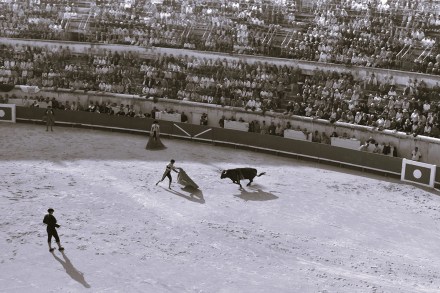
In May of last year, at the Saturday corrida of the Feria de Pentecôte in Nîmes – “no hay billetes” – I had the traveler’s luck to find myself seated next to the son of one of the late, great French toreros of the 1970s. We were seated high in the Arènes de Nîmes, the city’s Roman amphitheater completed around 100 years after the Crucifixion – a structure far superior in function and beauty to Rome’s defunct and messily eviscerated Colosseum. In Nîmes, as in neighboring Arles, the French have triumphed over the Fall of Rome in restoring these structures to something of their original purpose: hosting feats of gladiatorial courage tamed by a strict protocol. But that inheritance has once more been threatened by legislation that contests its place in the Fifth Republic.
bullfighting

Meet England’s octogenarian matador

From our UK edition

It’s a sunny October morning at a bull-breeding ranch north of Seville, and 82-year-old Frank Evans is preparing to step into the ring. Born in Salford, Evans is one of the few British men ever to become a professional bullfighter, or torero. There is something of the retired rock star about him. He is dressed in the traditional matador’s outfit of black trousers, white shirt and red-and-black waistcoat. Although a little frail, he is toned. His thinning hair is dyed brown but still reaches his shoulders. ‘There are a million people in the local cemetery who’d love to have my eye problem’ Evans and I are here for a tienta – a practice session in a private bullring, in which young cows and bulls are assessed for breeding.

The ultimate human futility of sports

If it were true that civilization progresses inexorably according to the laws of some teleological principle, public — in modern times, professional and commercialized — sports would not have survived Classical Greece and the Roman Empire, thus sparing the modern world such obscene extravagances as the Super Bowl in the United States, the World Cup in Europe and the international Olympic Games. Mass man at play in his leisure hours is not a pleasant and encouraging sight in any circumstances, but gathered with his fellows in massive sports stadia one views him at his absolute worst.

sports

Bullfighting and the fight for Spain’s future

From our UK edition

Being sanctimonious about foreigners and their cruelty to animals has long been a British tradition. The taste for dog meat in parts of Asia seems to incense many who perhaps should have matters closer to home to worry about – such as our collective addiction to cheap, factory farmed meat. When I was a child in the 1980s, ghoulish Spanish practices usually involving donkeys at some out of the way fiesta were a mainstay of Esther Rantzen’s unfathomably popular Sunday night programme, That’s Life. But sentimentality about animals has a way of catching on: South Korea’s President Moon Jae-in has suggested banning the consumption of dog meat and Spain is now debating whether children under the age of 16 should be prohibited from going to bullfights.

Why we need bullfighting

Which US state will be first to legalize bullfighting? OK, I need to qualify the question. A few bloodless corridas were held in Nevada in 2009, and some Portuguese-style bullfighting — again, bloodless — is permitted in California, legally classed as part of religious tradition. It won’t stop there, though. A friend in California breeds fighting bulls for sale to the Mexican market (bloodlines matter more than almost anything else to aficionados, each breeder seeking to stamp his beasts with his own aesthetic). My friend, the son of Mexican immigrants, is convinced it is only a matter of time before the law changes — probably through a referendum. ‘But we don’t want to win with 50 percent plus one. We want a big enough margin to settle the argument.

bullfighting